Copper peptides (GHK-Cu): what they do for skin and how they compare with retinol
ACTIVE INGREDIENTS
Copper peptides such as GHK-Cu, a tripeptide that occurs naturally in the body and carries a bound copper ion, have been linked in cream studies to denser, firmer skin and fewer fine lines. That is plausible, but far less well supported than retinol: much of the human data comes from small, older studies with close ties to industry. On the plus side, copper is considered a very weak allergen on the skin. If your routine already works, you do not need an extra copper peptide serum, and if you want to try one, keep your expectations realistic.
What are copper peptides (GHK-Cu) and where do they come from?
Copper peptides are small protein fragments that bind a copper ion; the best known is GHK-Cu, a chain of the three amino acids glycine, histidine and lysine. GHK occurs naturally in human blood plasma, saliva and urine, and has a strong affinity for copper, readily forming the complex GHK-Cu. According to a review in the International Journal of Molecular Sciences, plasma levels are around 200 ng/mL at the age of 20 and fall to 80 ng/mL by the age of 60. The peptide was first described in 1973. In cosmetics, it usually appears on the ingredient list as Copper Tripeptide-1, and the copper complex is the reason many of these serums look blue. The fact that the body’s own levels fall with age does not automatically mean that a serum can make up for this on the skin, though. Within the large peptide family, GHK-Cu belongs to the carrier peptides, which bind a trace element. How signal, carrier and other peptides differ, and how well they get into the skin at all, is covered in our article on peptides in skincare. This article is only about GHK-Cu as a skincare ingredient, not about peptide injections, capsules or hair products.
What do studies show about copper peptides on the skin, and how reliable is the evidence?
Studies of copper peptide creams report greater skin density, more firmness and fewer fine lines, but the evidence is thinner than the marketing suggests. The most widely cited review, published in the International Journal of Molecular Sciences in 2018, summarises it like this: a facial cream with GHK-Cu, applied for twelve weeks by 71 women with mild to advanced photoageing, increased skin density and thickness, decreased laxity and reduced fine lines and wrinkle depth. In another study, GHK-Cu improved collagen production in thigh skin after twelve weeks in 70 per cent of the women treated, compared with 50 per cent with a vitamin C cream and 40 per cent with retinoic acid. An older review in BioMed Research International reaches similarly positive conclusions. That sounds clear-cut, but there are three catches you should know about.
- The facial study with 71 women is cited as a contribution to the 2002 annual meeting of the American Academy of Dermatology, not as a peer-reviewed paper with full data.
- The collagen comparison comes from a pilot study from 1998 and was measured on thigh skin, not on the face.
- Both reviews were written by authors from a company’s research department; the lead author is Loren Pickart, who described the peptide in his doctoral thesis in 1973. The authors declare no conflicts of interest, but the closeness to the company remains.
So the collagen findings are study results under specific conditions, not a promise for every serum with copper peptides on the label. Whether a formula does anything depends on concentration, stability and delivery system, and that is exactly the information missing from a lot of packaging. How copper peptides measure up against other ingredients is shown in our overview of which anti-wrinkle ingredients are actually proven.
Copper peptides vs retinol: how do they differ in effect, evidence and tolerability?
Retinol is the better-researched ingredient; copper peptides are considered gentler but have been studied far less independently. Both aim at softer lines and firmer skin, but they get there in different ways. Retinol is converted into retinoic acid in the skin and acts directly on skin renewal via the retinoid receptors. GHK-Cu, by contrast, is thought to act on connective tissue cells as a copper carrier and signalling molecule; the authors of the reviews point mainly to gene data from the lab to support this. When it comes to evidence, the gap is wide. For retinol, there are randomised, double-blind studies from university hospitals. One of them, published in the Archives of Dermatology, treated 36 people with an average age of 87 for 24 weeks with 0.4% retinol on one arm and an inactive lotion on the other; fine wrinkles improved significantly on the retinol side. The 2018 review does mention a randomised, double-blind facial study of GHK-Cu over eight weeks, but that comes nowhere near the scope and quality of the research on retinol. On tolerability, copper peptides tend to have the edge, because retinol often irritates, especially at the start. What is normal and when you should stop is explained in our article on retinol side effects.
| Criterion | Copper peptides (GHK-Cu) | Retinol |
|---|---|---|
| How it works | Copper complex, thought to influence connective tissue cells | Converted into retinoic acid, acts via retinoid receptors |
| Evidence | Small, older studies, some only as conference contributions, close to industry | Randomised, double-blind studies from university hospitals |
| Typical irritation | Rarely described, copper is a very weak allergen | Redness, flaking and stinging are common while skin adjusts |
| Better choice when | Retinol does not agree with you and you want to try something gentle | You want the best-researched anti-wrinkle ingredient |
Whether the two work together in one routine, and in which order, is a separate question; what generally goes together is explained in our article on what to mix with retinol. If your skin reacts sensitively to retinol, it is also worth reading about bakuchiol or retinol for sensitive skin.
Can you use copper peptides with vitamin C?
Whether copper peptides and vitamin C are harmful together has not been studied: we are not aware of any study that has tested the two together on the skin. The widespread rule never to combine them is based on test-tube chemistry. Ascorbic acid, the pure form of vitamin C, can reduce metals such as copper and iron and so increase their oxidising effect. A review in Radiation Research describes this reaction between metals and ascorbate in detail and calls it a combination to avoid in its very title. What can be inferred from this is that pure L-ascorbic acid and free copper ions are a poor chemical match in the same solution. The paper does not show what that means for two separate products applied to the skin one after the other. For more stable vitamin C derivatives such as 3-O-Ethyl Ascorbic Acid, there are no data on this question at all. Incidentally, in the pilot study mentioned above, vitamin C and copper peptide were tested as separate creams in different groups, not combined. So you will not find a fixed rule here that promises more certainty than the evidence allows. What the different forms of vitamin C do on the skin is covered in our article on what vitamin C does for skin.
What side effects and limitations do copper peptides have?
Copper peptides are considered well tolerated, and serious side effects from cosmetic use have hardly been described, but that is partly because there are few large studies. On the question of allergies, there is a review in Contact Dermatitis: among people with suspected symptoms or exposure to copper, a weighted average of 3.8 per cent had a positive patch test to copper, and the authors classify copper as a very weak allergen compared with other metals. Rare does not mean never, though. If your skin does react, the rest of the formula may be to blame, for example alcohol, fragrance or acids in the same product. The second limitation is expectations: copper peptides do not replace sunscreen and are not a therapy, and if you are hoping deep wrinkles will disappear, bear in mind that the effects in the studies were fairly small and poorly substantiated. For scars, open wounds, eczema or other skin conditions, the decision belongs with a dermatologist, not with a serum off the shelf.
If you try a copper peptide serum, introduce it as the only new product and give it at least eight to twelve weeks, because that is how long the cited studies ran. Starting several new products at once makes any reaction impossible to read.
Who is a copper peptide serum worth it for, and when can you skip it?
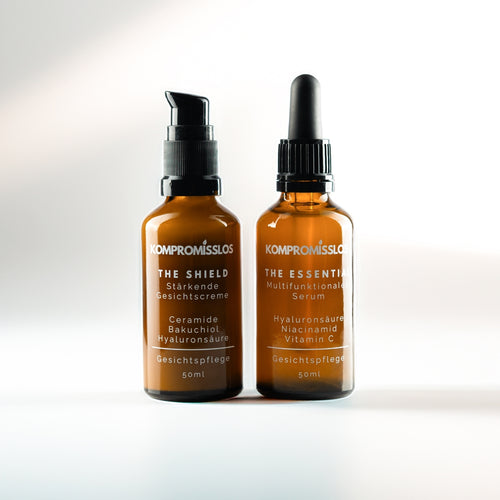
A copper peptide serum is most likely to be worth it if retinol does not agree with you, you fancy a gentle experiment and you are happy with a fairly small effect. You can skip it if your routine already works well, if you are looking for an anti-wrinkle ingredient with strong evidence, or if your skin reacts sensitively to every additional product. Another serum is always another variable too, one that can cause irritation and distract from what matters. For many skin types, a lean routine of serum and cream is the calmer choice. The Duo of The Essential serum and The Shield cream, for example, contains niacinamide, hyaluronic acid in three molecular sizes and zinc PCA in the serum, and bakuchiol, ceramide NP and squalane in the cream, but no peptide. That is not a statement that copper peptides do nothing, but one about what a routine needs to do. In her review on Judge.me, Barbara F. writes about switching from a seven-step routine: ‘Two products, clear ingredients, no frills’ (review translated from German).
There is no peptide in the Duo, not even a copper peptide. That is stated in our full ingredient list, and I would rather say it openly than leave you to go looking for it. So the Duo cannot promise you what the GHK-Cu studies show. I made different decisions for the two products: two products instead of eight, bakuchiol instead of retinol in the cream, and disclosed concentrations. The Duo contains 5% niacinamide, 2% vitamin C as 3-O-Ethyl Ascorbic Acid and 1% zinc PCA. If you want to try a copper peptide serum on top, that is your decision. You should just know that I cannot give you an evidence-based rule for combining them, because there are no data on it.
Frequently asked questions
Are copper peptides the same as peptides?
No, copper peptides are a small subgroup of peptides. Peptides in general are short chains of amino acids that are meant to do very different jobs in cosmetics. GHK-Cu is one specific tripeptide that binds copper and is therefore counted among the carrier peptides. What has been shown for GHK-Cu cannot be transferred to all peptides, and vice versa.
Are copper peptides suitable for sensitive skin?
Often, yes, because copper is considered a very weak allergen on the skin, and the kind of strong irritation seen while skin gets used to retinol is rarely described with copper peptides. What matters, though, is the whole formula: alcohol, fragrance or acids in the same product can put more strain on sensitive skin than the active ingredient itself. Test a new serum on a small area for a few days first.
How long do copper peptides take to make a visible difference?
Allow eight to twelve weeks before you make up your mind. The studies cited in the reviews ran over these periods. If you see nothing after two weeks, it is not because you used too little product, but because you judged too early. And even after three months, the changes you can expect are subtle rather than dramatic.
Can I combine copper peptides with niacinamide?
We are not aware of any study showing that copper peptides and niacinamide are incompatible on the skin. Nor are there any data showing a benefit from combining them. The warnings circulating on forums are not based on skin studies. If you use both, keep an eye on your skin and do not introduce both products at the same time.
Do copper peptides turn your skin or the serum blue?
The serum is often blue or bluish because the copper complex itself has a colour. How strong the colour is depends on concentration and formulation. Applied thinly, a serum like this usually absorbs without leaving a visible residue. If a coloured film remains, you probably used too much product at once.
Do copper peptides come in creams or only in serums?
They come in both. Several of the studies described in the reviews used creams, such as a facial cream and an eye cream. Serums are more common today because they are easier to add to an existing routine. When it comes to effect, concentration and stability matter more than the format.
Do I need copper peptides if I use The Duo?
No, you do not need them. The Duo is designed as a complete routine of serum and cream and contains no peptide. If you still want to try a copper peptide serum, introduce it on its own and keep an eye on your skin. There are no data on combining it with the form of vitamin C in the serum, which is why we do not give a fixed rule on it either. What is in the Duo of serum and cream is openly declared.
Sources
- Pickart L, Margolina A. Regenerative and Protective Actions of the GHK-Cu Peptide in the Light of the New Gene Data. International Journal of Molecular Sciences, 2018. Source
- Pickart L, Vasquez-Soltero JM, Margolina A. GHK Peptide as a Natural Modulator of Multiple Cellular Pathways in Skin Regeneration. BioMed Research International, 2015. Source
- Kafi R, Kwak HS, Schumacher WE, Cho S, Hanft VN, Hamilton TA, et al. Improvement of naturally aged skin with vitamin A (retinol). Archives of Dermatology, 2007. Source
- Buettner GR, Jurkiewicz BA. Catalytic metals, ascorbate and free radicals: combinations to avoid. Radiation Research, 1996. Source
- Fage SW, Faurschou A, Thyssen JP. Copper hypersensitivity. Contact Dermatitis, 2014. Source