Vitamins in skincare: which ones actually work in creams and serums
ACTIVE INGREDIENTS
When it comes to vitamins in skincare, four have been studied most thoroughly: vitamin A as retinol, vitamin B3 as niacinamide, vitamin C and vitamin E. Then there is panthenol, or provitamin B5, for dry and irritated skin. What matters is not how many vitamins are listed on the packaging, but which form is in the product, at what concentration and whether it stays stable in the cream. A good routine needs two or three of them, not all.
Which vitamins actually work in skincare?
Applied to the skin, the vitamins that work in skincare are mainly A, B3, C and E, plus provitamin B5, because there are studies on applying them topically. Each one has its own job: retinol influences skin renewal over a period of weeks, niacinamide supports the barrier and a more even-looking complexion, vitamins C and E neutralise free radicals, and panthenol binds water and supports the skin barrier. Other vitamins do turn up on labels, such as vitamin K, D or F, but the evidence for using them on the face is thin, or the term does not describe a vitamin in the strict sense. Vitamin F, for example, is an old umbrella name for unsaturated fatty acids. It also helps to separate skincare from diet: vitamins in a cream do not replace a balanced diet, and tablets containing biotin or vitamin complexes can at most make up for a deficiency. Whether you have one is something your GP can check with a blood test – not a skincare guide.
A review in the journal Nutrients makes an honest point here: healthy skin naturally contains a lot of vitamin C, but how effective topical application is compared with getting it through your diet is still poorly understood. That is exactly why it pays to look at form and concentration rather than at the list of vitamins alone.
Which vitamins are in face creams and how do you spot them?
Face creams and serums usually contain niacinamide, vitamin C, vitamin E and panthenol, less often retinol, and you can spot them in the ingredient list by their INCI names, such as Niacinamide, Tocopherol or Panthenol. The word “vitamin” hardly ever appears there. They can only work if the form reaches the outermost layer of the skin and the amount matches what has shown an effect in studies. The overview below puts the five most important candidates into context. The details on effects, timescales and concentrations are in the separate guides to vitamin C for skin, the benefits of niacinamide (vitamin B3), vitamin E for skin and panthenol (provitamin B5) for skin. Here, the focus is on the bigger picture: which vitamin does what, and which of them you really need.
| Vitamin | How it appears in the INCI list | Job in skincare | In The Duo |
|---|---|---|---|
| Vitamin A | Retinol, Retinal, Retinyl Palmitate | Skin renewal, fine lines | No – bakuchiol in the cream instead |
| Vitamin B3 | Niacinamide | Skin barrier, more even-looking complexion | Yes, 5% across The Duo as a whole |
| Provitamin B5 | Panthenol | Moisture, barrier | Yes, no percentage stated |
| Vitamin C | Ascorbic Acid, 3-O-Ethyl Ascorbic Acid, Sodium Ascorbyl Phosphate | Antioxidant, radiance, pigmentation spots | Yes, 2% as 3-O-ethyl ascorbic acid across The Duo as a whole |
| Vitamin E | Tocopherol, Tocopheryl Acetate | Protects skin lipids and the oils in the formula | Yes, as tocopherol |
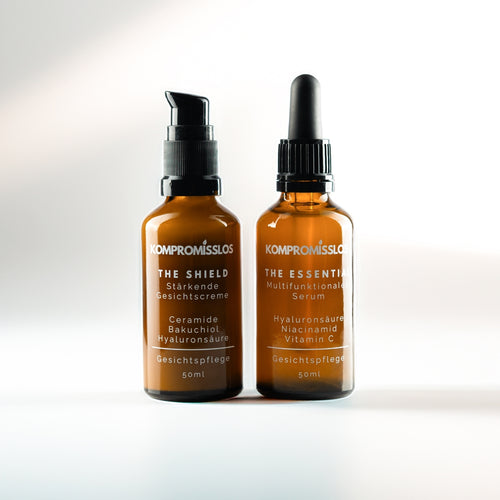
You can see how niacinamide, vitamin C, vitamin E and panthenol work together across two products in the ingredient list of The Duo with serum and cream.
Which forms of vitamins are stable in creams?
The forms that stay stable in creams are mainly niacinamide, panthenol and the ester or ether forms of vitamin C, whereas pure ascorbic acid and retinol are sensitive to light, air and heat. A review in the Journal of Cosmetic Dermatology describes exactly this problem for vitamin C: water-soluble ascorbic acid is unstable and difficult to deliver into the skin, which has been a challenge for formulators for years. That is why there are modified forms such as 3-O-ethyl ascorbic acid or sodium ascorbyl phosphate, which keep for longer in the bottle. The trade-off is that they have been studied less extensively than pure ascorbic acid, and the skin first has to convert some of them into the active form. With vitamin E, tocopherol is the active form and tocopheryl acetate the precursor that keeps better in storage. Retinol is considered sensitive to light and air, which is why it is better off in an airless dispenser or an opaque tube than in an open jar. What this means for you in practice: a vitamin C product that turns yellow or brown after a few weeks has usually already lost some of its active ingredient.
With vitamin C and retinol, pay attention to the packaging. Pump dispensers, dark glass and tubes offer better protection than open jars, and the PAO symbol on the packaging tells you how long the product should be used for after opening.
Which vitamins help with dry skin?
For dry skin, the vitamins that help most when applied topically are panthenol, niacinamide and vitamin E, because they work on the barrier and not just on the surface. Panthenol binds water in the outermost layer of the skin. A review in the Journal of Dermatological Treatment sums up that several studies have confirmed the moisturising and barrier-strengthening effect of dexpanthenol, and describes how it increases the mobility of important components of this layer. Niacinamide supports the skin’s own production of barrier lipids. Vitamin E is fat-soluble and protects skin lipids and plant oils from going rancid. Vitamin C and retinol, on the other hand, are not ingredients for dryness, and retinol can even dry out dry skin further at first. If you go looking for a missing vitamin to fix dry skin, you quickly end up with tablets. Yet dry facial skin is often down to a weakened barrier caused by central heating, cold, hot water or overly harsh cleansing. In that case, topical skincare works more directly than a tablet, and without nourishing lipids such as ceramides or squalane, even a good vitamin only gets you halfway.
Which vitamins have the best evidence for mature skin?
For mature skin, retinol and niacinamide have the best evidence, with vitamin C complementing them as an antioxidant for a fresher, more even-looking complexion. A study in the journal Dermatologic Surgery had 50 women with signs of photoageing apply 5% niacinamide to one half of the face and an active-free base to the other, twice a day for twelve weeks. The niacinamide side showed fewer fine lines, fewer pigmentation spots, fewer red blotches and less sallowness, and elasticity improved measurably. For retinol, a study in the Archives of Dermatology involving 36 people with an average age of 87 showed that a lotion with 0.4 per cent retinol, applied up to three times a week, significantly improved fine wrinkles on the arm after 24 weeks. That makes retinol well documented, but not the first choice for every sensitive skin. Whether vitamin C or retinol should come first in your routine is explained in a separate guide.
Vitamin C is often linked to collagen because the skin needs it to make its own collagen. That is a different route from a collagen cream, which applies collagen to the skin from the outside. Coenzyme Q10 in face cream is also often mistaken for a vitamin, but it is not one: it is an antioxidant the body makes itself, with its own body of research.
How many vitamin products does your routine need?
Your routine does not need a separate product for every vitamin; two products that sensibly divide up the most important vitamins are usually enough. Vitamin C and niacinamide are water-soluble and fit well into a light serum, while fat-soluble vitamin E is at home in formulas with oils and lipids. Layering three serums, a vitamin C ampoule and a vitamin cream on top of each other mainly increases the risk of irritation and the cost, and rarely the effect. Here is how to check whether your routine already contains enough vitamins:
- Put the ingredient lists side by side and mark the INCI names from the table above.
- Cross out duplicate vitamins: if Niacinamide appears in two products, the second one usually adds little.
- Look for concentrations: a disclosed percentage tells you more than “with vitamin complex”.
- Keep retinol and strong acids apart until your skin is used to them.
- Remember sunscreen during the day, because no vitamin replaces it.
In The Duo, I divided vitamin C, niacinamide, vitamin E and panthenol between two products and disclosed the concentrations of the two main active ingredients: 5% niacinamide and 2% vitamin C as 3-O-ethyl ascorbic acid, calculated across The Duo as a whole. I chose the stable form of vitamin C because a product is no use if its active ingredient oxidises in the bottle after a few weeks. I deliberately left out retinol and used bakuchiol in the cream instead, because The Duo is aimed above all at sensitive and mature skin. What The Duo cannot do: make up for a vitamin deficiency or replace sunscreen. We do not sell vitamin tablets, and neither of the two products has a sun protection factor. The role each individual ingredient plays is explained in our overview of all the active ingredients in The Duo.
Frequently asked questions
Is niacinamide a vitamin?
Yes, niacinamide is a form of vitamin B3, also known as nicotinamide. It is one of the most thoroughly studied active ingredients in skincare because it is well tolerated and stable in creams. It supports the skin barrier and can soften the appearance of redness and pigmentation spots. It has been studied well at concentrations of around 5%.
Is panthenol vitamin B5?
Panthenol is the precursor of vitamin B5, which is why it is called provitamin B5. The skin converts it into pantothenic acid, the actual vitamin. Panthenol is used in skincare products because it binds water, is very well tolerated and gets into the skin more easily than pantothenic acid itself. It is particularly suitable for dry and irritated skin.
Is vitamin A in creams the same as retinol?
Not quite. Vitamin A is the umbrella term for a whole group, the retinoids. Retinol is one of them and is widely used in cosmetics. Retinyl palmitate is a milder, weaker precursor, retinal a stronger one. Tretinoin, or retinoic acid, is a medicine and belongs in a doctor’s hands. If the packaging only says “vitamin A”, the INCI list is what tells you which form is inside.
Are antioxidants and vitamins the same thing?
No. Some vitamins are antioxidants, above all vitamins C and E. Niacinamide, panthenol and retinol, however, mainly work in the skin in other ways. Conversely, many antioxidants are not vitamins, such as coenzyme Q10, ferulic acid or polyphenols from plant extracts such as resveratrol or green tea extract. So “rich in antioxidants” on its own tells you nothing about the vitamin content.
Can I put too many vitamins on my skin?
Overdosing, as with tablets, is hardly an issue with skincare, but overwhelming your skin is. Using retinol, high-strength vitamin C and several active serums at the same time risks redness, stinging and flaking. The same vitamin in three products rarely does more than in one. Two well-dosed products are better than five overlapping ones.
Are provitamins weaker than vitamins?
Not as a rule. A provitamin is a precursor that the skin first converts into the active form. With panthenol, that is an advantage, because it gets into the skin better than pantothenic acid. Vitamin A is a different story: the ester retinyl palmitate has to go through several conversion steps and is considerably milder than retinol. So whether a precursor makes sense depends on the individual vitamin.
Which vitamins are in The Duo?
The Duo contains vitamin B3 as niacinamide at 5% and vitamin C as 3-O-ethyl ascorbic acid at 2%, both calculated across the serum and cream together. It also contains vitamin E as tocopherol and provitamin B5 as panthenol, with no percentage stated. Vitamin A in the form of retinol is deliberately left out; the cream contains bakuchiol instead. You can find out more about the serum and cream on the page for The Duo.
Sources
- Pullar JM, Carr AC, Vissers MCM. The Roles of Vitamin C in Skin Health. Nutrients, 2017. Source
- Stamford NP. Stability, transdermal penetration, and cutaneous effects of ascorbic acid and its derivatives. Journal of Cosmetic Dermatology, 2012. Source
- Proksch E, de Bony R, Trapp S, Boudon S. Topical use of dexpanthenol: a 70th anniversary article. Journal of Dermatological Treatment, 2017. Source
- Bissett DL, Oblong JE, Berge CA. Niacinamide: A B vitamin that improves aging facial skin appearance. Dermatologic Surgery, 2005. Source
- Kafi R, Kwak HS, Schumacher WE, Cho S, Hanft VN, Hamilton TA et al. Improvement of naturally aged skin with vitamin A (retinol). Archives of Dermatology, 2007. Source