Coenzyme Q10 cream: what it really does in facial skincare and what it doesn’t
ACTIVE INGREDIENTS
A coenzyme Q10 cream makes sense if you want to give your skincare an extra antioxidant, but it is not a must-have. Coenzyme Q10 has been shown to reach the upper layers of the skin, where it can neutralise oxidative stress. The studies showing visibly fewer wrinkles, however, are small and come largely from one manufacturer’s own research. If your skincare already contains vitamin C and vitamin E and you wear sunscreen during the day, you can skip a separate Q10 cream.
Is a coenzyme Q10 cream worth using?
A Q10 cream is worth using as one of several ways of supplying your skin with antioxidants, not as a key product against skin ageing. The ingredient has a plausible mechanism, and its ability to penetrate the skin is well documented. What is missing are larger independent studies that demonstrate visible changes over several months. That is no reason to throw away a Q10 cream you enjoy using and tolerate well. It is, however, a reason not to buy a new one just because ‘Q10’ is printed in large letters on the packaging. Whether it makes sense for you comes down to three questions: what does your skincare already do? Do you protect your skin from UV light during the day? And are you expecting a cream to do something it can actually do? A cream works on the surface and in the epidermis; it does not smooth out deep wrinkles. The ingredients with the most substance behind them for wrinkles are covered in our article on whether anti-wrinkle creams actually work. Here, the focus is on the narrower question of what Q10 can do by comparison and where its limits lie.
What does coenzyme Q10 do in the skin?
Coenzyme Q10 is a fat-soluble substance that the body produces itself and that every cell needs to generate energy in its mitochondria. It is also an antioxidant: in its reduced form, ubiquinol, it neutralises free radicals such as those produced by UV radiation. A study published in the journal BioFactors in 2015 describes how the skin’s Q10 levels decline with age and under external stress. That is precisely the idea behind Q10 cream: topping up from the outside what is dwindling inside. On ingredient lists, Q10 appears as Ubiquinone. Because it is fat-soluble, it suits creams and oils better than purely water-based serums. It is naturally yellowish-orange, which is why creams with a noticeable amount of Q10 often look slightly yellow. In the skin, Q10 works in the fat-soluble compartment, much like vitamin E, which also protects the skin’s lipids from oxidation. Its water-soluble counterpart in this protective system is vitamin C.
What do studies show about Q10 on the skin?
Studies show that the skin absorbs Q10 and that it has an antioxidant effect there, while the evidence for visibly fewer wrinkles remains thin. A paper by Hoppe and colleagues in BioFactors (1999) demonstrated that topically applied Q10 reaches the living layers of the epidermis and reduces oxidation there; a reduction in wrinkle depth was also described. According to a review in the Journal of Clinical and Aesthetic Dermatology (2024), this wrinkle finding came from application around the eyes over six months in 20 people. The study by Knott and colleagues (BioFactors, 2015), involving 73 women aged between 20 and 66, found higher Q10 levels in the skin and fewer free radicals under stress after two weeks of twice-daily application. Wrinkles were not measured in that study.
What stands out is where the research comes from: both skin studies were carried out by the research department of a large cosmetics manufacturer, and several authors of the 2024 review are also employed there. That does not make the data wrong. But it does mean that independent studies of comparable size are scarce and that the effect on wrinkles rests on just a handful of participants.
At what age is Q10 cream worth using?
There is no fixed age at which Q10 becomes worthwhile. It is documented that the skin’s Q10 content falls over the years, but that does not translate into a threshold beyond which a cream becomes necessary. In the study by Knott and colleagues, participants were aged between 20 and 66; no age-specific recommendations can be drawn from it. Labels saying ‘30+’ or ‘40+’ describe a target group, not a scientific threshold. A more useful question than age is the order of priorities. Daily sun protection comes first, because UV light is the biggest controllable driver of extrinsic skin ageing. Next comes skincare that holds in moisture and supports the barrier. Antioxidants such as Q10, vitamin C or vitamin E are the third layer, not the first. For the broader question of when anti-ageing skincare makes sense in the first place, see when to start anti-ageing skincare. What counts outside the bathroom is covered in how to slow down skin ageing.
Which antioxidants have better evidence than Q10?
Above all, vitamin C has better evidence than Q10, particularly when combined with vitamin E. A review in the Indian Dermatology Online Journal (2013) describes how vitamins C and E work synergistically to limit chronic UV damage, because one protects the water-soluble part of the cell and the other the fat-soluble part. The same paper notes that the effectiveness of a vitamin C serum increases with concentration, but only up to 20%, and cites a combination of 15% vitamin C, 1% vitamin E and 0.5% ferulic acid. These studies work with L-ascorbic acid, which oxidises quickly in cosmetics. More stable forms such as 3-O-Ethyl Ascorbic Acid last longer but have been studied less. So Q10 is not a bad ingredient; its evidence base is simply narrower. That is why The Duo contains no Q10, relying instead on vitamin C as 3-O-Ethyl Ascorbic Acid (2% for The Duo as a whole) and vitamin E as tocopherol. You can read more about forms and concentrations in what vitamin C realistically does for skin, and find an overview of every vitamin in creams and serums in vitamins in skincare.
| Antioxidant | Soluble in | How it appears in the INCI | Evidence on the skin |
|---|---|---|---|
| Coenzyme Q10 | Fat | Ubiquinone | Penetration and antioxidant effect shown; wrinkle data small and closely tied to one manufacturer |
| Vitamin C | Water | Ascorbic Acid, 3-O-Ethyl Ascorbic Acid, Magnesium Ascorbyl Phosphate | Broadest evidence base, mainly for high-dose L-ascorbic acid |
| Vitamin E | Fat | Tocopherol, Tocopheryl Acetate | Well documented as a partner to vitamin C; protects the skin’s lipids and the oils in the formula |
How can you tell whether a cream contains enough Q10?
You can only tell whether a cream contains enough Q10 if the manufacturer states the concentration, and very few do. On the ingredient list, Q10 appears as Ubiquinone. Its position is of limited help: although the list is ordered by quantity, very small amounts may be listed at the end in any order. Q10 is used in small quantities and therefore almost always appears towards the end of the list, even in well-formulated products. The studies do not offer a recognised minimum concentration you could go by; Knott and colleagues give their amounts in micromolar units, not as percentages. Rather than looking for a figure that does not exist, you are better off checking the things you can actually see:
- Concentration: is a specific percentage stated, or just ‘with Q10’?
- Packaging: tubes, pump dispensers and airless bottles protect against light and air better than an open jar.
- The surrounding formula: a single antioxidant achieves little on its own; with vitamin E or vitamin C alongside, the two complement each other.
- The rest of the ingredient list: fragrance or essential oils near the top matter more for sensitive skin than the Q10 question.
A day cream with Q10 is no substitute for sunscreen. If there is no SPF on the packaging, it does not protect against UV radiation, no matter how many antioxidants it contains.
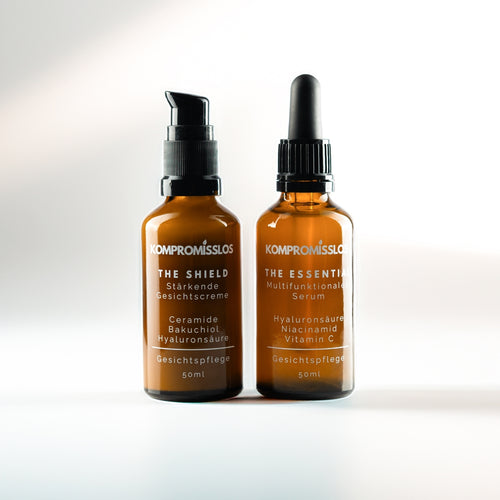
There is no Q10 in The Duo, and that is a deliberate decision, not a gap. With two products instead of eight, every ingredient has to earn its place. For the antioxidant side, I chose vitamin C as stable 3-O-Ethyl Ascorbic Acid, with a disclosed 2% for The Duo as a whole, plus vitamin E as tocopherol in the formula. This pairing of a water-soluble and a fat-soluble antioxidant is better researched than Q10. I am not claiming that 2% in the stable form achieves the same as the high-dose serums in the studies; that has not been investigated. But you know exactly what is in it. With The Duo, you do not need an additional Q10 cream. Everything in both products is listed in full in the A to Z ingredient list.
Frequently asked questions
Is Q10 better than hyaluronic acid?
Neither – the two cannot be compared directly because they do different jobs. Hyaluronic acid binds water and makes the skin look plumper; Q10 is an antioxidant. If your skin lacks moisture, Q10 will not help much. If you are looking for antioxidant protection, hyaluronic acid will not provide it. That is why many routines combine a humectant with an antioxidant.
Q10 or retinol: which works better for wrinkles?
For wrinkles, retinol has been studied far more thoroughly than Q10. Retinoids are among the best-evidenced ingredients for sun-related skin ageing, but they cause irritation more often. Q10 is gentler but has only a few small studies on wrinkles. People who cannot tolerate retinol often end up with bakuchiol; how it fits together with Q10 is explained in combining bakuchiol.
Do Q10 capsules do anything for your skin?
One small study suggests they might, but no more than that. In a placebo-controlled study in BioFactors (2017), 33 healthy people took 50 or 150 mg of Q10 a day for twelve weeks. Wrinkles and fine micro-wrinkles decreased significantly, while skin hydration did not change. If you take medication, check with your doctor or pharmacist before you start taking it.
Why does my Q10 cream sting?
It is usually not the Q10 itself but the rest of the formula. Q10 is generally considered well tolerated; if a Q10 cream stings or causes redness, look for fragrance, essential oils or Alcohol Denat. near the top of the list. For sensitive skin, the full ingredient list tells you more than the Q10 label on the front. Test a new product on a small area for a few days first.
Can I combine Q10 with vitamin C?
Yes, Q10 and vitamin C go well together and even complement each other: vitamin C works in the water-based compartment, Q10 in the fat-soluble one. In practice, that means vitamin C serum first, Q10 cream afterwards. But do not layer three products with overlapping antioxidants; two well-formulated ones are enough.
Why is Q10 in so many high-street creams?
Because Q10 has been marketed as an anti-ageing ingredient for a long time and many customers recognise the name. Much of the skin research on Q10 comes from the cosmetics industry itself; the paper by Hoppe and colleagues was published back in 1999. But familiarity is not proof of effectiveness. What matters is what the formula achieves as a whole and whether the concentration is disclosed.
Do I need Q10 if I use The Duo?
No. The Duo contains no Q10, but it covers the antioxidant side with vitamin C as 3-O-Ethyl Ascorbic Acid (2% for The Duo as a whole) and with vitamin E. An additional Q10 cream makes your routine longer without taking on a new job. More important than a third product is a separate sunscreen during the day, because The Duo contains no SPF.
Sources
- Hoppe U, Bergemann J, Diembeck W, Ennen J, Gohla S, Harris I, et al. Coenzyme Q10, a cutaneous antioxidant and energizer. BioFactors, 1999. Source
- Knott A, Achterberg V, Smuda C, Mielke H, Sperling G, Dunckelmann K, et al. Topical treatment with coenzyme Q10-containing formulas improves skin's Q10 level and provides antioxidative effects. BioFactors, 2015. Source
- Lain ET, Agrawal N, Ruvolo E, Weise JM, Callender VD. The Role of Coenzyme Q10 in Skin Aging and Opportunities for Topical Intervention: A Review. Journal of Clinical and Aesthetic Dermatology, 2024. Source
- Telang PS. Vitamin C in dermatology. Indian Dermatology Online Journal, 2013. Source
- Žmitek K, Pogačnik T, Mervic L, Žmitek J, Pravst I. The effect of dietary intake of coenzyme Q10 on skin parameters and condition: Results of a randomised, placebo-controlled, double-blind study. BioFactors, 2017. Source