Combining bakuchiol: which active ingredients go with it and which to keep apart
INGREDIENT COMBINATION
Combining bakuchiol with almost all common skincare ingredients is straightforward: niacinamide, hyaluronic acid, peptides, coenzyme Q10, aloe vera and shea butter all work without restriction. Only with acids such as AHA, BHA and salicylic acid is it worth separating them in time, because the combined irritation in a single application can become too much. The reason does not lie with bakuchiol itself.
Which active ingredients can you combine with bakuchiol?
Bakuchiol is an uncomplicated partner. You can use niacinamide, hyaluronic acid, ceramides, squalane, panthenol, vitamin E, peptides and coenzyme Q10 in the same routine without changing the order. Bakuchiol does not need a particular pH to remain stable, and it does not make your skin sensitive to light to the extent that retinol does. That is why it works both morning and evening. Restraint is only worthwhile with two groups: acids such as AHA, BHA and salicylic acid, and retinol itself. With these, you are layering two irritants that can each cause dryness or a feeling of tightness on their own. In practice, this means you don’t need to rebuild your routine when bakuchiol comes in; at most, you move an acid to a different time. What the ingredient actually does on your skin is covered in the article on bakuchiol benefits. For the broader picture across all active ingredients, see the overview of combining skincare ingredients.
| Active ingredient | In one application? | What to look out for |
|---|---|---|
| Niacinamide | Yes | Apply the lighter texture first |
| Hyaluronic acid | Yes | Apply to slightly damp skin |
| Peptides | Yes | Serum before cream |
| Coenzyme Q10 | Yes | Complementary, not reinforcing |
| Aloe vera | Yes | Water-based, goes before oil-based layers |
| Shea butter | Yes | Apply last, heaviest texture |
| AHA, BHA, salicylic acid | Better kept apart | On different days or at different times of day |
| Retinol | Not necessary | Both address similar signalling pathways |
Can you use bakuchiol with peptides and coenzyme Q10?
You can use bakuchiol with peptides and with coenzyme Q10 in the same routine without restriction. None of the three substances needs a particular pH, none contains an acid component, and no mutual deactivation is known. The order simply depends on texture: lighter serum first, richer cream afterwards. In terms of what they do, the three complement rather than reinforce one another. Coenzyme Q10 is primarily an antioxidant that neutralises free radicals. Peptides are short chains of amino acids that send signals to the skin. Bakuchiol acts on cell signals that retinol also addresses: a study in the International Journal of Cosmetic Science used gene expression profiling to show that, despite a completely different molecular structure, bakuchiol regulates similar genes to retinol. If you combine the three, you cover three different areas rather than the same one three times. That said, there is no evidence of a greater effect compared with using each on its own.
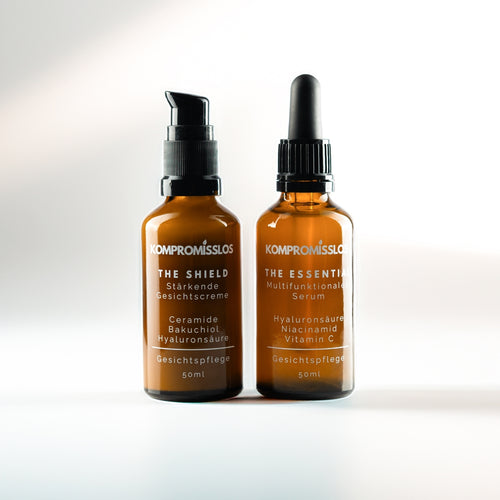
In the interest of honesty, one point belongs here. With peptides, the formulation matters particularly, because the packaging usually states neither the specific peptide chain nor its amount. The Duo of serum and cream contains 0.3% bakuchiol; peptides are not part of the formula. You can read what it contains instead in the overview of active ingredients.
How do you combine bakuchiol with AHA, BHA and salicylic acid?
It is best to combine bakuchiol and acids at different times rather than in the same application. AHAs such as glycolic acid or lactic acid, and BHA, whose best-known representative is salicylic acid, work at a low pH and loosen the bonds between dead skin cells. Bakuchiol itself doesn’t need a particular pH and chemically copes with acid without any problem. So the problem is not the chemistry but your skin: two irritants applied one straight after the other lead to burning, redness and flaking more often than either irritant on its own. Two patterns have proved themselves. Either acid one evening and bakuchiol the next, or acid in the evening and bakuchiol in the morning. How often you need the acid at all depends more on your current skin condition than on a fixed plan. If your skin reacts quickly, the more honest answer is often to leave out the acid entirely and stick to a calm routine until your skin has stabilised.
If your skin feels tight, burns or shines after application and still feels dry, it is usually the barrier that is overwhelmed rather than a single ingredient. How to recognise this is covered in the article on the damaged skin barrier.
Do bakuchiol, aloe vera and shea butter go together?
Bakuchiol goes well with aloe vera and with shea butter, and both combinations are among the least problematic of all. Aloe vera consists mainly of water and polysaccharides and has a soothing, moisturising effect. Shea butter is a rich plant fat that slows down evaporation from the skin. Neither substance shifts the pH in a way that would make bakuchiol lose anything, and neither competes for the same job. On the contrary: if you are introducing bakuchiol and notice dryness or a feeling of tightness, you will often benefit from exactly this kind of calming, oil-based layer on top. A practical note on the order belongs here too. Shea butter goes on last, because it has the heaviest texture and products applied on top of it barely absorb. Aloe vera, by contrast, is water-based and comes right at the start, directly before or within a serum. If you have very oily skin, you can do without shea butter without losing anything on the bakuchiol side.
Is bakuchiol suitable for mature skin?
Bakuchiol is suitable for mature skin above all if retinol has been too strong for you so far or you avoid it for reasons of tolerance. In a randomised double-blind study in the British Journal of Dermatology, 44 people applied either 0.5% bakuchiol twice a day or 0.5% retinol once a day for twelve weeks. Both groups showed a reduction in wrinkle surface area and dark spots, with no statistical difference between the two substances. More flaking and burning were reported in the retinol group. For mature skin, this is exactly what matters, because tolerance is often the reason a routine is abandoned after a few weeks. For context: these figures come from a study with 0.5%, not from a test of our product, which contains 0.3% bakuchiol in the Duo. What else matters at this stage of life is covered in the routine for mature skin.
When is bakuchiol not the right choice?
Bakuchiol is not needed while your skin is irritated, flaky or sore. In this phase, it needs rest and barrier care rather than an additional active ingredient, and any question of combinations can wait a few weeks. Switching also makes little sense if you have tolerated retinol well for years and are happy with it. In that case, you would be swapping it for something milder without getting anything in return. And there is a clear boundary with dermatology: persistent redness, weeping patches, pustules that don’t heal, or a skin change that alters in shape or colour should be checked by a doctor rather than dealt with in a skincare routine. If you are planning a pregnancy or are pregnant, it is better to discuss new active ingredients with a professional beforehand anyway. Skincare cares for the appearance of your skin; it does not replace a diagnosis. Whether bakuchiol or retinol for sensitive skin is the better choice for you is covered point by point in this comparison.
For the Duo, I chose 0.3% bakuchiol rather than a higher figure, even though bigger numbers look better on the label. The reason is the combination: in our products, bakuchiol sits alongside 5% niacinamide, 2% vitamin C as 3-O-ethyl ascorbic acid and ceramides. When several active ingredients have to fit into just two products, what matters is not the highest individual figure but whether your skin can cope with the total morning and evening. I deliberately left out peptides. Otherwise I would have put an ingredient on the list whose amount I couldn’t honestly tell you. I would rather have fewer lines and numbers you can check. What this looks like day to day is explained in the how-to-use guide.
Frequently asked questions
Can you use bakuchiol and coenzyme Q10 together?
Yes, bakuchiol and coenzyme Q10 can be used in the same routine. Both are fat-soluble, both have an antioxidant effect, and there is no pH conflict. Apply the lighter texture first, which usually means the serum before the cream. Expect them to complement rather than reinforce each other, because the two substances cover different jobs.
Can you use bakuchiol and peptides together?
Yes, bakuchiol and peptides get on with each other without restriction. Both are mild, neither contains an acid component, and no mutual deactivation is known. The order depends on texture: the lighter product first, then the richer one. The Duo contains 0.3% bakuchiol; peptides are not part of the formula.
Can you use bakuchiol and salicylic acid together?
Chemically, there is nothing against it, but for your skin, separating them in time is the better choice. Salicylic acid is a BHA and works at a low pH. Use it on a different evening from bakuchiol, or use the acid in the evening and bakuchiol in the morning, so that the irritation doesn’t add up.
Can you use bakuchiol and AHA together?
Better not in the same application. AHAs such as glycolic acid or lactic acid loosen dead skin cells at a low pH. Bakuchiol is not sensitive to that, but your skin is. Separate the two by day or by time of day. With skin that reacts quickly, it often makes more sense to do without the AHA entirely.
Can you use bakuchiol and aloe vera together?
Yes, this is one of the most uncomplicated combinations of all. Aloe vera consists mainly of water and polysaccharides, has a soothing effect and does not shift the pH in a way that would affect bakuchiol. Because aloe vera is water-based, it belongs at the start of your routine, before oil-based layers.
Can you use bakuchiol and shea butter together?
Yes, shea butter and bakuchiol go well together. Shea butter slows down evaporation from the skin and counteracts exactly the feeling of tightness some people notice when they start using bakuchiol. Apply it last, because its heavy texture prevents products applied on top from absorbing.
Is it better to apply bakuchiol in the morning or the evening?
Both are possible, because bakuchiol does not make your skin as sensitive to light as retinol does. Twice a day is the application most often studied. If you combine bakuchiol with acids, the morning is the more practical time, because you can then use the acid in the evening.
Sources
- Dhaliwal S. et al., Prospective, randomized, double-blind assessment of topical bakuchiol and retinol for facial photoageing, British Journal of Dermatology, 2019. Source
- Chaudhuri R.K., Bojanowski K., Bakuchiol: a retinol-like functional compound revealed by gene expression profiling and clinically proven to have anti-aging effects, International Journal of Cosmetic Science, 2014. Source