Green tea extract for skin: what EGCG actually does in skincare
ACTIVE INGREDIENTS
Green tea extract works on the skin mainly as an antioxidant: its key polyphenol, EGCG, can neutralise free radicals, has reduced UV-induced redness in experiments and, in small studies, has shown signs of lowering sebum. In an ordinary cream, however, there is often little of it left, because EGCG is sensitive to pH, heat and oxygen, and its content is almost never declared. Green tea extract is therefore a useful supporting ingredient, but not an active you need to build a routine around.
What does green tea do for the skin?
What green tea mainly brings to the skin is a group of plant compounds called catechins, which can counter the oxidative stress caused by UV light and air pollution. The best-known and most thoroughly studied of them is epigallocatechin gallate, or EGCG for short. A green tea extract also contains other catechins, a little caffeine and, depending on how it is made, varying amounts of tannins. On the INCI list it usually appears as Camellia Sinensis Leaf Extract, with no indication of how much EGCG it actually contains in the end. In cosmetic terms, this means green tea can add antioxidant support to a formula, but how much of it is still active in the finished product is rarely proven. Nor is it a vitamin, and it does not replace an active ingredient with a clearly specified dose. If you want to understand which vitamins actually work in creams and serums and how antioxidants differ from them, it is worth looking at these basics before you add another product.
Many of the claims made about green tea for the face, from ‘firming’ to ‘shrinks pores’, go well beyond what studies on topical use show. Incidentally, the tea bag on puffy eyes is a separate topic and has little to do with EGCG in a cream.
What is EGCG, and why is it so hard to keep stable in creams?
EGCG is a polyphenol that oxidises very easily, and the very reactivity that makes it an antioxidant also makes it unstable in a cream. A review in Phytotherapy Research by a research group at the Technical University of Munich brought together what is known about the stability of EGCG for use on the skin. The result: higher EGCG concentrations, low temperatures and low pH values are associated with better stability. At the same time, the authors point out that the molecule is unstable, which can hold back its dermatological and cosmetic use, and that little is known about how it interacts with common cosmetic ingredients.
For you, this means that green tea extract in a neutral, water-rich cream that sits open in a warm bathroom for months faces different conditions from a laboratory solution. A brownish discolouration can be a sign of oxidation. The same stability question arises with vitamin C, which is why more stable forms of it exist. How this works with vitamin C and vitamin E as an antioxidant pairing is a topic in its own right. Similar questions also come up with ferulic acid and resveratrol.
What do studies show about green tea extract on the skin, and what do they not show?
Studies show that green tea polyphenols have measurable effects on the skin under laboratory conditions, but there is little evidence of visible differences in everyday skincare. In a study in the Journal of the American Academy of Dermatology, researchers applied a green tea extract or individual components of it to the skin of volunteers and exposed the areas to simulated sunlight 30 minutes later. The extract inhibited redness in a dose-dependent manner, with the EGCG and ECG fractions proving the most effective. Treated skin also showed fewer sunburn cells and less UV-induced DNA damage.
A placebo-controlled study in Dermatologic Surgery paints a more sobering picture. In it, 40 women with moderate photoageing received either a 10% green tea cream plus 300 mg of green tea in capsule form twice a day for eight weeks, or a placebo. Clinically, that is, when the skin was assessed by eye, there was no significant difference from the placebo group, and the green tea group actually reported higher irritation scores. Only under the microscope did more elastic tissue show up. And because cream and capsules were combined, there is no way of telling what the cream contributed on its own.
- Shown: green tea polyphenols can reduce UV-induced redness in experiments when they are applied shortly before exposure.
- Shown: EGCG is chemically unstable, which can limit its effect in the finished product.
- Not shown: that an ordinary cream with green tea extract visibly softens wrinkles.
- Not shown: that green tea replaces sunscreen. For that, you need a separate sunscreen for your face.
Does green tea help with redness and oily, blemish-prone skin?
For oily, blemish-prone skin, there are early signs that topically applied tea polyphenols can reduce sebum production; for redness, robust data are lacking, and in both cases the evidence is thin. A review in Antioxidants found that only eight of 59 studies met the inclusion criteria, seven of them on application to the skin. The authors remain cautious: there is some evidence of a benefit, they say, but many of the studies were small and some had no control group. A randomised split-face study in the Journal of Investigative Dermatology tested isolated EGCG on acne for eight weeks and reported a significant improvement, with good tolerability. That was a study formulation with pure EGCG, not a skincare cream with green tea extract somewhere near the end of the list. If your spots are persistent or painful, acne is something to have checked by a professional. What makes for gentle skincare for blemish-prone skin comes down to more than a single plant extract.
With redness, the picture is even less clear. The experimental data on UV-induced redness cannot be transferred to persistent redness in everyday life, and rosacea is a skin condition that a dermatologist should assess. Cosmetically, green tea is at most a supporting player here. You can read more about what skincare can do cosmetically for facial redness in a separate article.
How can you tell from the INCI list how much green tea a product contains?
The INCI list only gives you a rough idea of how much green tea is really in a product, because it names the plant but never the EGCG content. Ingredients are listed in descending order of quantity, but only down to a low threshold; below that, they may appear in any order. So if Camellia Sinensis Leaf Extract comes after the preservatives and fragrances, it is very likely present only in a small amount. Nor does the word ‘extract’ tell you which solvent was used or in what ratio it was made. What does help is the form that is declared:
| On the INCI list | What it tells you | Stability |
|---|---|---|
| Camellia Sinensis Leaf Extract | Extract of green tea leaves, catechin content unknown | Depends heavily on the formula, pH and packaging |
| Camellia Sinensis Leaf Water | Water-based tea extract, often used as a base instead of water | Fairly low amount of active ingredient, prone to oxidation |
| Epigallocatechin Gallate (isolated) | Isolated active ingredient; the amount is only known if the brand states it | The most demanding; benefits from a low pH and airtight packaging |
| Camellia Sinensis Leaf Powder (matcha) | Ground leaves, mainly for colour and texture | Content of dissolved catechins hard to estimate |
The same principle applies to any plant extract. Once you understand how to assess a plant extract such as edelweiss, you will also read green tea on the packaging more realistically.
When is green tea extract worth it, and when can you skip it?
Green tea extract is worth it when it comes in a product you need anyway, and you can skip it if it would mean buying an extra serum. An antioxidant in your routine makes sense, especially during the day. What matters, though, is not which plant is on the label, but whether a stable active ingredient is present in a traceable amount. If your routine already covers that, a dedicated green tea serum mainly adds another step.
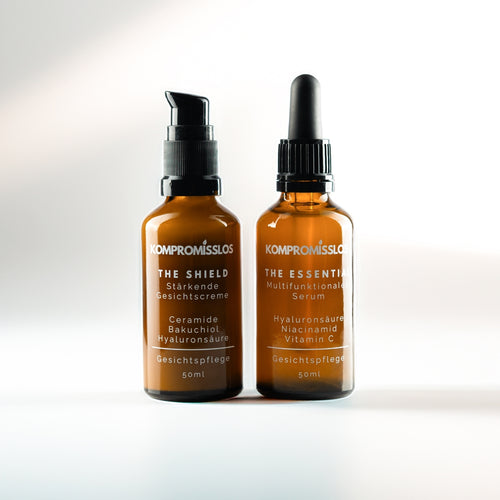
The Duo of serum and face cream does not contain green tea extract. In the Duo, the antioxidant job is done by 2% vitamin C as stable 3-O-Ethyl Ascorbic Acid and vitamin E (tocopherol), complemented by Swiss plant extracts such as edelweiss. The concentrations of the main active ingredients are disclosed; for the plant extracts, we do not give a percentage either.
- Check whether your routine already contains an antioxidant with a disclosed concentration.
- Check where green tea appears on the INCI list and whether EGCG is included in isolated form or only as part of an extract.
- Check the packaging: a tube or pump dispenser protects better against air than an open jar.
- Check your skin: if it reacts to plant extracts with stinging or redness, less is more.
I decided against green tea in the Duo, even though it looks good on plenty of labels. My problem is not the plant but the labelling: with an extract, the packaging does not say how much EGCG it contains or how much of it is still active after months. For the antioxidant job, I wanted an active ingredient with a disclosed concentration instead, hence 2% vitamin C in the stable 3-O-Ethyl form. Two products instead of eight also means you do not need an extra antioxidant serum. What the Duo cannot do: the cream contains no SPF, so during the day you need a separate sunscreen as well. All active ingredients and their concentrations are listed openly.
Frequently asked questions
Is cooled green tea worth using as a toner?
You can use it to freshen up, but as active skincare it does little. A brew does contain catechins, but it is not preserved and oxidises quickly. So make it fresh each time and do not keep it for days. If your skin reacts with stinging or redness, leave it out.
Does green tea extract replace sunscreen?
No. Green tea polyphenols have reduced UV-induced redness in experiments, but they have no declared sun protection factor and do not filter UV radiation the way a sunscreen does. During the day, you need a separate sunscreen for your face; an antioxidant can at most complement it.
Is green tea extract suitable for sensitive skin?
There is no blanket answer. Plant extracts are mixtures of many substances, and in one placebo-controlled study the green tea group reported higher irritation scores. Test a new product on a small area, such as along the jawline, for a few days before using it on your whole face.
Is matcha in skincare the same as green tea extract?
No. Matcha is finely ground leaf powder, whereas an extract is drawn out of the leaves. Powder in a cream or mask often mainly provides colour and texture, and how many catechins dissolve out of it is hard to estimate. What counts for the effect is not the name, but form, amount and stability.
Does drinking green tea work the same way as applying it?
No, they are two different routes with different evidence behind them. Drinking green tea is no substitute for skincare, nor the other way round, and a cup a day is not a skincare regime.
Can I combine green tea extract with vitamin C and niacinamide?
Yes, that is generally unproblematic. Green tea extract, vitamin C and niacinamide sit side by side in many formulas. What matters more than the combination is not layering three serums with overlapping jobs on top of each other. One product with clearly declared active ingredients usually makes more sense than several half-measures.
Do I need a green tea serum if I use The Duo?
No. The Duo does not contain green tea extract, but it covers the antioxidant job with 2% vitamin C as stable 3-O-Ethyl Ascorbic Acid and vitamin E. An extra green tea serum makes the routine longer without filling a real gap. During the day, you still need sunscreen after the Duo of serum and cream.
Sources
- Elmets CA, Singh D, Tubesing K, Matsui M, Katiyar S, Mukhtar H. Cutaneous photoprotection from ultraviolet injury by green tea polyphenols. Journal of the American Academy of Dermatology, 2001. Source
- Chiu AE, Chan JL, Kern DG, Kohler S, Rehmus WE, Kimball AB. Double-blinded, placebo-controlled trial of green tea extracts in the clinical and histologic appearance of photoaging skin. Dermatologic Surgery, 2005. Source
- Frasheri L, Schielein MC, Tizek L, Mikschl P, Biedermann T, Zink A. Great green tea ingredient? A narrative literature review on epigallocatechin gallate and its biophysical properties for topical use in dermatology. Phytotherapy Research, 2020. Source
- Saric S, Notay M, Sivamani RK. Green Tea and Other Tea Polyphenols: Effects on Sebum Production and Acne Vulgaris. Antioxidants, 2016. Source
- Yoon JY, Kwon HH, Min SU, Thiboutot DM, Suh DH. Epigallocatechin-3-gallate improves acne in humans by modulating intracellular molecular targets and inhibiting P. acnes. Journal of Investigative Dermatology, 2013. Source