Edelweiss extract for skin: what it does and when it’s really worth it
SINGLE INGREDIENT
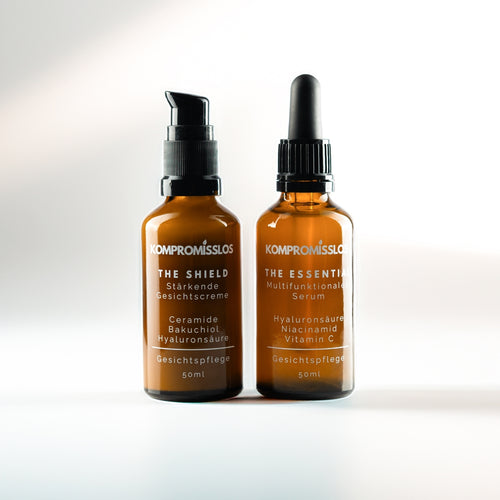
Edelweiss extract is a plant extract from Leontopodium alpinum, used in skincare as a supporting ingredient with antioxidant properties. It is intended to visibly calm skin that looks stressed and to make the complexion appear more even. It does not replace dosed active ingredients such as niacinamide or hyaluronic acid. The Kompromisslos Duo contains 2 per cent edelweiss extract.
What does edelweiss extract do in skincare?
In a skincare formulation, edelweiss extract works mainly as an antioxidant supporting ingredient. It contains phenolic compounds, above all the leontopodic acids named after the plant, which the research literature describes for their capacity to scavenge free radicals. In cosmetic terms, this means the extract improves the environment in which the dosed active ingredients work and helps stressed skin look calmer and more even. What it doesn’t do is just as important. It doesn’t bind moisture as hyaluronic acid does, it doesn’t regulate any skin process, and it doesn’t replace an active ingredient with a fixed concentration. If you buy a product because edelweiss is written large on the front, you are usually buying a story, not a formulation. In our products, 2 per cent edelweiss extract sits alongside 5 per cent niacinamide and 2 per cent vitamin C, and this order also reflects the order of responsibility. All figures refer to the Duo as a whole and can be checked in the full overview of all ingredients.
What the studies on edelweiss show, and what they don’t
The robust skin data on edelweiss comes almost entirely from callus cultures, not from conventionally obtained plant extracts. Callus culture means that plant cells are multiplied in the laboratory instead of harvesting the Alpine plant, which is protected in many places. An analysis in the journal Plants describes a pronounced free-radical-scavenging activity of 122 milligrams of ascorbic acid equivalent per gram of dry matter for such a callus extract, with four phenylpropanoid derivatives making up around 57 per cent of the extract’s mass. A placebo-controlled study in the journal Genes reports improvements in skin elasticity and dermal density for the same type of extract. It does not follow that every edelweiss extract delivers the same results. Manufacturing, solvents and concentration vary widely, and none of these studies was carried out on our formula.
Which skin conditions benefit from edelweiss extract?
Edelweiss extract is worthwhile above all for skin that looks stressed from cold, high-altitude sun, central heating or frequent washing, and that tends towards visible redness. For mature skin showing less firmness, an antioxidant supporting ingredient also makes sense, because oxidative stress is considered one of the drivers of visible skin ageing. If, on the other hand, your skin is stable, tolerates almost everything and the only thing bothering you is a slight feeling of tightness, you don’t need an extra plant extract – you need moisture and an intact skin barrier without constant irritation. To be honest: edelweiss is never a reason to buy a product. It is a reason to like a good product a little more. That is exactly how we approached it in The Essential serum and The Shield cream, where plant extracts accompany the dosed active ingredients rather than replacing them. Which partners go well with it is covered in our guide to which active ingredients can be combined with edelweiss.
Can you use edelweiss extract on sensitive skin?
Yes, edelweiss extract is considered well tolerated by sensitive skin, as long as it is used at a low dose and in a fragrance-free formulation. The botanical family is worth noting: edelweiss belongs to the daisy family, as do chamomile, arnica and calendula. If you have ever reacted to this plant group, go more slowly and test it first along your jawline or on the inside of your elbow. In practice, though, sensitive skin and its typical triggers react less often to a single plant extract than to the sum of everything: lots of fragrance, high-strength acids, alcohol and too many new steps at once. So introduce a new product on its own, wait a few days and watch how your skin feels in the evening. If your skin is currently flaky, broken or badly irritated, don’t start anything new at all – calm it first with what you already know and tolerate.
What should you do if you don’t tolerate edelweiss extract?
In cosmetic terms, an intolerance to edelweiss extract usually shows up as stinging, tightness, itching or redness that does not fade within a few minutes of application. In that case, stop using the product, keep your skincare to the bare essentials for a few days and then reintroduce one product after another. That way you can tell whether it really was the plant extract or another component. An overloaded routine, with too many active products sitting on already irritated skin at the same time, is in fact more common than a genuine intolerance. This is also where my field ends: skincare cares for the skin and improves its appearance. If symptoms last longer than a few days, spread, or are joined by blisters, swelling or weeping patches, they need to be assessed by a dermatologist rather than become another skincare experiment. You will find the exact steps of our routine in the step-by-step guide to using the serum and cream.
How much edelweiss extract should a product contain?
There is no universal percentage for edelweiss extract, because plant extracts vary greatly in strength depending on how they are made, the solvent used and the concentrate. Two products with the same figure can therefore be composed completely differently. More telling than the figure alone is whether a brand gives one at all, and whether there is still room for the dosed active ingredients alongside it. If a plant extract is right at the end of the INCI list, it is more decoration than a real part of the formula, even if it features prominently on the packaging. In our Duo, it is 2 per cent edelweiss extract – the same proportion as gentian root extract, our second Alpine extract. The following table shows how this proportion compares with the fully dosed active ingredients, so you can judge the orders of magnitude for yourself rather than take them on trust.
| Ingredient | Proportion in the Duo | Role in the formulation |
|---|---|---|
| Niacinamide | 5 per cent | Carries the result for the complexion. |
| Hyaluronic acid | 2 per cent | Binds moisture in the outer layer of the skin. |
| Vitamin C as 3-O-ethyl ascorbic acid | 2 per cent | Stable form of vitamin C for a more even complexion. |
| Edelweiss extract | 2 per cent | Antioxidant supporting ingredient, not a main active. |
| Gentian root extract | 2 per cent | Calming supporting ingredient alongside the edelweiss. |
| Zinc | 1 per cent | Supports a calmer-looking complexion. |
| Bakuchiol | 0.3 per cent | Gentle alternative to the retinol principle. |
I deliberately state 2 per cent for edelweiss extract, even though the figure does nothing for us commercially. Nobody expects a figure for a plant extract, and that is exactly why most brands don’t give one. The opposite mattered to me: if I put an Alpine plant on the packaging, I want to be able to say how much of it is inside. At the same time, I never made edelweiss the main selling point. Swiss origin sells well, but it doesn’t care for anyone’s skin. Our formulation is carried by the active ingredients whose fixed concentrations I can state. The edelweiss extract makes the result more rounded and the skin feel more pleasant; I never expected more of it than that. If this sober approach has too little romance for you, our Duo of serum and cream is probably not the right choice for you – and that is absolutely fine.
Frequently asked questions
What does edelweiss extract do for the skin?
In cosmetics, edelweiss extract is used as an antioxidant supporting ingredient, intended to visibly calm stressed skin and make the complexion appear more even. This is down to phenolic compounds such as the leontopodic acids. The extract does not replace dosed active ingredients such as niacinamide, hyaluronic acid or vitamin C.
How often should I use edelweiss extract?
Every day, morning and evening, as part of your normal skincare. Unlike acids or retinoids, you don’t need to cycle it, because it doesn’t work through irritation. For our products, we recommend 3 to 6 drops of serum and 3 to 6 pumps of cream per application. A bottle then lasts 2 to 4 months.
Is edelweiss extract suitable for sensitive skin?
At a low dose and in a fragrance-free formulation, edelweiss extract is considered well tolerated by sensitive skin. Edelweiss does, however, belong to the daisy family. If you have ever reacted to chamomile, arnica or calendula, test it first along your jawline and introduce the product on its own.
How can you tell if you’re intolerant to edelweiss extract?
Typical signs are stinging, tightness, itching or redness that doesn’t fade quickly after application. Stop using the product, then reintroduce your products one at a time. If the symptoms persist, or blisters and swelling appear, have them checked by a dermatologist.
What percentage of edelweiss extract makes sense?
There is no universal percentage, because plant extracts are concentrated to different degrees depending on how they are made. More telling is whether a brand gives a figure at all and where the extract appears on the INCI list. The Kompromisslos Duo contains 2 per cent edelweiss extract.
Is wild Alpine edelweiss picked for cosmetics?
No, cosmetic raw materials come from controlled cultivation or from cell cultures in the laboratory, not from the wild. Edelweiss is protected in several Alpine cantons, and that is precisely why alternative methods of production such as callus culture were developed. The research on skin relates mainly to these culture extracts.
Does edelweiss extract replace an antioxidant such as vitamin C?
No, edelweiss extract does not replace a fully dosed antioxidant. In our products, vitamin C is present as 3-O-ethyl ascorbic acid at 2 per cent – a defined amount of a defined substance. A plant extract, by contrast, varies from batch to batch and with how it is made. Together, the two achieve more than either on its own.
Sources
- Pralea I.-E. et al., Profiling of Polyphenolic Compounds of Leontopodium alpinum Cass Callus Cultures Using UPLC/IM-HRMS and Screening of In Vitro Effects, Plants, 2022. Source
- Cho W. K. et al., Anti-Aging Effects of Leontopodium alpinum (Edelweiss) Callus Culture Extract through Transcriptome Profiling, Genes, 2020. Source