Combining edelweiss extract: what goes together and what to keep apart
INGREDIENT COMBINATION
Combining edelweiss extract works with almost every common skincare ingredient. The extract is a polyphenol-rich plant extract with no critical pH requirement, and it gets on with niacinamide, vitamin C, hyaluronic acid, panthenol, squalane, ceramides, zinc and bakuchiol. Things only get tricky in routines that are already irritating, with acids or retinol. There, the problem is the overall load on your skin, not the extract.
Do vitamin C and edelweiss extract go together?
Vitamin C and edelweiss extract fit into the same routine without restriction. Both count as antioxidants, but they work differently: vitamin C is a defined pure substance with a concentration that can be stated, while edelweiss extract is a plant extract made up of many polyphenols. According to an analysis in the journal Molecules, leontopodic acid and chlorogenic acid were identified as the most abundant components of the edelweiss callus extracts examined. A chemical reaction between the two is not to be expected in a finished cosmetic formula. What matters is the form of vitamin C: pure L-ascorbic acid needs a very low pH and quickly becomes unstable in the company of plant extracts. The more stable form, 3-O-ethyl ascorbic acid, works in a range close to the skin’s own and is therefore much easier to combine with extracts. If you know the basic rules for combining active ingredients, you will recognise the pattern: it is not the ingredients that clash, but the conditions each of them needs. In practice, as long as your vitamin C product doesn’t come with an extremely acidic pH, you can use it alongside a product containing edelweiss extract, morning or evening, without either losing its effect.
If you layer two separate products, apply the more fluid one first. This combination doesn’t need a pause between layers.
Do niacinamide and edelweiss extract go together?
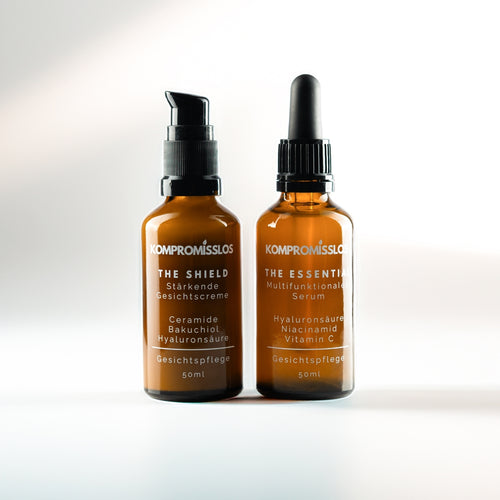
Niacinamide and edelweiss extract are one of the least problematic pairings of all. Niacinamide is chemically inert, works across a wide pH window and doesn’t react with the polyphenols in plant extracts. The old rule that niacinamide shouldn’t be used next to other actives comes from laboratory conditions involving heat and extreme pH values, not from the bathroom. In terms of what they do, the two complement each other well: niacinamide targets barrier function and the look of pores and redness, while edelweiss extract contributes antioxidant plant compounds. In the Duo of serum and cream, 5% niacinamide and 2% edelweiss extract sit side by side; both figures apply to the two products combined, not to either one on its own. If you combine two products from other brands, pay less attention to the ingredient list than to the total amount of actives per day. Too much at once is a more common mistake than a wrong pairing, and it usually only shows after two to three weeks.
How do hyaluronic acid, panthenol and squalane work with edelweiss extract?
Hyaluronic acid, panthenol and squalane are the lowest-risk group to use with edelweiss extract, because none of the three needs a particular chemical environment. Hyaluronic acid binds water in the upper layers of the skin, panthenol is a humectant with a reputation for being soothing, and squalane is a skin-identical oil that seals in the moisture you have applied. All three work physically rather than reactively, so there is nothing that could compete with the extract’s polyphenols. The only thing that matters in practice is the order: water-based before oil-based. A serum with hyaluronic acid and edelweiss extract goes on first, the product containing squalane on top. The Duo contains 2% hyaluronic acid as well as panthenol, squalane and jojoba oil; you will find the complete list in the overview of ingredients. This group is also why extracts rarely stand alone: a plant extract without humectants and lipids alongside it does little for your skin, because the carrier system determines whether the product stays on the skin long enough in the first place.
Do bakuchiol, zinc and ceramides go with edelweiss extract?
Bakuchiol, zinc and ceramides can all be used with edelweiss extract without reservation. Bakuchiol is a plant-based terpene phenol which, unlike retinol, doesn’t need a sensitive conversion step and therefore stays stable alongside antioxidants. How to combine bakuchiol sensibly follows the same logic. In cosmetics, zinc usually appears as zinc PCA, a salt that binds moisture and targets the look of shiny areas. Ceramides are barrier lipids and chemically passive anyway. The more interesting question is two extracts side by side: gentian root extract has a different polyphenol profile from edelweiss, which is why the Duo contains both at 2% each. Two extracts with different profiles make more sense than twice the amount of the same one. With zinc, it is worth taking a second look at the texture rather than the chemistry: products containing zinc can have a slightly mattifying effect on some skin types, which may feel unfamiliar next to a rich product containing extracts. That is not a chemical problem.
| Ingredient | Combined with edelweiss extract | What to watch |
|---|---|---|
| Vitamin C | Unproblematic | Prefer a stable form to pure L-ascorbic acid |
| Niacinamide | Unproblematic | No pause needed between layers |
| Hyaluronic acid | Unproblematic | Apply the water phase first |
| Panthenol | Unproblematic | No known restriction |
| Squalane | Unproblematic | Apply as the last layer |
| Zinc PCA | Unproblematic | No known restriction |
| Bakuchiol | Unproblematic | For sensitive skin, preferably in the evening |
| Ceramides | Unproblematic | Apply after water-based products |
What doesn’t work when combining edelweiss extract?
Edelweiss extract doesn’t become a problem through chemical incompatibility but through over-treating your skin. If you layer an AHA peel, a retinol serum and several extracts on the same evening, you risk tightness and redness, and no plant extract will prevent that. An extract doesn’t neutralise an acid or cushion retinol. Secondly, extracts are complex mixtures: the more of them there are in a routine, the harder it becomes to find the cause once your skin reacts. Thirdly, the extract is less at home at a very low pH, which is why applying it directly after a fresh acid peel achieves little. The right order of application solves most of these points. And to be honest: if your skin is calm, even and free of problems, you don’t need edelweiss extract on top. It is a sensible addition, not a prerequisite. If you only use two products anyway and they work well for you, adding a third with an extract will usually gain you nothing but extra effort.
There is also a caveat that is rarely spelled out: what research has mostly tested is a callus culture extract made in the laboratory, not just any edelweiss extract. According to a study in the journal Genes, measurements of skin elasticity and fine lines around the eyes improved with such an extract in a placebo-controlled test. That applies to the raw material studied, not automatically to every product with edelweiss on the packaging.
When does your skin concern belong with a professional rather than in your skincare routine?
Cosmetics care for the appearance of your skin and do not replace a medical assessment. As soon as redness, flaking or itching lasts for more than a few weeks, gets worse or comes with pain, weeping or crusting, it belongs in a dermatologist’s hands, not in a new combination of active ingredients. The same applies to sharply defined skin changes, to moles that change shape or colour, and to anything that looks like a reaction to a medication. If your skin reacts to every new product, an allergy assessment also makes more sense than the next self-experiment. Which active ingredients go together is a cosmetic question. Why your skin reacts like this in the first place often isn’t. Drawing this line clearly saves money and is kinder to your skin than any further serum on the shelf. A dermatological assessment doesn’t rule out skincare – it is what tells you which skincare makes sense in your case at all.
I deliberately set edelweiss extract at 2% rather than as a trace amount that only looks good on the packaging. Just as deliberately, gentian root extract sits alongside it, also at 2%, because two Alpine plants with different polyphenol profiles contribute more than one at double the dose. What I don’t claim is that edelweiss is the decisive building block in The Duo. The real work is done by niacinamide, vitamin C, hyaluronic acid and the lipid components. Edelweiss is the part that turns a solid formula into a Swiss one, and it is fine to say that as plainly as that.
Frequently asked questions
Can you use edelweiss extract with retinol?
Yes, chemically there is nothing against it. The extract doesn’t affect retinol and isn’t broken down by it. The real question is the overall load, because for many sensitive skin types retinol alone is already enough. Start with retinol on two evenings a week and see how your skin responds before adding further actives alongside it.
Does edelweiss extract need a waiting time between two layers?
No, edelweiss extract doesn’t need a waiting time. Pauses only make sense where two products have very different pH values, for example after an acid peel. With a serum and cream from the same routine, apply the more fluid one first and the richer one straight on top.
Is edelweiss extract suitable for sensitive skin?
As a rule, yes – edelweiss extract is considered well tolerated. As with any plant extract, individual intolerances are possible, particularly if you are known to be sensitive to plants of the daisy family. Test a new product on a small area of your forearm or jawline first, before using it over a larger area.
Does more edelweiss extract automatically work better?
No, a higher amount of extract doesn’t mean more benefit. Plant extracts have an effective range above which it is mainly colour, scent and the potential for irritation that increase. The Duo contains 2% edelweiss extract, and this figure applies to the serum and cream together. What matters is the formula as a whole, not the highest single figure.
What does edelweiss extract actually contain?
Edelweiss extract is a complex mixture of polyphenols. In the callus culture extracts examined, leontopodic acids A and B were identified as the most abundant components, along with chlorogenic acid and other phenylpropanoids. The exact composition depends on the part of the plant, how it is grown and the extraction process, and differs considerably between manufacturers.
Does edelweiss extract replace sun protection?
No, no antioxidant replaces sun protection. Antioxidant plant compounds and a UV filter work differently: the filter blocks radiation, and antioxidants only come in after that. A product with edelweiss extract is a sensible addition in the morning, but it replaces neither SPF nor shade and a hat.
Can two plant extracts go in the same routine?
Yes, two extracts can be combined without any problem, as long as their profiles differ. Edelweiss and gentian root bring different polyphenols and therefore complement each other. It only becomes confusing when five or more extracts from different products come together and a skin reaction can no longer be traced to its source.