Apple stem cell cream: what’s behind the Swiss Uttwiler Spätlauber apple
NATURAL SKINCARE
An apple stem cell cream does not contain living stem cells but an extract from a plant cell culture; the best-known raw material comes from the Uttwiler Spätlauber, an old Swiss apple variety. On the ingredient list it appears as Malus Domestica Fruit Cell Culture Extract. Most of the data comes from cell experiments and a small manufacturer study with 20 people over four weeks. There is no evidence that the extract rejuvenates your own skin stem cells. As a supporting ingredient, there is nothing against it; as a reason to buy, it does not amount to much.
What are apple stem cells in a cream, exactly?
Apple stem cells in a cream are an extract from apple cells that were multiplied in a nutrient solution in the lab and then broken open – not living cells. The term sounds medical, but it mainly describes a manufacturing process. Where plants are wounded, they form an undifferentiated tissue called callus. Its cells can still develop into different cell types, and this is exactly the property the cosmetics industry has in mind when it talks about plant stem cells. To make the raw material, cells from the apple fruit are put into culture and multiplied. According to a review in Future Science OA, the extract is then obtained by breaking the cells open under high pressure. Liposomes made from lecithin serve as carriers. The same review notes that practically all products advertised with stem cells contain extracts rather than living stem cells: the cells in the formulation are already dead.
So what ends up on your skin is a mixture of plant compounds from these cells. That does not make the extract bad, but it puts it in the same league as other plant extracts. A review in the journal Plants lists the main advantages of such cell cultures over field-grown plants as sustainability, freedom from pesticide residues and independence from fluctuations in the climate. These are real advantages for production. They say nothing yet about what happens on your skin.
What does the Uttwiler Spätlauber have to do with skincare?
The Uttwiler Spätlauber is the old Swiss apple variety from which the best-known apple stem cell ingredient is made; its name refers to the village of Uttwil on Lake Constance in the canton of Thurgau. According to the Swiss raw material manufacturer Mibelle Biochemistry, the variety goes back to a seedling from the mid-18th century and was known for keeping exceptionally well in storage. This gave rise to the idea that still features in many product descriptions today: an apple that stays fresh for a long time must have particularly long-lived cells, and these are supposed to benefit the skin too. The review in Plants describes how Mibelle launched liposomes containing cells of this rare variety as a cosmetic ingredient in 2008, under the name PhytoCellTec Malus domestica.
It is a well-told story, but it has a gap. How long an apple stays crisp in the cellar depends on the fruit itself – on its skin, its metabolism and how it is stored. Whether an extract from cultivated cells of this variety does anything measurable on human skin is a completely different question. The Swiss origin makes the ingredient appealing, but it is no proof that it works. For a sober way to assess a Swiss plant extract, look at gentian root extract and when it belongs in your routine: a supporting ingredient that rounds off a formula, not as the main active ingredient.
What do studies show about apple stem cells on the skin?
The studies on apple stem cells essentially consist of cell experiments and one small manufacturer study; independent, controlled studies on human skin do not appear in the reviews. According to the review in Future Science OA, Mibelle exposed human fibroblasts – the connective tissue cells of the skin – with typical age-related damage to their DNA to a solution containing 2% of the extract. Genes important for cell division and growth were more strongly expressed, as was the antioxidant enzyme haem oxygenase-1. In further lab experiments, the extract extended the lifespan of isolated human hair follicles and improved the viability of stem cells from umbilical cord blood. All of this happened in a Petri dish, where the extract reaches the cells directly. On your skin, there is a barrier in the way that is designed to prevent exactly that.
For use on people, there is one study by the manufacturer: 20 people applied a cream containing 2% of the raw material to the crow’s feet area twice a day for four weeks. Wrinkle depth, measured with an optical 3D measuring system, decreased by 8 per cent after two weeks and by 15 per cent after four weeks. This is a manufacturer’s claim that has not been independently verified; the review in Plants relies on the manufacturer’s product page for it. Whether a comparison group used the same cream without the extract is not clear from this account. Without one, it is impossible to separate the effect of the extract from that of the cream itself, because a good moisturiser can also make fine dryness lines look flatter. The authors of the review in Future Science OA conclude that any cosmetic currently marketed as anti-ageing because of plant stem cells is about as effective as skin creams without stem cells. If wrinkles are your concern, it is worth looking at which proven ingredients anti-wrinkle creams actually rely on. On the current evidence, apple stem cells are not among them.
Can plant stem cells affect your skin’s stem cells?
There is no evidence that plant stem cells rejuvenate, replace or activate your skin’s stem cells, and in a cream they are no longer alive anyway. The review in Future Science OA puts it plainly: extracts from stem cells cannot act in the same way as living stem cells. The authors attribute the advertised effects, such as smoother and firmer skin, to antioxidants and other active compounds in the extracts. Even a living plant cell could not become part of your skin. Plant cells have a rigid cell wall and completely different genetic material from human cells. What the cell experiments showed was altered gene activity in lab-grown cells, not more or younger stem cells in human skin. Phrases such as ‘activates your skin stem cells’ or ‘repairs DNA’ are therefore advertising language, not findings.
An opinion review in the World Journal of Biological Chemistry criticises the fact that manufacturers often did not disclose that ‘stem cells’ on the label meant plant extracts. The authors also doubt that the benefit of hundreds of such products, mixed with all sorts of other ingredients and preservatives, can be consistent. If you are looking for ingredients intended as messengers for skin cells, you are more likely to end up with peptides in skincare and what they can do, although the clinical evidence there is also thin. A stem cell cream is not the answer to wound healing, hair loss or skin conditions. Those belong with a dermatologist.
How do you spot apple stem cells on the ingredient list, and how much is in there?
On the ingredient list, you can spot apple stem cells by the name Malus Domestica Fruit Cell Culture Extract; the list only gives a rough idea of how much it contains. According to its product information, the Swiss manufacturer’s raw material is a blend of this cell culture extract with xanthan gum, glycerin, lecithin, the preservative phenoxyethanol and water. The recommended amount is 2 to 5% of this blend in the finished product. If a brand advertises ‘2% apple stem cells’, it is worth asking whether this refers to the entire raw material blend, because that does not consist of extract alone. Do not confuse the cell culture extract with ordinary apple extract from the fruit, such as Pyrus Malus Fruit Extract. That is a conventional fruit extract and has nothing to do with cell culture. If the cell culture extract comes after the preservatives at the end of the list, its share is small. How to interpret positions on the list in general is explained in the guide on how to read an ingredient list and see what’s really in your cream.
For a quick check in a shop or online, four questions are enough:
- Does the list really say Malus Domestica Fruit Cell Culture Extract, or just an ordinary apple extract?
- Where does it appear: near the top, or only after preservatives and fragrances?
- Does the brand state a percentage, and does it refer to the extract or to the raw material blend?
- Do the claims rest on the brand’s own studies with the finished product, or only on the raw material manufacturer’s data?
Who is an apple stem cell cream worth it for, and when can you skip it?
An apple stem cell cream is worth it if you like the cream as a whole and the extract is an extra rather than the reason for the price; you can skip it if you are hoping it will rejuvenate your skin. The extract is an antioxidant supporting ingredient from an interesting source – so far, the data does not show more than that. If you like a cream anyway and it happens to contain apple stem cells, there is nothing against it. If, on the other hand, you choose a more expensive cream just because of the stem cell label, you are paying for a story. Comparing it with other ingredients puts things in proportion:
| Ingredient | Origin | Evidence in humans | Concentration stated | Used for |
|---|---|---|---|---|
| Apple stem cell extract | Cell culture from the Uttwiler Spätlauber | One small manufacturer study with 20 people | Rarely; manufacturer recommends 2–5% of the raw material blend | Antioxidant supporting ingredient |
| Edelweiss extract | Alpine plant, data mainly from callus cultures | Mostly lab data | Rarely | Antioxidant supporting ingredient |
| Bakuchiol | Seeds of the babchi plant | A few controlled studies | Sometimes | Plant-based alternative to retinol |
| Niacinamide | A form of vitamin B3 | Several clinical studies | Often | Skin barrier and a more even complexion |
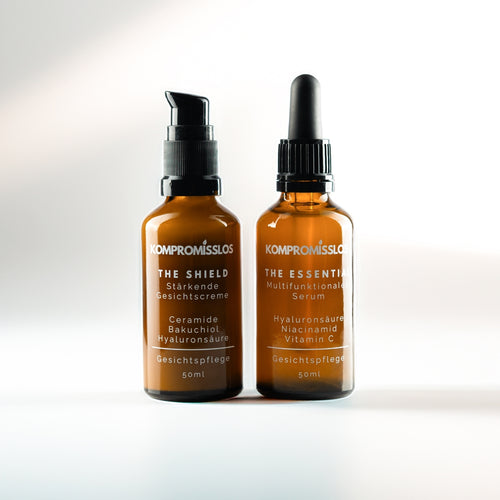
Edelweiss is only included here for comparison, because its data also comes largely from cell cultures; what edelweiss extract does for skin is a topic of its own. If you want Swiss plant extracts in your skincare, you do not need a stem cell label for that. The Duo does not contain apple stem cells. In the Duo, the Swiss plant side is covered by edelweiss extract and organic gentian root from Switzerland, while the base is aloe vera juice, which comes before water on the ingredient list. On the anti-ageing side, it relies on active ingredients with disclosed concentrations – 5% niacinamide and 2% vitamin C as 3-O-Ethyl Ascorbic Acid – plus bakuchiol in the cream. Everything in The Duo of serum and face cream is fully declared. In her review on Judge.me, Barbara F. writes: ‘Two products, clear ingredients, no frills.’ (review translated from German)
There is no apple stem cell extract in the Duo, and that is not an oversight. I wanted Swiss plant extracts in it, which is why edelweiss extract and organic gentian root from Switzerland are part of the formula. For these two, however, I do not give a percentage and I do not promise any effect of their own. I give figures where they are disclosed: 5% niacinamide, 2% vitamin C as 3-O-Ethyl Ascorbic Acid and 1% zinc PCA for The Duo as a whole. A trendy ingredient with a nice story would have looked good on the packaging. But it would mainly have changed the product description, not the skincare. Two products instead of eight also means not chasing every trend. You will find every ingredient in our complete list of ingredients.
Frequently asked questions
Does an apple stem cell cream contain living cells?
No. An apple stem cell cream contains an extract from cultivated apple cells that were broken open during production. A review in Future Science OA notes that the cells in such formulations are already dead and that extracts cannot act like living stem cells.
Is apple stem cell extract vegan?
The extract itself comes from plant cells and is therefore plant-based. Whether a cream is vegan, however, depends on all the other ingredients. The carriers in the raw material, such as glycerin and lecithin, can also be of plant or animal origin depending on the source. What you can rely on is the brand’s statement about the whole product, not the name of a single ingredient.
Can I be allergic to apple stem cells?
Yes – as with any plant extract, reactions are possible, even if they are not typical. If you know you react to apples, test a new cream on a small area first for a few days, for example along your jawline. If you notice redness, burning or itching, stop using it. If a reaction persists, have it checked by a dermatologist.
Do apple cider vinegar or apple juice have a similar effect on the skin?
No. Apple cider vinegar is mainly a diluted acid and is more likely to irritate sensitive skin than to care for it. Apple juice contains fruit sugar and fruit acids, but nothing equivalent to the cell culture extract. Apart from the fruit, neither has anything in common with apple stem cells.
Are apple stem cells better than retinol or bakuchiol?
There is no evidence for that. Retinol is one of the best-researched ingredients against wrinkles, and bakuchiol has at least a few controlled studies. For apple stem cells, there are mainly lab experiments and one small manufacturer study. What bakuchiol does on the skin and how it differs from retinol is covered in the article on bakuchiol benefits for your skin.
Is a stem cell cream worth the higher price?
Usually not, if the extra cost rests only on the stem cell label. A review in the World Journal of Biological Chemistry describes how the words ‘stem cell’ support a considerably higher price even though the basic formula stays the same. Before you pay more, it is worth looking at what you are really paying for in an expensive face cream.
Do I need apple stem cells if I use The Duo?
No. The Duo does not contain apple stem cells and does not need them as an add-on either. The Swiss plant extracts in the Duo are edelweiss and organic gentian root, alongside active ingredients with disclosed concentrations such as 5% niacinamide. An extra stem cell cream makes your routine longer without adding any proven benefit. With The Duo of serum and cream, you stick to two steps.
Sources
- Trehan S, Michniak-Kohn B, Beri K. Plant stem cells in cosmetics: current trends and future directions. Future Science OA, 2017. Source
- Gardiki V, Pavlou P, Siamidi A, Papageorgiou S, Papadopoulos A, Iakovou K, et al. Plant Stem Cells in Cosmetic Industry. Plants (Basel), 2025. Source
- Al-Sowayan BS, Al-Shareeda AT. Stem cells and the pursuit of youth, a tale of limitless possibilities and commercial fraud. World Journal of Biological Chemistry, 2021. Source
- Mibelle Biochemistry. PhytoCellTec Malus Domestica, product information from the raw material manufacturer (manufacturer’s claim). Source