Skin supplements: what biotin, zinc and co. actually do, according to studies
ACTIVE INGREDIENTS
Skin supplements mainly work when you are genuinely short of a nutrient. Your skin needs biotin, zinc and vitamins, but if you already get enough of them, studies show hardly any visible extra benefit. The evidence for biotin in healthy people is weak, and it can skew blood test results; oral zinc has mainly been studied in acne. Whether you are lacking anything is something a blood test at your GP will tell you – not the promise on the packet.
Do skin supplements do anything if you are not deficient?
If you are not deficient, the classic skin supplements usually do little that you would notice in the mirror. The reason is a matter of principle: vitamins and trace elements are essential for the skin, but the body needs a certain amount of them, and anything beyond that does not make well-nourished skin any better. A deficiency, on the other hand, often shows in the skin, hair and nails, and that is where topping up genuinely helps. A large part of the advertising relies on exactly this confusion: what works for people with a deficiency is promised to everyone. Things look somewhat different for products that are not aimed at a deficiency at all. A meta-analysis in Frontiers in Nutrition evaluated 66 randomised trials on skin hydration and found effects compared with placebo for collagen, ceramides, hyaluronan and procyanidin, although most of the trials ran for no more than 24 weeks. The classic skin, hair and nail ingredients biotin and zinc do not appear on that list.
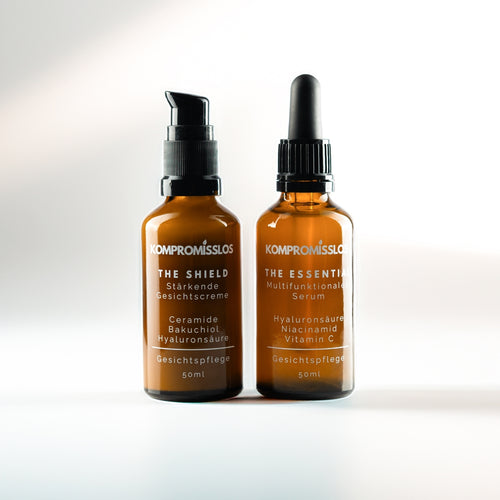
So if you are not deficient, your money is better spent in two other places: on daily sun protection and on a pared-back skincare routine that works where you apply it. What a capsule delivers passes from the gut into the bloodstream and is distributed throughout the body. What a serum contains goes straight onto the skin’s surface. That is the approach behind The Duo with its disclosed concentrations: 5% niacinamide, 2% vitamin C as 3-O-Ethyl Ascorbic Acid, 1% zinc PCA, ceramide NP and hyaluronic acid in three molecular sizes. It does not make up for a nutrient deficiency, though – no skincare can. Which factors count outside the bathroom cabinet is covered in the article on what really slows down skin ageing.
What does biotin do for your skin, according to studies?
Studies show a benefit from biotin almost exclusively in people with a deficiency or a specific medical condition, not in healthy skin. In 2017, a review by Patel, Swink and Castelo-Soccio in the journal Skin Appendage Disorders searched systematically for evidence on biotin for hair and nail growth. It found 18 reported cases, and every one of the people involved had an underlying cause for the poor growth. In these people, the condition improved with biotin. The authors see a benefit most likely in acquired or inherited biotin deficiency and in individual conditions such as brittle nails. For healthy people, they consider the evidence insufficient. For the skin itself, the picture is even thinner, because most studies focus on hair and nails.
The fact that biotin is nonetheless found in almost every skin, hair and nail supplement has to do with its reputation and with an authorised health claim relating to the skin, not with a study on healthy skin. On top of that comes a side effect that has nothing to do with the skin at all: larger amounts of biotin can skew lab results, for example thyroid values. What one study found on this is covered below in the frequently asked questions.
What does taking zinc do for your skin, and when is it a matter for your doctor?
Oral zinc has mainly been studied in acne, and acne is a matter for a dermatologist, not for self-experimentation. In 2020, a systematic review and meta-analysis by Yee and colleagues in Dermatologic Therapy found that people with acne had lower zinc levels in their blood on average than control subjects. Treatment with zinc – taken orally in some of the studies analysed and applied to the skin in others – mainly reduced the number of inflamed papules, either on its own or alongside another therapy. That does not mean, however, that zinc tablets make sense for all blemish-prone skin. Acne has several causes, and which treatment is right, zinc included, is something to discuss with your doctor or dermatologist. Dosages from online forums are no substitute for that, especially as high amounts of zinc taken over a long period can affect the absorption of other trace elements.
For skin without acne, there is no evidence of a visible effect from extra zinc. If you are prone to blemishes, skincare for blemish-prone skin is usually the calmer first step: gentle cleansing, few products and patience. Zinc on the skin, by the way, is a different matter from zinc in a tablet – more on that in the frequently asked questions.
Omega-3, vitamin C, vitamin D and co.: what is the evidence for skin?
Omega-3, vitamin C and vitamin D follow the same pattern as biotin and zinc: a deficiency harms the skin, but there is little evidence that extra amounts help skin that is already well supplied. For omega-3 fatty acids, a review by Pilkington and colleagues in Experimental Dermatology describes mechanisms through which they could protect the skin from UV damage, and classes them as a possible additional measure alongside sun protection, not as a replacement for it. The body needs vitamin C to form collagen, and a severe deficiency also shows in the skin. Whether tablets do anything visible on top of a normal diet is far less clear than the role of vitamin C in skincare, which is explained in the article on vitamins in creams and serums. Vitamin D is produced by the skin itself under UV light. As a supplement, it is a matter for your bones and immune system, and a blood test will show whether you need one. Collagen drinks have their own body of research and are a separate topic, distinct from what collagen in a cream can do.
| Nutrient | What the evidence shows | When it makes sense |
|---|---|---|
| Biotin | Benefit in deficiency and certain conditions, hardly any evidence in healthy people | If a deficiency has been confirmed, after talking to your doctor |
| Zinc | Lower blood levels in acne, fewer inflamed papules with zinc | For acne, only after assessment by a dermatologist |
| Omega-3 | Possible mechanisms for additional UV protection, no substitute for sunscreen | As part of your diet, for example from oily fish or algae oil |
| Vitamin C | Needed for collagen formation, a deficiency shows in the skin | With a very unbalanced diet or a diagnosed deficiency |
| Vitamin D | Produced in the skin under UV light, no proven beauty effect | If a blood test shows a deficiency |
| Collagen | Better skin hydration than placebo in studies mostly lasting up to 24 weeks | A separate topic that needs weighing up on its own |
What do claims like ‘contributes to the maintenance of normal skin’ on the packet mean?
The phrase ‘contributes to the maintenance of normal skin’ is an authorised health claim, not a promise of better-looking skin. In Switzerland, as in the EU, wordings like this are set out in a fixed list, and a manufacturer may use them if the product contains a certain minimum amount of the nutrient. What the claim establishes is the nutrient’s role in the body: without it, the skin does not function normally. What it does not establish is that extra amounts make a visible difference to someone who is already well supplied. So the word ‘normal’ is meant literally: it refers to the normal state, not to an improvement beyond it. Claims of this kind exist for biotin, zinc, niacin, riboflavin and vitamin A, among others.
For you, this means that such a claim tells you a nutrient is necessary, not that you need more of it. A supplement with six of these phrases on the packet sounds comprehensive, but it simply proves the same principle six times over. Whether you are low in any of these nutrients is not written on any label.
When is a blood test better than a skin, hair and nail supplement?
A blood test makes more sense as soon as you have a specific concern, rather than simply wanting to do something for your skin. In these cases, it is not about skincare but about finding a cause. That could be a deficiency, but it could also be a thyroid disorder, a skin condition or a side effect of medication. Taking a combination supplement on a hunch tends to cloud this question rather than answer it, and it can skew the lab results you will need later. Which values are worth testing is something your GP decides based on your symptoms. A large panel on your own initiative is rarely necessary. Typical reasons for that conversation include:
- Hair loss that persists for weeks or suddenly gets worse.
- Nails that change, become brittle or discolour.
- Skin that stays noticeably dry, flaky or sore despite good skincare.
- A very unbalanced or severely restricted diet over a longer period.
- Acne or other skin changes that do not settle down over several months.
If you want to try a supplement, do not start three at once. Otherwise, if something changes, you will not know what caused it – and if you react badly, you will not know which one to stop.
I have not added a skin, hair and nail supplement to our range, and that is part of the same decision as two products instead of eight. At Kompromisslos, the active ingredients go where they are needed, namely on the skin, and the amounts are listed openly on the page about our active ingredients and their concentrations. At the same time, the limits matter to me: a cream does not make up for a deficiency. Whether you have one is something a blood test will tell you – not me, and not a label either. And because our cream deliberately contains no SPF, I will say it plainly: separate sun protection during the day does more for your skin than any capsule in the bathroom cabinet.
Frequently asked questions
How long does it take for supplements to show in your skin?
That depends mainly on whether there was a deficiency in the first place. If a genuine deficiency is corrected, the skin needs weeks, and hair and nails grow back even more slowly. The trials in the meta-analysis on skin hydration also measured their effects over weeks to months, mostly up to 24 weeks, not over days. Without a deficiency, the more honest question is not when, but whether at all.
Can too much biotin or zinc be harmful?
Yes, in different ways. Larger amounts of biotin can skew lab results and so lead to incorrect findings. High amounts of zinc over a long period can interfere with the absorption of other trace elements and upset your stomach. If you combine several supplements, it is easy to take the same substance twice without noticing. So it is worth going over the total amount with a pharmacist or doctor.
Does biotin affect blood test results?
Yes, it can. In a study in the journal JAMA, six healthy adults took 10 mg of biotin a day for seven days. Afterwards, 9 of 23 lab tests that rely on biotin binding gave skewed results, either too high or too low depending on the type of test. The values measured included thyroid levels. So always mention that you take biotin before having blood taken.
Can capsules replace a good facial skincare routine?
No, because the two do different jobs. Capsules supply the body via the gut, while skincare works on the skin’s surface: it provides moisture, supports the skin barrier and keeps the skin supple. The same applies the other way round: a cream cannot replace a nutrient you are lacking.
Is zinc in tablets the same as zinc in a cream?
No. Zinc in tablets is absorbed through the gut and distributed throughout the body, whereas zinc in a cream or serum stays in the upper layers of the skin and works where you apply it. What the form most commonly used in skincare can do, and which skin it suits, is covered in the article on zinc PCA in skincare.
Are skin, hair and nail supplements worth it over 40?
Not automatically. From 40 onwards, skin and hair do genuinely change, during menopause mainly because of falling oestrogen levels. But that is not a nutrient deficiency a capsule can top up. What lies behind wrinkles in menopause has more to do with hormones and UV light than with biotin. A blood test is worthwhile if specific symptoms appear as well.
Do I need skin supplements if I use The Duo?
No, not because of The Duo. The Duo of serum and cream is skincare for the skin’s surface; it neither replaces a balanced diet nor makes up for a deficiency. Nor does it need a capsule to complement it. Whether you should take anything depends on your blood results and your diet, not on your skincare.
Sources
- Patel DP, Swink SM, Castelo-Soccio L. A Review of the Use of Biotin for Hair Loss. Skin Appendage Disorders, 2017. Source
- Li D, Radulescu A, Shrestha RT, Root M, Karger AB, Killeen AA, et al. Association of Biotin Ingestion With Performance of Hormone and Nonhormone Assays in Healthy Adults. JAMA, 2017. Source
- Yee BE, Richards P, Sui JY, Marsch AF. Serum zinc levels and efficacy of zinc treatment in acne vulgaris: A systematic review and meta-analysis. Dermatologic Therapy, 2020. Source
- Pilkington SM, Watson RE, Nicolaou A, Rhodes LE. Omega-3 polyunsaturated fatty acids: photoprotective macronutrients. Experimental Dermatology, 2011. Source
- Sun Q, Wu J, Qian G, Cheng H. Effectiveness of Dietary Supplement for Skin Moisturizing in Healthy Adults: A Systematic Review and Meta-Analysis of Randomized Controlled Trials. Frontiers in Nutrition, 2022. Source