Sudden menopause wrinkles: why skin ages so quickly after menopause
SKIN OVER 40
Wrinkles that appear suddenly during menopause are no coincidence: as oestrogen falls, your skin loses collagen, thickness and moisture within just a few years. One scientific review estimates that skin collagen decreases by up to 30 per cent in the first five years after menopause. Lines that used to show up only when your skin was dry then stay put. Skincare can improve moisture, the skin barrier and the appearance of fine lines, but it cannot bring back lost collagen.
Why do wrinkles suddenly appear during menopause?
Wrinkles appear suddenly during menopause because the skin’s connective tissue depends heavily on oestrogen, and this hormone drops away within a short space of time. For decades, oestrogen has been working quietly in the background: it keeps the fibroblasts going – the cells that produce collagen and elastic fibres – and it helps the outer layer of the skin hold on to moisture. Once this driving force is gone, the dermis becomes thinner and less elastic. Facial expressions then leave deeper marks, because the cushioning that used to smooth a line out again is no longer there. Skin researcher Julie Thornton of the University of Bradford sums it up in a review in the journal Dermato-Endocrinology: when oestrogen is lacking, skin becomes thinner, contains less collagen, loses elasticity and becomes drier and more wrinkled. There is a simple reason why it feels so sudden. Skin ageing normally progresses slowly over decades; here, a second, hormone-driven push is added on top within just a few years.
Many women notice the first perimenopause skin changes in their early 40s, but the biggest jump comes after their last period. The other changes that come with menopause and your skin, from increased sensitivity to the feeling that no skincare suits you any more, are a separate topic. This article is only about wrinkles and what lies behind them.
What does falling oestrogen do to collagen and moisture?
Falling oestrogen mainly reduces type I and type III collagen, the two types of fibre that give skin its firmness and elasticity. A study from the University of Naples, published in the journal Maturitas, examined skin samples from 14 women before and 18 women after menopause. In the postmenopausal women, the levels of both collagen types were significantly lower, and the longer ago menopause had been, the less collagen the researchers found. Their conclusion: the loss of skin collagen is an oestrogen-related phenomenon. At the same time, moisture levels change. In the studies Thornton summarises, oestrogen replacement increases moisture in the outer layer of the skin. Put the other way round: without the hormone, the skin’s surface holds on to water less well, feels rougher and becomes tight more quickly.
This distinction is key to making sense of what you see. Some of the new lines are a moisture problem at the surface, others a structural problem deeper down. The first can be influenced well with skincare, the second only to a very limited extent. If you lump the two together, you either expect too much from a cream or give up too soon.
How quickly does skin change after menopause?
Skin changes most markedly in the first few years after menopause, and the decline does not simply stop after that. Thornton’s review states that type I and III collagen may fall by up to 30 per cent in the first five years after menopause. She also cites measurements showing that, with oestrogen deficiency, skin thickness falls by 1.13 per cent and collagen content by 2 per cent for every year after menopause. These figures come from older studies with small groups. They are averages, not a forecast for your face.
A finding published in the British Journal of Obstetrics and Gynaecology in 1985 is revealing: in women not taking hormone therapy, skin collagen content was linked to the number of years since menopause, not to their age. For you, this means that what matters is less whether you are 52 or 56 than how long ago your last period was. It also explains why the wave of wrinkles arrives at 48 for some women and not until their mid-50s for others.
What can skincare still do at this stage?
At this stage, skincare can noticeably improve the skin’s surface, but it cannot restore the structure underneath. Three things are realistic: more moisture in the outermost layer of the skin, a more stable barrier and a smoother appearance of fine lines. Humectants such as hyaluronic acid and glycerin bind water at the surface; lipids such as ceramides and squalane keep it there. Niacinamide supports the barrier and helps to give a more even-looking complexion. For the lines themselves, bakuchiol is worth a closer look, especially if your skin has become more reactive. In a randomised, double-blind study in the British Journal of Dermatology, 44 people applied either 0.5% bakuchiol twice a day or 0.5% retinol once a day for twelve weeks. Both reduced wrinkle surface area and pigmentation, with no statistically significant difference between the groups. The retinol group reported flaking and stinging more often. Which anti-wrinkle ingredients are backed by evidence overall is covered in the article do anti-wrinkle creams actually work.
| Change | What lies behind it | What skincare can do | Where skincare stops |
|---|---|---|---|
| Fine lines that soften after you apply cream | Too little moisture in the outermost layer of the skin | A lot: humectants plus lipids visibly reduce them | They come back if you stop your skincare |
| Tightness and roughness | The barrier holds water less well | A lot: ceramides, squalane and enough product in the evening | Itching or eczema should be checked by a doctor |
| Wrinkles that remain even when skin is well cared for | Less collagen and elasticity in the dermis | Limited: ingredients such as bakuchiol or retinol can soften their appearance | No cream rebuilds lost collagen |
| Skin looks thinner and less firm | Loss of skin thickness and connective tissue | Little: a plumper surface makes skin look fresher | Cosmetics do not change the thickness of your skin |
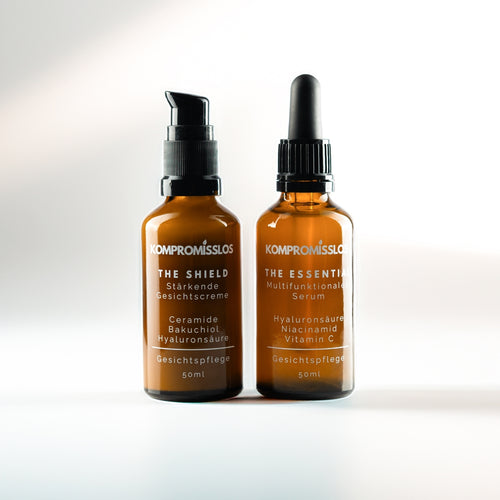
This surface work is exactly what The Duo is designed for: the serum provides hyaluronic acid, niacinamide and vitamin C, the cream ceramides, squalane, jojoba oil and bakuchiol. In her review on Judge.me, Nicole L. writes: ‘Great for my mature skin too, not shiny or greasy, just right, doesn’t feel tight, but still nourishing […]’ (review translated from German). A comfortable feel without tightness and a smoother surface: that is as much as you should expect from a cream at this stage. No cosmetic product can make up for the hormone deficiency itself. Whether hormone therapy is an option for you is a question for your gynaecologist, who can weigh up the benefits and risks for your situation.
What role do sun, sleep and smoking play now?
Sun, sleep and smoking play a bigger role now than before, because your skin has fewer reserves to make up for damage. UV radiation breaks down collagen as well, and this is precisely the collagen that skin rebuilds more slowly after menopause. Thornton also describes how, with oestrogen deficiency, the skin’s defences against oxidative stress decline – against exactly the kind of damage that sun and cigarette smoke cause. Smoking also reduces blood flow to the skin. When it comes to sleep, the evidence on wrinkles is thinner. What is clear, however, is that hot flushes and night sweats often disrupt sleep during menopause, and tired skin makes existing lines look more visible. How much of skin ageing overall is down to the sun is explained in detail in the article on how to slow down skin ageing.
The levers within your own control at this stage are few:
- Daily sun protection on your face, even in winter and on overcast days.
- Not smoking, because smoke puts further strain on defences against oxidative stress that are already weakened.
- Enough skincare in the evening so that your barrier does not dry out overnight.
- Raising sleep problems caused by hot flushes with your doctor instead of simply putting up with them.
Why are the changes different for every woman?
The changes vary because falling oestrogen meets very different starting points. How much collagen your skin has before menopause depends on genetics, skin type and, above all, how much sun it has been exposed to so far. A woman with fair skin and many unprotected summers behind her starts with less in reserve than a woman who has been protecting her face for years. Then there is timing. Menopause does not happen at the same age for everyone, and because collagen loss is linked to the years since menopause, the wave of wrinkles shifts too. An early menopause, for example after surgery, can bring the process forward. Even within the face, it does not progress evenly: where your expressions work hardest, around the eyes and mouth, lines appear first.
How skin ageing begins long before menopause is shown in the overview of the first signs of skin ageing. And what skincare for mature skin looks like without eight steps is covered in a separate article. Above all, try not to measure yourself against friends of the same age. Your starting point is different from theirs.
I have not developed a separate menopause range, and that is a deliberate decision. Skin after menopause usually does not need different active ingredients, but more of what works anyway: moisture, lipids and calm. That is why I have stuck with the same two products. If your skin becomes drier, you use a little more cream, which is also what the instructions for use say. I put bakuchiol rather than retinol in the cream because retinol is more likely to sting and cause flaking, especially on dry, reactive skin. What I cannot promise you is that two products will bring back lost collagen. No cream can do that, and I will not pretend otherwise. You need sun protection on top; it is deliberately not part of the cream.
Frequently asked questions
Are the new wrinkles dryness or a real loss of firmness?
Usually both: lines that soften noticeably after you apply cream are mainly down to dryness, while wrinkles that remain even when your skin is well hydrated come from less collagen and elasticity. How to tell the two apart reliably is explained in the article dehydration lines vs wrinkles.
Are menopause wrinkles permanent?
Wrinkles caused by collagen loss stay; dehydration lines do not. Skincare can make deeper wrinkles softer and less noticeable, but it cannot reverse them. Fine lines caused by a lack of moisture, on the other hand, often fade considerably once the barrier is stable again. If you want to change more about deeper wrinkles, you will end up looking at medical procedures, and that decision belongs in a consultation with a dermatologist.
Does retinol help after menopause?
Yes, retinol can improve the appearance of wrinkles after menopause too, but dry, thinner skin is more likely to react with redness, flaking or stinging. Start with a low concentration on a few evenings a week. If your skin does not tolerate it, bakuchiol is an alternative that performed similarly in a comparative study and was better tolerated.
Why does skin become drier during menopause?
Because, as oestrogen declines, a factor that helps the outer layer of the skin hold on to moisture disappears, so the barrier holds water less well and your skin feels tight more quickly; how to adjust your skincare accordingly is covered in the article on dry skin during menopause.
Can diet slow down the wave of wrinkles?
Only a little. No food makes up for the drop in oestrogen in your skin, and supplements are no shortcut either. A balanced diet with enough protein supports your skin as it does the rest of your body, but the bigger levers remain daily sun protection, not smoking and skincare that keeps the barrier stable.
Do I need a different cream after menopause?
Not necessarily a different one – a slightly larger amount of the same skincare is often enough; how menopause skincare, phytoestrogens and oestrogen creams differ is explained in the article on menopause face cream without hormones.
What can The Duo do after menopause?
The Duo can give your skin moisture, support the skin barrier and soften the appearance of fine lines. It contains no hormones and does not reverse collagen loss. If your skin becomes drier, use a little more cream. During the day, you also need sun protection, because the Duo of serum and cream contains no SPF.
Sources
- Thornton MJ. Estrogens and aging skin. Dermato-Endocrinology, 2013. Source
- Affinito P, Palomba S, Sorrentino C, Di Carlo C, Bifulco G, Arienzo MP, et al. Effects of postmenopausal hypoestrogenism on skin collagen. Maturitas, 1999. Source
- Brincat M, Moniz CJ, Studd JW, Darby A, Magos A, Emburey G, et al. Long-term effects of the menopause and sex hormones on skin thickness. British Journal of Obstetrics and Gynaecology, 1985. Source
- Dhaliwal S, Rybak I, Ellis SR, Notay M, Trivedi M, Burney W, et al. Prospective, randomized, double-blind assessment of topical bakuchiol and retinol for facial photoageing. British Journal of Dermatology, 2019. Source