Menopause face cream without hormones: how it differs from oestrogen creams and phytoestrogens
SKIN OVER 40
A menopause face cream without hormones is essentially any ordinary face cream: in Switzerland and the EU, cosmetics must not contain oestrogens, progestogens or substances with an androgenic effect. ‘Hormone-free’ on the label therefore states the obvious. Creams containing oestrogen are medicines and belong in a consultation with your gynaecologist. Phytoestrogens are plant compounds that can act like hormones in the lab, but they are not hormones. When you choose a cream, openly declared active ingredients count for more than a ‘menopause’ label.
What is the difference between a hormone-free menopause cream and an oestrogen cream?
A hormone-free menopause cream is a cosmetic that cares for the surface of the skin, whereas an oestrogen cream is a medicine with a hormone as its active substance. So the difference is not one of strength but of category. Cosmetics exist to cleanse, care for and protect the skin and to improve its appearance. A medicine is meant to influence a bodily function and needs marketing authorisation to do so. Annex II of Regulation (EC) No 1223/2009 on cosmetic products lists the substances that are prohibited in cosmetics. Oestrogens, progestogens and substances with an androgenic effect are named explicitly. According to the Swiss Federal Food Safety and Veterinary Office (FSVO), this regulation also applies in Switzerland under Article 54 of the Foodstuffs and Utility Articles Ordinance. A cream from the cosmetics shelf therefore cannot contain hormones, whatever it is called. There is a real reason why the subject still preoccupies so many women: a review in Dermato-Endocrinology describes how the drop in oestrogen after menopause makes skin thinner, drier and less elastic.
| Product | Contains hormones | Category | How to recognise it | Who decides |
|---|---|---|---|---|
| Oestrogen cream | Yes, an oestrogen as the active substance | Medicine | Authorisation number, patient information leaflet, active substance with its quantity stated | A gynaecologist |
| ‘Menopause’ skincare | No | Cosmetic | INCI list, target group on the label | You, based on the ingredient list |
| Skincare with phytoestrogens | No, but plant compounds with hormone-like activity in the lab | Cosmetic | Soy, red clover, genistein or bakuchiol in the INCI list | You, based on the ingredient list |
| Ordinary facial skincare | No | Cosmetic | INCI list | You, based on the ingredient list |
Is menopause skincare any different from ordinary skincare?
In legal terms, menopause skincare is ordinary cosmetics like any other, just with a target group printed on the label. Products marketed ‘for the menopause’ have no category of their own and no rules of their own. They are subject to the same regulations as any other face cream and, like it, must not contain hormones. At best, what sets them apart is a well-thought-out formula for drier, thinner skin. At worst, it is only the packaging. Whether a cream suits you is therefore shown by the ingredient list, not the label. You can read about what changes in your skin during this phase in the article on menopause and your skin. In short, mature skin mainly needs lipids such as ceramides, humectants and a bit of peace rather than one new product after another.
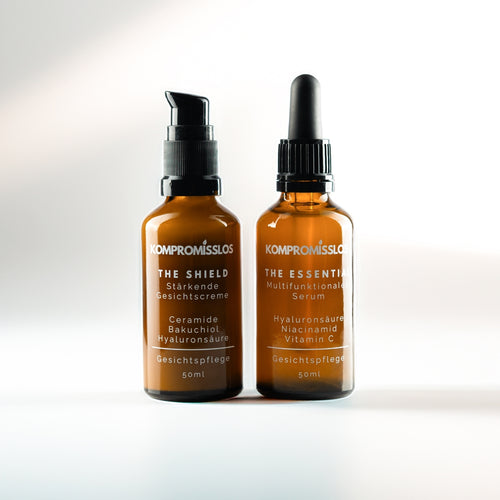
The more honest alternative to a special range is openly declared active ingredients. That is the approach behind The Duo, skincare without a special menopause line: instead of a separate range for the menopause, every active ingredient is declared and the key concentrations are disclosed. If all you find on a menopause cream is mood words and no information on active ingredients, you are mainly paying for the positioning. What a pared-back skincare routine for mature skin looks like depends more on the condition of your skin than on your age anyway. And if the first changes are only just beginning, the article on perimenopause skin changes will help you make sense of them.
What can phytoestrogens in a cream actually do?
Phytoestrogens can act like hormones in the lab, but they are not a hormone replacement, and what they do on facial skin depends on the individual compound and product. The term covers plant compounds that can bind to oestrogen receptors, such as isoflavones like genistein from soy or red clover. Chemically, they are not hormones, and you will find some of them in cosmetics too. The review in Dermato-Endocrinology names phytoestrogens, alongside hormone replacement and selective oestrogen receptor modulators, as a possible approach to counter skin ageing. But a possible approach is not the same as a proven effect of a particular cream. Whether a product does anything depends on which compound it contains, in what amount, and whether that exact formula has been tested on people. If the packaging only says ‘with phytoestrogens’, that is precisely the information you are missing.
One example that concerns us directly is bakuchiol. In natural skincare for mature skin, it is regarded as a plant-based alternative to retinol. In a 2011 paper in the journal Phytomedicine, bakuchiol showed oestrogen-like activity in yeast and cell assays and bound to both oestrogen receptors. In the yeast assay, its activity at the same concentration was even higher than that of genistein. A second paper in the same journal found in 2010 that bakuchiol activates both receptor types in cell experiments. The two papers give different answers on whether it also stimulates the growth of oestrogen-sensitive cells. What this means for cosmetic use on the skin has not been studied.
How can you tell whether a cream contains hormones?
You can tell whether a cream contains hormones from its category: a hormone product is a medicine with an authorisation number, a patient information leaflet and an active substance with its quantity stated, whereas a cosmetic cream carries an INCI list. At first glance, the two worlds look alike, as both come in tubes and jars. But the packaging quickly gives away which category a product belongs to. These points will help you check:
- Authorisation number and patient information leaflet: both belong to a medicine. If neither is there, it is not an authorised hormone product.
- Active substance with its quantity: in medicines, hormones such as estradiol or estriol are declared by name and amount.
- INCI list: cosmetics list every ingredient by its INCI name. This list must not include hormones.
- Phytoestrogens in the INCI list: look out for Glycine Soja, Trifolium Pratense (red clover), genistein or bakuchiol if you deliberately want to avoid plant compounds of this kind.
- Advertising claims: if a cosmetic cream promises an effect ‘like oestrogen’, some scepticism is in order. Cosmetics are not a hormone replacement, even if the packaging hints otherwise.
A complete, publicly available ingredient list tells you the most. That this matters to customers is shown by a review on Judge.me in which J.D. writes of being delighted ‘by the whole concept and the great transparency regarding ingredients’ (review translated from German).
Why is oestrogen face cream a matter for your gynaecologist?
Oestrogen cream for the face belongs in a consultation with your gynaecologist because it is a hormone medicine, and whether to use it depends on your medical history, not on the appearance of your skin alone. The review in Dermato-Endocrinology states that skin ageing can be significantly delayed by administering oestrogen. That explains why the question of an oestrogen face cream comes up at all. But it says nothing about whether a hormone product is an option for you personally. That weighing-up depends on factors that only come to light in a conversation with a doctor, such as pre-existing conditions, family history and other medication. A product intended for another part of the body should not end up on your face on your own initiative, not even ‘just a little’. Hormone therapy is a medical decision with its own benefits and its own risks. Cosmetics can neither replace nor imitate it, and a cream off the shelf is not a gentle first step towards it either. If what bothers you most are the lines that appear faster after menopause, the article on sudden wrinkles in menopause explains what lies behind them.
Take specific questions with you to the appointment: what bothers you about your skin, since when, and what you have already tried. The more clearly you describe this, the easier it is to separate what skincare can solve from what it cannot.
I did not make a menopause edition. Instead of a special range, I disclose what is inside: 5% niacinamide, ceramide NP and bakuchiol, which I use in the cream instead of retinol. Bakuchiol comes with a caveat you rarely read about: in cell experiments, it shows oestrogen-like activity. What this means for use on the skin has not been studied, and I do not want to claim anything I cannot back up. That is why I only ever say that The Duo contains no hormones, and never that it is free of phytoestrogens. If you deliberately want to avoid phytoestrogens, The Duo is not the product for you, and that is fine. All the active ingredients and their disclosed concentrations are listed on our website.
Frequently asked questions
Do phytoestrogens work like hormones?
Not in the same sense. In the lab, phytoestrogens can bind to oestrogen receptors and show hormone-like activity there, but chemically they are not hormones. Findings from cell cultures cannot be transferred directly to a cream on your face. How strongly an individual compound acts on the skin depends on the substance, the amount and the formula.
Are phytoestrogens in cosmetics safe?
There is no blanket yes or no, because phytoestrogens are very different substances. According to the FSVO, substances that are not explicitly regulated may only be used in cosmetics if their safety has been demonstrated in a product safety report. If you want to avoid them deliberately because of your medical history, discuss this with your doctor and check the INCI list for soy, red clover, genistein or bakuchiol.
Is ‘hormone-free’ a special feature in a face cream?
No. Oestrogens, progestogens and substances with an androgenic effect are listed in Annex II of the EU Cosmetics Regulation, which also applies in Switzerland via food law. Every face cream from the cosmetics shelf is therefore hormone-free. A label that highlights this is stating the obvious. What tells you more is whether a cream contains phytoestrogens, if that matters to you.
Are menopause creams more expensive, and why?
Not necessarily, and whether a higher price is justified depends on the formula, not the label. Menopause lines are ordinary cosmetics with a target group of their own, and positioning, packaging and advertising all cost money. So compare the ingredient list and the information on active ingredients with an ordinary cream for mature, dry skin. If you find the same lipids and humectants, you are paying the difference for the label.
Can I combine hormone-free skincare with hormone therapy?
As a rule, yes, because ordinary cosmetics contain no hormones and are neither a substitute for nor an addition to the therapy, simply skincare. If you apply a hormone product to your skin, ask your gynaecologist whether you can also apply a cream to the same area and how long to wait in between. No cream can make the decision for or against hormone therapy for you. What HRT changes in your skin, and what it does not, is covered in a separate article.
Is The Duo hormone-free?
The Duo contains no hormones. The serum and cream are cosmetics with openly declared active ingredients such as 5% niacinamide, ceramide NP and bakuchiol. Because bakuchiol shows oestrogen-like activity in cell experiments, we deliberately do not describe The Duo serum and cream as free of phytoestrogens. The full ingredient list is publicly available so that you can decide for yourself.
Sources
- Thornton MJ. Estrogens and aging skin. Dermato-Endocrinology, 2013. Source
- Lim SH, Ha TY, Ahn J, Kim S. Estrogenic activities of Psoralea corylifolia L. seed extracts and main constituents. Phytomedicine, 2011. Source
- Xin D, Wang H, Yang J, Su YF, Fan GW, Wang YF et al. Phytoestrogens from Psoralea corylifolia reveal estrogen receptor-subtype selectivity. Phytomedicine, 2010. Source
- Europäisches Parlament und Rat der Europäischen Union. Verordnung (EG) Nr. 1223/2009 über kosmetische Mittel, Anhang II (Einträge 37, 194 und 260). Amtsblatt der Europäischen Union, 2009. Source
- Bundesamt für Lebensmittelsicherheit und Veterinärwesen BLV. Geregelte Stoffe in kosmetischen Mitteln. BLV, 2026. Source