HRT and skin: what hormone replacement therapy does and doesn’t change about dryness, wrinkles and pigmentation
SKIN OVER 40
HRT can change your skin in measurable ways, but less than many women hope. In studies, skin on hormone replacement therapy was sometimes thicker, richer in collagen and less often dry. When it came to visible wrinkles, however, two large placebo-controlled trials found no difference. Guidelines do not support hormone therapy for the skin alone, because robust studies are lacking. The decision belongs with your gynaecologist, and a simple, gentle skincare routine still makes sense alongside hormones.
Does hormone replacement therapy improve your skin?
Hormone replacement therapy can improve certain properties of the skin, mainly its thickness, moisture and collagen content, but it does not bring back the skin you had before menopause. The background in two sentences: in the skin, oestrogen supports collagen production and the ability to hold on to water. When levels drop, skin becomes drier and thinner, as explained in detail in the article on why wrinkles suddenly appear in menopause. HRT targets exactly this deficiency, which is why hoping for better skin seems only natural.
The German-language S3 guideline on peri- and postmenopause from 2018 states that HRT improves the skin’s capacity to retain water and its barrier function. The same section, however, also says that despite many studies the effect of HRT on the skin has not been conclusively established, and that short-term HRT has no proven dermatological effects. For you, this means that some changes may improve while others stay. Sun exposure, smoking, genetics and the years before all continue to play a part. Which changes begin even before your last period is covered in the article on perimenopause skin changes.
What do studies show about HRT, skin thickness, collagen and moisture?
For skin thickness, collagen and moisture, studies mostly show positive results, though not consistently. A 2025 review in the Journal of Cosmetic Dermatology summarises the research on this. It describes a randomised, placebo-controlled study of 60 postmenopausal women in which twelve months of systemic oestrogen increased skin thickness by 11.5 per cent and the thickness of the dermis by 33 per cent. In another study, the collagen content of the dermis rose by 6.49 per cent after six months of HRT. A large US population survey of 3,875 postmenopausal women found dry skin to be less common among those taking oestrogen, with an odds ratio of 0.76.
The same review, however, also cites a study in which a year of HRT changed neither the amount of collagen nor the rate at which it was produced, and it concludes that most studies show positive associations, but the results are sometimes contradictory. Two points help to put this in perspective. A measurement such as skin thickness on ultrasound is not the same as what you see in the mirror. And observational data show associations, not causes, because women on HRT often also differ in lifestyle and in the medical care they receive.
| Area | What HRT can change | What HRT does not change | What skincare contributes |
|---|---|---|---|
| Dryness | Dry skin less common in observational data | Dry air from central heating, overly harsh cleansing | Humectants and lipids such as hyaluronic acid and ceramides |
| Skin thickness and collagen | Measurably more in individual studies | Sun damage from earlier decades | Daily sun protection against further UV damage |
| Wrinkles | No difference from placebo in two large studies | Expression lines and deep wrinkles | Skin looks plumper and suppler, deep wrinkles remain |
| Pigmentation | No proven benefit, hormones can encourage new discolouration | Existing sun spots | Sun protection, vitamin C and niacinamide for a more even-looking complexion |
| Sensitivity | No proven protection against irritation from products | Reactions to too many active ingredients | A few fragrance-free products |
If your skin tends to look papery and is more easily damaged, the article on thin skin on the face is worth a read, as it looks at what skincare can realistically do for this kind of skin.
Does HRT help with wrinkles?
In the two most meaningful studies, hormone therapy had no effect on visible wrinkles. In a randomised, double-blind study in the Journal of the American Academy of Dermatology, 485 postmenopausal women received either a low-dose combination of oestrogen and progestogen or a placebo for 48 weeks. For fine and coarse facial wrinkles, there was no statistically significant difference from the placebo group. The researchers themselves point out that the study does not allow conclusions about higher doses, longer treatment or starting during perimenopause.
Starting early was tested by the KEEPS study in Fertility and Sterility: women aged 42 to 58 whose last period had been no more than 36 months earlier received oestrogen as a tablet, oestradiol through the skin or a placebo for four years. Neither the wrinkle score nor skin rigidity differed between the groups. In this study, the factor most strongly linked to skin ageing was ethnicity, not hormones. The US population survey did also find wrinkles to be less common among women taking oestrogen, but it only shows an association, not a cause. And the S3 guideline mentions evidence that HRT started around the time of perimenopause may reduce signs of skin ageing. According to the available studies, however, it is not a reliable remedy for wrinkles.
What skin changes can happen on hormone therapy?
Hormone therapy can also bring unwanted changes to the skin – usually harmless, but always worth mentioning at your next appointment. Which ones occur depends on the product, the form and the dose, and that is exactly why the assessment should be left to the practice that prescribed your therapy. These are the changes mentioned most often:
- Redness, itching or a rash where a patch is stuck on or where a gel is applied. Raise it with your doctor before you start tackling it yourself with creams.
- New brownish patches on the cheeks, forehead or upper lip that resemble melasma. Hormones are considered a possible trigger, and sun makes them worse. Mention it at your appointment and have it checked by a dermatologist.
- Oilier skin or new breakouts, depending on the progestogen, because some progestogens have a residual androgenic effect. Raise it with your doctor rather than drying your skin out with harsh products.
- Dryness or itching that persists despite therapy. This does not automatically mean that something is going wrong, but it is worth mentioning if it bothers you in everyday life.
Spots that change, grow, bleed or look different from the others should be seen by a dermatologist, regardless of any therapy. How to tell harmless discolouration apart and what skincare can do for it is explained in the article on dark spots on the face.
If your skin reacts where a patch is stuck on, do not switch product, form or dose on your own. Note down when and where the redness appears, and take these notes to your next appointment.
Why is your skin alone not a reason for hormone replacement therapy?
Your skin alone is not a reason for hormone replacement therapy, because the benefit for the skin is uncertain and the therapy has other aims and risks of its own. The S3 guideline recommends offering HRT to women with vasomotor symptoms (such as hot flushes and night sweats) once they have been informed about the short- and long-term benefits and risks. So the starting point is symptoms, not wrinkles. The review in the Journal of Cosmetic Dermatology puts it just as clearly: clinical guidelines do not support HRT solely for skin changes caused by oestrogen deficiency, because robust studies are lacking.
Whether hormone therapy is an option for you depends on your symptoms, your age, how long ago your menopause was and your medical history. Weighing up these benefits and risks belongs with your gynaecologist, not in a skincare guide, which is why I do not assess it here. If you have heard that oestrogen creams for the face are an alternative, read the article on how hormone-free menopause skincare differs from oestrogen creams. These, too, are medicines that need weighing up in their own right.
How should you care for your facial skin during hormone therapy?
During hormone therapy, you essentially care for your facial skin the same way as without it: cleanse gently, provide moisture and lipids, and use sun protection during the day. The therapy does not replace skincare, and skincare does not replace therapy. Even with HRT, your skin will not go back to how it was at 35. A pared-back, gentle routine makes particular sense when your skin is already more reactive because of a patch, a gel or new spots, since every additional layer is one more potential irritant.
- Cleanse with water or a mild product, without exfoliating particles and without alcohol.
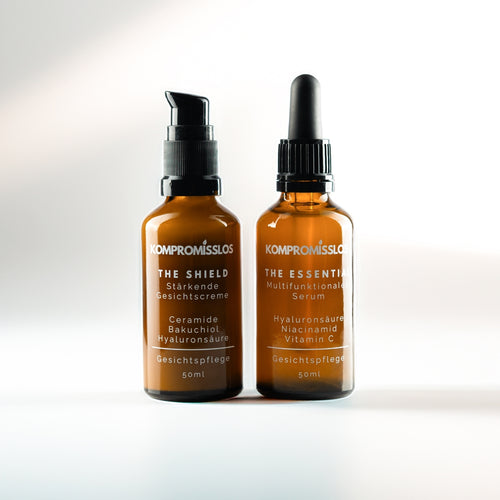
- A serum with humectants. In The Duo of serum and cream, this is The Essential, with hyaluronic acid in three molecular sizes and niacinamide (declared at 5% for The Duo).
- A cream with skin-identical lipids for the barrier. The Shield contains ceramide NP, squalane and jojoba oil.
- In the morning, a separate sunscreen as the final step. How it all fits together is explained in the article on sunscreen for your face when your skincare has no SPF.
To be honest about it: The Duo contains no hormones. The cream does, however, contain bakuchiol, and in a laboratory study in the journal Phytomedicine, bakuchiol showed oestrogen-like activity. What this means when it is applied to the skin has not been studied. If you have a hormone-sensitive condition, ask your doctor before you start using a product with bakuchiol.
Skincare is not a hormone replacement, and I do not claim it is. The Duo contains no hormones, but openly declared concentrations instead: 5% niacinamide, 2% vitamin C as 3-O-Ethyl Ascorbic Acid and 1% zinc PCA, fragrance-free, in two products rather than eight. There is one limit I deliberately point out: because the bakuchiol in the cream acts like oestrogen in laboratory tests and nobody knows what that means on the skin, I write ‘without hormones’ and not ‘without phytoestrogens’. The cream has no sun protection factor, so a separate sunscreen is still necessary. You can see exactly what is in both products in our active ingredients with disclosed concentrations.
Frequently asked questions
How quickly does your skin change after starting hormone therapy?
There is no reliable timeframe. The studies in which skin thickness or collagen changed measurably ran for six to twelve months. The S3 guideline states that short-term HRT has no proven dermatological effects. So do not expect a visible change after a few weeks, and keep caring for your skin as usual regardless.
Can hormone therapy cause spots or oily skin?
Yes, depending on the product, that is possible. Some progestogens have a residual androgenic effect that can stimulate sebum production. If new breakouts appear, raise it with your doctor rather than going at your skin with drying products. Whether an adjustment makes sense is your doctor’s decision. Until then, a mild cleanser and a light moisturiser are enough.
What happens to your skin when you stop HRT?
For the skin, this has hardly been studied. It seems likely that effects tied to oestrogen levels fade after stopping and that the skin moves closer to how it would be without therapy. How quickly and how much cannot be quantified. Discuss stopping itself with your doctor. Simply carry on with your skincare and sun protection without overhauling your routine.
Does it make a difference to your skin whether you use tablets, gel or patches?
For wrinkles, the KEEPS study found no difference from placebo with either tablets or oestradiol delivered through the skin. The practical difference lies at the application site: patches and gels can cause redness or itching there, tablets cannot. Which form suits you depends mainly on medical reasons and is decided by your doctor.
Can I use retinol or bakuchiol while on hormone therapy?
From a skin perspective, hormone therapy is not in itself a reason to avoid retinol, but the usual rules still apply: start low, increase slowly, use sun protection during the day. If your skin is already dry, less is often more. Bakuchiol is considered a gentler alternative, but in the lab it shows oestrogen-like activity whose significance on the skin has not been studied. If you have a history of hormone-sensitive conditions, check with your doctor first.
Do I still need an anti-ageing cream if I am on HRT?
You do not need a special anti-ageing cream, but you do need good basic skincare. Studies show that HRT does not reliably prevent wrinkles and does not completely eliminate dryness. What your skin needs every day is moisture, lipids for the barrier and sun protection. Whether the packaging says anti-ageing matters less than a short, well-tolerated list of active ingredients.
Can I use The Duo during hormone therapy?
Yes, from a cosmetic point of view there is nothing against it: The Duo contains no hormones, and the serum and cream go on after cleansing, morning and evening. Because of the bakuchiol in the cream, if you have a hormone-sensitive condition, check with your gynaecologist first. During the day you also need sunscreen, as The Duo has no SPF.
Sources
- Viscomi B, Muniz M, Sattler S. Managing Menopausal Skin Changes: A Narrative Review of Skin Quality Changes, Their Aesthetic Impact, and the Actual Role of Hormone Replacement Therapy in Improvement. Journal of Cosmetic Dermatology, 2025. Source
- Phillips TJ, Symons J, Menon S; HT Study Group. Does hormone therapy improve age-related skin changes in postmenopausal women? A randomized, double-blind, double-dummy, placebo-controlled multicenter study assessing the effects of norethindrone acetate and ethinyl estradiol in the improvement of mild to moderate age-related skin changes in postmenopausal women. Journal of the American Academy of Dermatology, 2008. Source
- Owen CM, Pal L, Mumford SL, Freeman R, Isaac B, McDonald L, et al. Effects of hormones on skin wrinkles and rigidity vary by race/ethnicity: four-year follow-up from the ancillary skin study of the Kronos Early Estrogen Prevention Study. Fertility and Sterility, 2016. Source
- Lim SH, Ha TY, Ahn J, Kim S. Estrogenic activities of Psoralea corylifolia L. seed extracts and main constituents. Phytomedicine, 2011. Source
- Deutsche Gesellschaft für Gynäkologie und Geburtshilfe (DGGG) et al. Peri- und Postmenopause – Diagnostik und Interventionen. S3-Leitlinie, AWMF-Registernummer 015-062, Version 2.0, 2018. Source