Resveratrol in skincare: what the plant antioxidant can and can’t do for your skin
ACTIVE INGREDIENTS
A resveratrol cream delivers a plant antioxidant whose skincare benefits look promising in laboratory and animal studies but have barely been studied in humans. The cleanest study so far with resveratrol as the only active ingredient found that, after eight weeks, the cream on its own did not improve wrinkle scores significantly more than a placebo – although it did reduce pigmentation more. On top of that, resveratrol is sensitive to light and pH. It can be an addition to your routine, but it is not an essential step, and it never replaces sunscreen.
What is resveratrol and where does it come from in skincare?
Resveratrol is a polyphenol from the stilbene group that plants produce to defend themselves – the grapevine among them. It became famous through red grapes and red wine, but for skincare it is not only extracted from vines; it is also obtained from Japanese knotweed, for example. A study in Acta Biochimica Polonica gives an average content of 1.9 milligrams per litre for red wine, which is a very small amount. Chemically, resveratrol exists in two forms: trans-resveratrol and cis-resveratrol. The trans form is more biologically active and far better researched, which is why it is almost always the one meant in studies and in good raw materials. On an ingredient list, the pure substance simply appears as “Resveratrol”. It is important to tell it apart from grape extracts: names such as Vitis Vinifera Seed Extract or Vitis Vinifera Fruit Extract tell you nothing about how much resveratrol they actually contain. A grape extract can be a worthwhile plant ingredient, but it does not turn a product into a resveratrol cream.
Resveratrol is not a vitamin, by the way, even though the two are often mentioned in the same breath. If you want to know which vitamins in skincare actually work, that article gives you the overview. This one is only about resveratrol as a single active ingredient.
What does resveratrol do for your skin?
On the skin, resveratrol acts first and foremost as an antioxidant: it can neutralise free radicals, such as those formed under UV radiation. This property is well documented in the laboratory. Almost everything else you hear about resveratrol comes from cell cultures and animal models. There, it influences various signalling pathways involved in cell ageing, pigment formation and the way skin cells respond to UV stress. A 2025 review in Clinical, Cosmetic and Investigational Dermatology sums it up like this: the preclinical data from animal models is extensive, while clinical data in humans is only just emerging. The authors name the molecule’s unfavourable physicochemical properties as the main obstacle to putting it into practice.
Less well known is that the study in Acta Biochimica Polonica classes resveratrol as a phytoestrogen – a plant substance that shows oestrogen-like activity in laboratory tests. What this means for cosmetic use on the skin has not been established. If you are pregnant or breastfeeding, or unsure for any other reason, ask a healthcare professional. And if you have a skin condition, it needs to be assessed by a dermatologist, not handled with a cream.
What do studies on resveratrol creams in humans show?
So far, human studies on resveratrol creams have shown small, mixed effects, and the evidence is thin. The most meaningful study was published in 2025 in the journal Frontiers in Aging. Women over 40 applied either a cream containing 1.5% trans-resveratrol or a placebo cream twice a day for eight weeks, and also took capsules containing either resveratrol or a placebo. Of the 134 participants, 122 completed the study. The authors themselves write that, to their knowledge, no previous study had tested trans-resveratrol as the only active ingredient in humans.
- Wrinkles: the cream alone made no significant difference compared with the placebo group. Only the group that combined the cream with the capsules did significantly better.
- Pigmentation: in the groups using the resveratrol cream, measured pigmentation fell more than with the placebo.
- Sebum: the resveratrol cream increased sebum in the U-zone of the face more than the placebo cream did.
- Hydration and elasticity: no differences were found between the groups.
The study was funded by the company that developed the raw material. That does not make it worthless, but it belongs in the picture. There are also smaller studies, such as the Acta Biochimica Polonica study mentioned above, with 20 volunteers over six weeks, which mainly measured skin hydration. That is not enough for a robust conclusion about skin ageing. If you look at what the evidence shows for slowing down skin ageing, you end up with entirely different levers, above all daily sun protection.
Why is resveratrol so hard to keep stable in creams?
Resveratrol is hard to keep stable in creams because it is sensitive to light, pH and heat all at once, and it dissolves poorly in water. Under UV light, the active trans form converts into the less active cis form. A study in Photochemistry and Photobiology showed that this conversion is significantly delayed when resveratrol is encapsulated in nanocarriers such as liposomes or lipid nanoparticles. A study in the European Journal of Pharmaceutics and Biopharmaceutics also found that trans-resveratrol is stable in the acidic range, but that its breakdown increases exponentially above pH 6.8. For a cream, this means that formula, packaging and storage all help decide how much active resveratrol actually reaches your skin. The percentage on the label describes the product at the time of manufacture, not after three months in a bright bathroom.
A few criteria help you tell whether a resveratrol cream has been properly thought through:
- Concentration: the manufacturer states a specific percentage rather than just “with resveratrol”.
- Packaging: an opaque pump or airless bottle rather than an open jar sitting in the light.
- Encapsulation: mentions of liposomes or other carriers that protect the molecule.
- INCI position: if resveratrol only appears after the preservatives, the amount is usually very small.
- Name: “Resveratrol” in the INCI list, not just a grape extract.
Here is how it compares with better-known antioxidants. You will find the details on vitamin C in the article on what vitamin C does for skin, and those on Q10 in the article on what coenzyme Q10 really does in a cream.
| Antioxidant | Soluble in | Stability | Evidence in humans (on the skin) | Typical INCI |
|---|---|---|---|---|
| Resveratrol | Dissolves poorly in water | Sensitive to light, pH and heat | Few studies, mostly small | Resveratrol (Vitis Vinifera Extract is not the same thing) |
| Vitamin C | Water | Pure ascorbic acid oxidises easily, derivatives are more stable | Much more widely studied | Ascorbic Acid, 3-O-Ethyl Ascorbic Acid |
| Vitamin E | Oil | Moderately stable as tocopherol, more stable as acetate | More widely studied, often combined with vitamin C | Tocopherol, Tocopheryl Acetate |
| Coenzyme Q10 | Oil | Sensitive to light | Limited | Ubiquinone |
Which skin types benefit from a resveratrol cream, and which don’t?
A resveratrol cream is most worthwhile for normal to dry skin that is not very reactive, if you want to try an additional antioxidant and keep your expectations realistic. It makes the most sense if your routine does not yet contain any antioxidant at all. It is less interesting if you already use a stable vitamin C and vitamin E. These two cover the antioxidant role and have been better studied in humans. In that case, you do not necessarily need a third antioxidant. For very sensitive skin that already reacts to just a few active ingredients, every extra product is an extra risk. And if your skin tends to be oily, bear in mind that the resveratrol cream in the Frontiers in Aging study increased sebum in the U-zone. Whether that is noticeable in everyday life is something the study does not show.
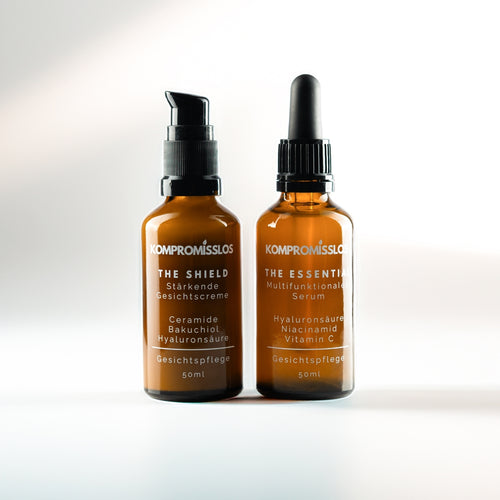
To be honest: The Duo of Essential serum and Shield cream contains no resveratrol and no grape extract. In The Duo, the antioxidant role is taken on by 2% vitamin C as stable 3-O-Ethyl Ascorbic Acid and by vitamin E as tocopherol; the percentage applies to The Duo as a whole. If you already use it, adding resveratrol does not supply a missing building block, just a variation on the same principle.
Light-sensitive active ingredients do not belong on a sunny bathroom windowsill. Close the lid after every use and keep the cream somewhere cool and dark, so that more of what you paid for stays intact.
Should you use resveratrol in the morning or evening, and what can you combine it with?
You can use resveratrol in the morning or in the evening. Its sensitivity to light is a good argument for the evening, but it is not a must: in the Frontiers in Aging study, the cream was applied twice a day. If you use resveratrol in the morning, always put a separate sunscreen for your face on top, because an antioxidant does not replace a UV filter. In principle, resveratrol can be combined with other antioxidants. How the two best-known ones work together is explained in the article on combining vitamin C and vitamin E. Ferulic acid also often turns up in formulas as a partner for antioxidants. EGCG from green tea extract is another plant polyphenol built on a similar idea. But more antioxidants do not automatically mean more protection. Every extra product is another variable, and with sensitive skin it is the total that counts. If you try something new, introduce one thing at a time and give each active ingredient a few weeks before you judge it.
There is no resveratrol in The Duo. For the antioxidant role, I chose vitamin C in the stable 3-O-ethyl form, openly declared at 2%, together with vitamin E. Both have been studied far more thoroughly in humans than a trending ingredient whose cleanest study ran for just eight weeks. On top of that comes 5% niacinamide, again with the percentage stated. Two products instead of eight also means I am not adding a third antioxidant serum just because a name happens to sound good right now. And because even the best antioxidant does not replace a UV filter, our cream deliberately contains no SPF – during the day, you need a separate sunscreen as well. You can read up on which active ingredients are in The Duo and in what concentrations.
Frequently asked questions
Is resveratrol better than vitamin C?
No, not on current evidence. Both are antioxidants, but vitamin C has been studied far more widely on the skin, and there are stable forms of it that are easy to formulate with. Resveratrol has promising laboratory data but only a few small studies in humans. If you have to choose one antioxidant, a stable vitamin C is the better-evidenced choice.
Does resveratrol replace sunscreen?
No. As an antioxidant, resveratrol can neutralise free radicals formed under UV radiation, but it does not filter the radiation itself. In fact, it is light-sensitive and converts into a less active form under UV light. During the day, you should therefore always wear a sunscreen with adequate SPF over your skincare, whatever antioxidants it contains.
Can resveratrol irritate the skin?
It is possible, but it seems to be rare. In the Frontiers in Aging study, skin irritation was only reported in isolated cases – in fact more often with the placebo cream than with the resveratrol cream – and all side effects were mild. Irritation often has more to do with the formula as a whole than with a single active ingredient. Patch-test a new product on a small area first, and do not introduce it at the same time as other new active ingredients.
Does red wine or grapeseed oil have the same effect as resveratrol in a cream?
No. According to a study in Acta Biochimica Polonica, red wine contains on average only 1.9 milligrams of resveratrol per litre, and drinking it is not a sensible route to better skin. In skincare, grapeseed oil is mainly used as a nourishing oil, and no resveratrol content is declared for it. If you want resveratrol on your skin, you need a product that lists it as a pure substance in the INCI.
Do resveratrol capsules do anything for your skin?
There is very little data on this so far. In the Frontiers in Aging study, wrinkle scores were only significantly better in the group that combined the capsules with the cream, but the study was funded by the raw material manufacturer. That is not enough for a recommendation. Supplements are a topic of their own; if you take medication, are pregnant or are unsure, talk to a healthcare professional first.
Can I use resveratrol with retinol?
In principle, yes – based on current knowledge, there is nothing against the combination. Retinol, however, is the ingredient with the higher potential for irritation, and starting two new products at once makes it hard to tell which one your skin does not tolerate. Introduce one first, wait a few weeks and then add the other, ideally using both in the evening.
Do I need resveratrol if I use The Duo?
No, you don’t. In The Duo, 2% vitamin C as stable 3-O-Ethyl Ascorbic Acid and vitamin E take on the antioxidant role – two ingredients with a broader body of evidence in humans than resveratrol. If you still want to try a resveratrol cream, it is an extra step on top and does not replace either of the two products in The Duo of serum and cream.
Sources
- Rao A, Briskey D, Roche G, Tremblay A, Da Silva Pinto M, Tompkins TA. Trans-resveratrol reduces visible signs of skin ageing in healthy adult females over 40: an 8-week randomized placebo-controlled trial. Frontiers in Aging, 2025. Source
- Igielska-Kalwat J, Firlej M, Lewandowska A, Biedziak B. In vivo studies of resveratrol contained in cosmetic emulsions. Acta Biochimica Polonica, 2019. Source
- Cui Q, Wang H. Resveratrol in Dermatological Therapy: A Critical Review of Mechanisms, Delivery Innovations, and Clinical Frontiers. Clinical, Cosmetic and Investigational Dermatology, 2025. Source
- Detoni CB, Souto GD, da Silva AL, Pohlmann AR, Guterres SS. Photostability and skin penetration of different E-resveratrol-loaded supramolecular structures. Photochemistry and Photobiology, 2012. Source
- Zupančič Š, Lavrič Z, Kristl J. Stability and solubility of trans-resveratrol are strongly influenced by pH and temperature. European Journal of Pharmaceutics and Biopharmaceutics, 2015. Source