Does drinking collagen work for skin? What the studies on powders and drinks show
ACTIVE INGREDIENTS
According to some studies, drinking collagen can make your skin slightly more hydrated and elastic, but the evidence is far from solid. Two large meta-analyses reach opposite conclusions: one review of 26 studies found positive effects on hydration and elasticity, while a more recent review of 23 studies found no effect in the trials that were independently funded and methodologically sound. A collagen drink is therefore an experiment with an uncertain outcome. What protects your own collagen is far better established – above all, daily sun protection.
Does drinking collagen do anything for your skin?
Whether drinking collagen does anything for your skin is, as things stand, an open question: many studies measure an effect, but that very effect disappears as soon as you look only at the independent and methodologically strongest trials. The whole question hinges on this. Most studies on collagen powders and collagen drinks are small, last between two and twelve weeks and measure skin hydration or elasticity with instruments that pick up even tiny changes. A measurable change, however, is not the same as a change you can see in the mirror. On top of that, some of the studies were funded by pharmaceutical companies. That does not automatically make them wrong, but it is a well-known reason why results in a research field come out looking better than they really are. The honest answer is therefore this: a small effect on hydration and elasticity is possible, a visible effect on wrinkles is not established, and nobody can predict whether anything will change for you at all.
Personal experience reports are of little help here either. Whether your skin looks plumper after six weeks of a collagen drink is almost impossible to separate in everyday life from the season, your sleep, a new cream or simply your own expectations. That is exactly what placebo-controlled trials are for, and their results are put into context below.
What happens to collagen in your body after you drink it?
Collagen that you drink is broken down in the digestive tract into amino acids and small peptides, like any other protein, and does not reach your skin as ready-made collagen. Collagen is a large structural protein. For powders and drinks, it is split into fragments beforehand so that it dissolves in water and can be drunk. The packaging then says hydrolysed collagen or collagen peptides. Some of these fragments, however, survive digestion without being broken down completely. A study in the Journal of Agricultural and Food Chemistry found small collagen peptides in the blood after people had taken gelatin hydrolysates, mainly prolyl-hydroxyproline. Blood levels peaked after one to two hours and had fallen to roughly half after four hours. The hypothesis behind this is that such peptides act as a signal to the connective tissue cells in the skin. That they reach the blood has been shown. Whether they make the skin on your face, of all places, produce more collagen cannot be read from blood levels.
This makes drinkable collagen fundamentally different from collagen in skincare products. There, the problem arises much earlier, at the outermost layer of the skin. The details are in our guide on why collagen from a cream cannot get into your skin.
What do the meta-analyses on collagen and skin show, and why do they contradict each other?
The meta-analyses contradict each other because they break down similar, mostly small studies in different ways: pool them all and you find an effect, separate them by funder and quality and the better studies show none. A review in Nutrients from 2023 combined 26 randomised controlled trials with 1,721 participants and found significantly better skin hydration and elasticity compared with placebo. The authors themselves point to several risks of bias in the included studies and call for larger trials. Back in 2021, a meta-analysis in the International Journal of Dermatology covering 19 studies and 1,125 participants had already reached a positive result. In 2025, a review in the American Journal of Medicine then asked the question that had been missing until then: what is left once you separate the studies by funding and quality? Across all 23 studies with 1,474 participants, an effect on hydration, elasticity and wrinkles showed up once again. In the studies without funding from pharmaceutical companies, however, there was none, and the high-quality studies found no significant effect in any category either. The authors conclude that there is currently no clinical evidence for collagen supplements against skin ageing.
| Review | Studies and participants | Result | Key limitation |
|---|---|---|---|
| International Journal of Dermatology, 2021 | 19 studies, 1,125 people | Positive for hydration, elasticity and wrinkles | Not broken down by funder and quality |
| Nutrients, 2023 | 26 studies, 1,721 people | Positive for hydration and elasticity | The authors themselves cite several risks of bias |
| American Journal of Medicine, 2025 | 23 studies, 1,474 people | Positive overall, no effect in independent and high-quality studies | Also based on many small individual studies |
What this means for you: the positive overall effect relies heavily on studies funded by pharmaceutical companies and on studies with methodological weaknesses. That does not prove that collagen does nothing. It does mean, though, that advertising built on “clinical studies” promises more certainty than the data can deliver.
What can powders, drinks and collagen shots realistically do for hydration, elasticity and wrinkles?
Realistically, powders, drinks and collagen shots can slightly improve skin hydration and elasticity in measurements, the evidence on wrinkles is weakest, and if anything changes at all, it only does so after several weeks. In the Nutrients review, the effect on hydration and elasticity was more favourable when collagen was taken for more than eight weeks than for shorter periods. The included studies lasted two to twelve weeks; there are no long-term data covering years. The format hardly plays a role in the research: the reviews distinguish by collagen source, duration, funding and quality, not by powder, ready-to-drink bottle or shot. In 14 of the 26 studies in the Nutrients analysis, the collagen came from fish, and for elasticity the authors found no significant difference between sources. A collagen shot is therefore first and foremost different packaging for the same idea, sometimes with added flavourings, sweeteners and vitamins that make the label longer but do nothing to improve the evidence.
Things get even less certain when it comes to firmness. When your face looks softer and less defined, deeper layers of skin, fat pads and bone all play a part, and studies on drinkable collagen provide no reliable answers here. What you can realistically expect is covered in our guide to sagging skin on the face.
If you want to try collagen, photograph your face beforehand in the same light and at the same time of day, and do not change your skincare routine during the weeks that follow. Otherwise you will not know afterwards what made the difference.
What should you look for if you still want to try collagen?
If you still want to try collagen, look for clear labelling, the origin of the collagen and a fair trial period, not before-and-after pictures. The evidence gives no product an edge, so transparency, tolerability and price are what decide. These points help when comparing products:
- Labelling: hydrolysed collagen or collagen peptides with the amount per serving stated, rather than a “beauty complex” with no figures.
- Origin: fish, beef, pork or chicken. This matters if you have allergies or follow a vegetarian or vegan diet.
- Additives: check for sugar, sweeteners and long lists of vitamins. More ingredients do not mean a greater effect.
- Promises: claims such as “wrinkles disappear” or “builds collagen” are not supported by the evidence.
- Trial period: eight to twelve weeks, with photos taken under the same conditions. If you see nothing after that, that is a result too.
Collagen is a food supplement, not a treatment. If you have a kidney, liver or metabolic condition, are pregnant or breastfeeding, take medication regularly or are allergic to fish or egg, check with your doctor or pharmacist before taking it. You will deliberately not find a recommended amount here – that belongs in such a consultation, not in a skincare guide.
What has been shown to protect your own collagen better than a drink?
What protects your own collagen most is daily sun protection, plus not smoking; both are far better supported by evidence than any drink. UV radiation is one of the strongest external drivers of collagen breakdown, and no powder helps against it. Which habits really count is explained in our guide on how to slow down skin ageing, according to the evidence. How to put this into practice in the morning is shown in our guide to daily sunscreen for your face.
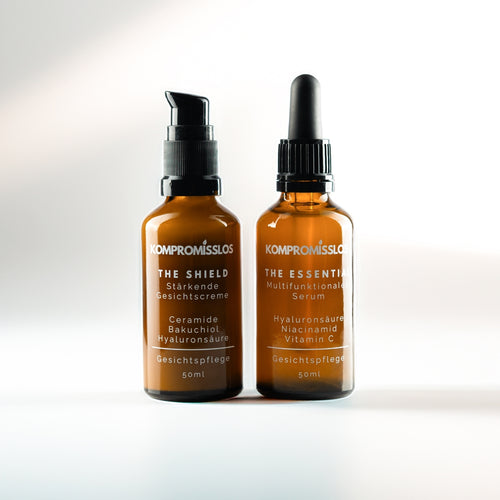
Skincare applied from the outside has a different, more modest job: it keeps the skin’s surface hydrated and supports the skin barrier so that your skin looks smoother and feels more supple. Building collagen is not part of that job, not even for creams with collagen on the label. This is exactly where The Duo with The Essential and The Shield comes in. The serum provides hyaluronic acid in three molecular sizes and niacinamide, and the cream on top provides ceramide NP, squalane and jojoba oil. It deliberately contains no collagen, and because the cream has no sun protection factor, a separate sunscreen is part of your morning routine. Whether you also take a collagen drink is a separate decision that has nothing to do with your skincare.
I deliberately decided against putting collagen in The Duo, and Kompromisslos does not sell food supplements either. When it comes to drinkable collagen, the evidence is too contradictory for me to sell you a beauty-from-within promise in good conscience. Instead, there are two vegan products for the skin’s surface with disclosed concentrations: 5% niacinamide, 2% vitamin C as stable 3-O-Ethyl Ascorbic Acid and 1% zinc PCA, calculated for The Duo as a whole. I am just as open about what the products cannot do: the cream has no sun protection factor. That means you need the most important protection for your collagen in addition: a separate sunscreen in the morning. You can find out which active ingredients are in the Duo and what each one is for on our page on active ingredients with disclosed concentrations.
Frequently asked questions
How long do I have to drink collagen before I see results?
If anything shows, it will take several weeks at the earliest. The studies in the meta-analyses lasted two to twelve weeks, and in the review in Nutrients, taking collagen for more than eight weeks did better than taking it for a shorter period. If you see no difference after about three months without changing your skincare, there is little reason to simply keep drinking it.
Is there such a thing as vegan collagen?
Conventional collagen comes from animals, because plants do not produce collagen. Products sold as “vegan collagen” often contain amino acids, vitamin C and plant extracts that are meant to support the body’s own production but are not collagen themselves. Biotechnologically produced versions are the exception. For skincare products, our guide on how to tell whether a face cream is really vegan can help.
Is collagen powder better than collagen capsules or collagen shots?
For your skin, no format is better supported by evidence than another; the studies distinguish by source and duration, not by format. Each capsule holds only a little powder, so you often need several of them for the same amount. Collagen shots and ready-to-drink bottles sometimes come with sweeteners and flavourings, so it is worth checking the ingredient list.
Does collagen need extra vitamin C?
Your body needs vitamin C to produce collagen, but that does not mean you have to take it separately alongside your drink. A varied diet with fruit and vegetables usually covers your needs. What vitamin C does when applied to the skin is a separate topic – find out more in our guide on what vitamin C does for your skin.
Can drinking collagen be harmful?
Collagen peptides are protein fragments from animal tissue and are digested like any other dietary protein. Caution is needed if you are allergic to fish or egg, depending on where the product comes from, if you have a kidney, liver or metabolic condition, during pregnancy and breastfeeding, and if you take medication regularly. In these cases, check with your doctor or pharmacist before taking it.
Is drinking collagen worth it during menopause?
For menopause, the evidence is just as inconclusive as it is for everyone else. The meta-analysis in the International Journal of Dermatology included participants aged between 20 and 70, 95 per cent of them women, and no special effect at this stage of life can be inferred from it. Why your skin now loses firmness more quickly and what matters at this point is explained in our guide to sudden wrinkles in menopause.
Do I need to drink collagen if I use The Duo?
No, and The Duo does not need a drink to do its job either. The serum and cream work on the skin’s surface: hydration, the skin barrier and a calmer, more supple-looking complexion. Whether you also drink collagen is something you decide independently of that. The Duo with serum and cream does not replace a drink, and a drink replaces neither skincare nor sun protection.
Sources
- Myung SK, Park Y. Effects of Collagen Supplements on Skin Aging: A Systematic Review and Meta-Analysis of Randomized Controlled Trials. American Journal of Medicine, 2025. Source
- Pu SY, Huang YL, Pu CM, Kang YN, Hoang KD, Chen KH, et al. Effects of Oral Collagen for Skin Anti-Aging: A Systematic Review and Meta-Analysis. Nutrients, 2023. Source
- de Miranda RB, Weimer P, Rossi RC. Effects of hydrolyzed collagen supplementation on skin aging: a systematic review and meta-analysis. International Journal of Dermatology, 2021. Source
- Iwai K, Hasegawa T, Taguchi Y, Morimatsu F, Sato K, Nakamura Y, et al. Identification of food-derived collagen peptides in human blood after oral ingestion of gelatin hydrolysates. Journal of Agricultural and Food Chemistry, 2005. Source