Vegan face cream: how to tell it really contains nothing animal-derived
VEGAN NATURAL SKINCARE
A vegan face cream contains not a single ingredient of animal origin – no lanolin from sheep’s wool, no beeswax, honey, carmine or animal collagen. You can tell from the list of ingredients on the packaging, not from the word “natural”. Vegan does not, however, tell you anything about animal testing, organic farming or how well your skin will tolerate it.
What makes a face cream vegan?
For a face cream, vegan means that no ingredient comes from an animal – not even a by-product or a substance an animal has produced. That makes vegan stricter than vegetarian: a vegetarian formula may contain beeswax or honey, a vegan one may not. It is important to distinguish it from two terms that often come up in the same breath. “Natural” only says that a substance comes from nature, and animals are part of nature. Lanolin from sheep’s wool is an entirely natural raw material and still animal-derived. “No animal testing”, on the other hand, describes how a product was tested, not what it is made of. A cream can be formulated entirely from plants and still have been tested on animals, and vice versa. If you want both, you have to check both separately. A look at the full ingredient list of a product reliably answers the first question, but not the second.
Which animal-derived ingredients are typically found in face creams?
The animal-derived raw materials used in cosmetics are a fairly small group, and most of them turn up in face creams again and again. The most common is lanolin, the wool grease of sheep, because it holds moisture like few other raw materials. Then there are the bee products: beeswax for texture, honey as a humectant, propolis and royal jelly as active ingredients. Carmine, a red dye made from dried scale insects, is more likely to be found in tinted creams and make-up. Collagen, elastin and keratin traditionally come from slaughter by-products, although plant-based and biotech versions now exist. For decades, squalene from shark liver was the standard source of a lipid very similar to the skin’s own, until olives and sugar cane took over that role. Less common, but possible, are milk proteins, silk proteins, shellac and gelatine. For almost all of these substances there is now a plant-based or biotech equivalent that performs just as well technically.
| Animal-derived ingredient | Where it comes from | Plant-based equivalent |
|---|---|---|
| Lanolin, wool wax | Grease from sheep’s wool | Shea butter, jojoba oil, squalane |
| Cera Alba, beeswax | Wax from the beehive | Candelilla wax, carnauba wax |
| Mel, Propolis, Royal Jelly | Products of the honeybee | Aloe vera, panthenol, glycerin |
| Carmine, CI 75470 | Dye from scale insects | Mineral pigments |
| Collagen, elastin, keratin | By-products of slaughter | Peptides, plant proteins |
| Squalene from shark liver | Liver oil of deep-sea sharks | Squalane from olives or sugar cane |
How do you read the ingredient list on a face cream?
The list under the word “Ingredients” is the only reliable place where a cream discloses its composition. It follows the international INCI nomenclature, and according to the Cantonal Laboratory of Bern’s fact sheet on labelling cosmetics, the ingredients must be listed in descending order of quantity. Ingredients making up less than one per cent by mass of the finished product may be listed in any order at the end. In practice, that means whatever comes first makes up most of the formula; towards the end, the order becomes blurred. To answer the vegan question, work through the list from top to bottom and look for the names in the table above. If you find none of them, the cream is very likely formulated from plants. Even so, this check does not give you complete certainty, and there is a reason for that which hardly any brand mentions of its own accord.
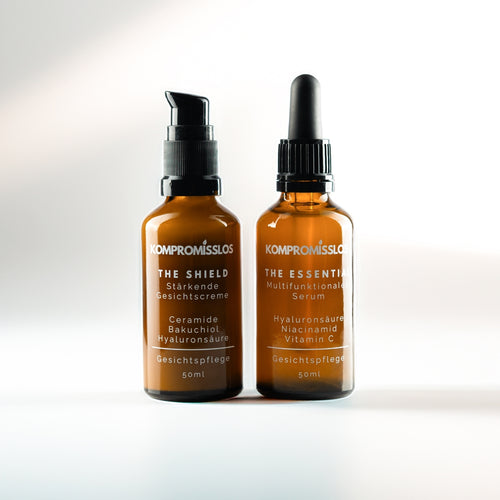
Some INCI names do not reveal their origin. Glycerin, stearic acid, lactic acid, hyaluronic acid, ceramides and squalane can be obtained from plants, through biotechnology or from animals, and the name stays the same in every case. The ceramides and squalane in our two-step skincare are not of animal origin either, but you cannot tell that from the INCI list. For these substances, the only help is a statement from the brand or asking directly. A brand that cannot give you a clear answer has probably never asked the question itself.
Is a vegan face cream automatically free from animal testing?
No – these are two separate questions, and marketing likes to blur them. Vegan describes the formula; “no animal testing” describes how a product and its raw materials were tested. In Switzerland and the EU, finished cosmetic products may no longer be tested on animals – that is the good news. The catch lies with the raw materials: many substances found in creams are also used in cleaning products, paints or medicines and are tested under those other legal frameworks. A label such as the V-Label or the Vegan Society’s sunflower logo confirms that the ingredients are of plant origin; a rabbit logo refers to testing practice. Both are useful, both are voluntary, and neither tells you whether a cream is good for your skin. In the end, that third question is the one you want answered – and no logo on the packaging will answer it for you.
What should a vegan face cream do for mature or sensitive skin?
Being formulated from plants is a question of origin, not of effectiveness. Whether a cream is right for your skin depends on three things: the lipids that support the skin barrier, the humectants that bind water in the outer layer of the skin, and the active ingredients that address your particular concern. For mature skin, that usually means dehydration lines, an uneven complexion and a loss of firmness. Ceramides, squalane and jojoba oil cover the lipid side; hyaluronic acid and glycerin cover the moisture side. On the active side, niacinamide, vitamin C and bakuchiol do the work, and all three are available in purely plant-based or synthetic form. Taken together, our Duo of serum and cream contains 5% niacinamide, 2% hyaluronic acid and 0.3% bakuchiol. These figures always apply to both products together, never to one on its own. What other customers report varies considerably, depending on where they started.
If you are weighing up individual active ingredients, the comparison of vitamin C and niacinamide will help. If your complexion is unsettled, it is worth looking at the causes of blemish-prone skin, because the origin of the raw materials is rarely the problem there. And if you want to know what a Swiss plant extract actually contributes, you will find it under the effects of gentian root extract.
When a vegan cream is not the right answer
A cream is a cosmetic, not a medicine, and Swiss law draws that line clearly. If your skin is weeping, bleeding, very itchy or changing in clearly defined patches, you should see a dermatologist rather than have a conversation about where raw materials come from. The same applies if you already have a diagnosis and are following a prescribed treatment: in that case, it is better to discuss anything else you apply with whoever is treating you. And there is a second situation in which a new cream does little good. Layering six products on top of each other often irritates the skin more than a single additional product could make up for. Then leaving things out is the more effective step – regardless of whether the products you drop were vegan or not. We have described what a pared-back routine looks like on the how-to-use page.
From the very beginning, I decided that no raw material of animal origin would go into the Kompromisslos formula. Not because vegan sells well, but because for every animal-derived raw material I would have had to check a supply chain that, as a small Swiss brand, I have no control over. With plant-based and biotech raw materials, I can say where they come from. Limiting myself to two products has the same reason: I can take responsibility for two formulas down to the last line, but not for twelve. If you want to know where a particular ingredient comes from, ask me. I would rather answer honestly than quickly.
Frequently asked questions
What does vegan mean for a face cream?
Vegan means that no ingredient in the formula comes from an animal – not even a by-product such as beeswax or honey. The term refers solely to the composition. It says nothing about animal testing, organic farming or skin tolerability; those are three separate questions.
Is vegan face cream automatically free from animal testing?
No. Vegan describes the formula; “no animal testing” describes how it was tested. Finished cosmetic products may not be tested on animals in Switzerland and the EU, but different rules apply to individual raw materials depending on what they are used for. If both matter to you, check both points separately.
How do I spot animal-derived ingredients in the ingredient list?
Look specifically for lanolin, Cera Alba, Mel, Propolis, Royal Jelly, carmine or CI 75470, collagen, elastin and keratin. The ingredients are listed in descending order of quantity; substances below one per cent by mass may appear at the end in any order. If you find none of these names, the formula is very likely plant-based.
Is hyaluronic acid vegan?
Today, as a rule, yes. Hyaluronic acid used to be obtained from rooster combs, but is now almost always produced biotechnologically by fermentation. The INCI name Sodium Hyaluronate does not reveal its origin, so asking the manufacturer remains the safe route if the point really matters to you.
Is squalane animal-derived or plant-based?
It can be either, which is why the name alone tells you nothing. For a long time, squalane came from the liver oil of deep-sea sharks, but today it is mostly obtained from olives or sugar cane. Brands that use plant-based squalane usually say so, because the raw material is more expensive.
Is a vegan face cream better for sensitive skin?
Not automatically. Tolerability depends on the specific formula, on fragrances, essential oils and the concentration of active ingredients, not on where the raw materials come from. Plant extracts and essential oils can irritate just as much as animal-derived raw materials. What matters is a mild formulation and introducing new products gradually.
Does a vegan face cream need a label?
A label such as the V-Label or the Vegan Society’s sunflower logo makes things easier, but it is not a must. It independently confirms what you would otherwise have to check in the ingredient list yourself. If there is no label, the cream is not automatically non-vegan – you just need to look more closely or ask.
Sources
- Cantonal Laboratory of Bern, Merkblatt Kennzeichnung von Kosmetika (fact sheet on labelling cosmetics), Version 2, 2021. Source