Ozempic face: what rapid weight loss does to your skin and what skincare can do
SKIN OVER 40
Ozempic face is not a medical condition in its own right, but the visible result of rapid, substantial weight loss: fat in the face shrinks, the cheeks and temples look hollow, the skin sits more loosely and wrinkles become more noticeable. This can happen with weight-loss injections just as it can without them. Skincare cannot bring back the lost volume. What it can do is keep your skin well cared for during this phase, so that it does not look dry, dull and irritated on top of everything else.
What is Ozempic face, and is it caused by the medication or by the weight loss?
Ozempic face is a colloquial term for a face that looks hollower, more tired and older after rapid weight loss, and according to current knowledge it is mainly down to the weight loss itself. The name dates from the time when weight-loss injections containing semaglutide or tirzepatide became widely known and many people lost a lot of weight in a short time. In 2024, a systematic review in Aesthetic Surgery Journal Open Forum brought together the studies on facial changes after major weight loss, both after bariatric surgery and after treatment with medication. The finding: massive weight loss accelerates facial ageing, visible as a loss of volume in the fat tissue and increasing skin laxity. The midface at cheek level was the most affected area.
How large the effect can be is shown by a very small analysis cited in the review: in five people taking Ozempic, the superficial fat pad at the temples shrank by an average of 41.8 per cent and the cheek fat pad by 69.9 per cent. Five people are not enough to establish averages, but they do show where the volume is lost. Whether the medications also have an effect of their own on the face has not been conclusively established. The authors themselves point out that only a single study measured facial volume objectively. What is clear, though, is that the studies they analysed describe the same changes after bariatric surgery, in other words with no weight-loss medication at all.
Why does rapid weight loss change the face more than losing weight slowly?
Rapid weight loss is more noticeable in the face mainly because it is usually also substantial and shows up over months rather than years, although research has yet to compare it directly with slow weight loss. The review in Aesthetic Surgery Journal Open Forum states explicitly that there are no comparative studies on facial changes with gradual weight loss. To be honest, then, speed is a plausible explanation, but not a well-established one. Three points still suggest that it plays a role:
- Extent: people who lose weight quickly often lose a lot of weight overall. The more fat the body breaks down, the more the face loses too.
- Composition: in a randomised trial in the journal Obesity, two groups lost a similar amount of weight, one quickly on 500 kilocalories a day and one more slowly on 1,250. The percentage of fat-free mass lost, meaning everything other than fat, was higher in the fast group: 8.8 versus 1.3 per cent.
- Perception: a change over just a few months stands out more to you and the people around you, because the picture of how you looked before is still fresh.
For your face, this means that not only how much but also how quickly you lose weight helps determine how pronounced the change looks. What pace makes sense for you is a conversation to have with your doctor.
Why is it more visible in women over 40 than in younger women?
From 40, weight loss affects a face that has already begun to lose support, which is why the difference is more visible than at 25. When you are young, a slimmer face often looks more defined, and the skin is thicker and retracts more easily. Over the years, fat pads and bone change anyway, and the fat that disappears with weight loss had previously masked part of that change. A twin study in Plastic and Reconstructive Surgery involving 186 pairs of identical twins illustrates this very clearly: a body mass index four points higher made twins under 40 look older than their sibling, but after 40 it made them look younger. A little extra weight, which tends to make the face look heavier before 40, gives it some fullness afterwards.
That is not an argument against losing weight. Health reasons matter more than a few millimetres of cheek fat, and nobody has to justify using weight-loss injections. But it does explain why two people who lose the same amount of weight can look very different in the face. Age, face shape, sun damage from past decades and how often your weight has already fluctuated all play a part. On top of that, the skin itself loses substance over the years. A separate article explains why skin thins with age.
What happens to the skin itself, and what happens to the volume underneath?
The volume underneath changes far more than the skin itself: the fat shrinks, while the surface area of the skin initially stays the same, so it sits more loosely. Think of it like a cover whose contents are shrinking. Whether the skin tightens up again depends on its framework of collagen and elastic fibres, and from 40 onwards that framework is less resilient. After very substantial weight loss, it may have suffered as well. A small study in Plastic and Reconstructive Surgery analysed skin samples from ten people after bariatric surgery. The samples came from the body, not the face. They showed a poorly organised collagen framework, degraded elastic fibres and areas of scarring in skin that looked normal from the outside. This can only be applied to the face with caution, but it does show that skin does not simply spring back to its old firmness after major weight loss.
How skin also loosens over the years without any weight loss is covered in the article on what skincare can and can’t do when firmness fades. What matters here is the difference between the layers, because skincare only reaches the top one:
| Layer | What happens with rapid weight loss | What skincare can achieve |
|---|---|---|
| Skin surface | Dryness and dullness stand out more because shadows become deeper | Visibly support hydration and the barrier, skin looks smoother and more supple |
| Dermis | Collagen and elastic fibres have to adapt to less volume, the skin sits more loosely | Hardly anything, sunscreen prevents additional breakdown from UV |
| Fat pads | Volume shrinks, especially in the cheeks, the temples and around the eyes | Nothing, no cream reaches this layer |
| Muscle and bone | With very rapid weight loss, more fat-free mass may be lost; whether this measurably affects the facial muscles has not been studied | Nothing |
The effect shows on the neck too: besides the cheek area, the review mainly describes sagging skin in the centre of the neck. You can read more about this in the article on neck wrinkles and sagging neck skin.
What can skincare realistically do during and after weight loss?
During and after weight loss, skincare can mainly do one thing: keep your skin well cared for, so that it does not look dry, dull and irritated as well, making your face look even more tired. No cream brings back the lost volume, not even an expensive one, and a new firming cream will not change that. What helps is unglamorous:
- Hydration: well-hydrated skin looks smoother and plumper, and fine dryness lines are less noticeable. If your skin feels tight despite moisturiser, it is worth reading about dehydrated skin and how to recognise it.
- Barrier: lipids such as ceramides and squalane support the skin’s protective layer. That matters during a phase in which eating habits, sleep and stress levels often change.
- Sun protection: UV light breaks down collagen, which your skin needs more urgently than usual right now. Daily sunscreen for your face does more here than any anti-ageing product.
- Calm: no switching to five new active ingredients at once, no daily exfoliation. Irritated skin looks older.
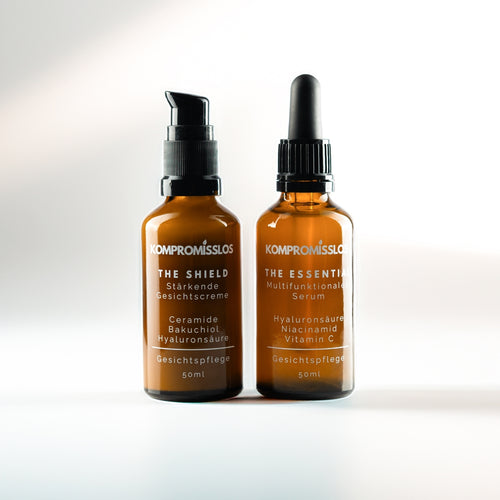
Collagen creams are especially tempting in this situation. Before you spend money on one, read up on whether collagen from a cream can actually get into your skin. A simple routine is enough: The Duo consists of The Essential, a light serum with hyaluronic acid in three molecular sizes and niacinamide, topped with The Shield, which contains ceramide NP, squalane and jojoba oil for the skin barrier. During the day, add a separate sunscreen, because neither product contains SPF.
When is it no longer a skincare issue, and who should you talk to?
It stops being a skincare issue as soon as the question is about the medication, unintended weight loss or the wish to restore lost volume, and each of these has its own right person to talk to. Questions about the dose, pace or stopping of weight-loss injections are for the doctor who prescribed them. If you are losing weight without trying to, or your face becomes hollow within a few weeks for no reason you can explain, have it checked by your GP. A dietitian can help you plan in concrete terms how to get enough protein and maintain your muscle while losing weight.
If the hollowness in your face after weight loss is really getting to you, an aesthetic medicine consultation is the right place to go. There, a specialist can assess whether fillers, energy-based procedures or surgery are suitable for you at all, and with what risks and costs. The review in Aesthetic Surgery Journal Open Forum notes that surgery only makes sense once your weight is stable. Even without any procedure, that is a good reason to wait a few months after major weight loss before deciding what really bothers you.
One photo a month in the same light tells you more than your daily glance in the bathroom mirror. Many changes look more dramatic in the first few weeks than they do after a period of stable weight.
I do not promise firmer skin with The Duo, and on this topic that is especially important. Volume lost in the fat and deeper layers is beyond the reach of any cream, mine included. What I can do is offer a routine that does not put extra strain on skin during a phase of so much change: two products instead of a new arsenal of anti-ageing products, with disclosed concentrations of 5% niacinamide, 2% vitamin C in the stable 3-O-ethyl form and 1% zinc PCA. For the cream, I chose bakuchiol rather than retinol, because skin that is already going through a lot does not need another adjustment period. The cream deliberately has no SPF, which is why a separate sunscreen belongs in your routine during the day. You can find out exactly what is in the Duo and why on the page about our active ingredients with disclosed concentrations.
Frequently asked questions
Does Ozempic face go away?
Partly. If you regain some weight after losing it, some volume may return to your face too. But if your skin has lost elasticity, it often does not fully tighten up again, especially from 40 onwards. How much still changes after a few months at a stable weight varies from person to person. So far, there is hardly any reliable long-term data on this.
Can I prevent Ozempic face?
With major weight loss, it cannot be avoided entirely, but it can probably be softened. A pace your doctor considers sensible, enough protein as agreed with them, daily sunscreen and skincare that does not irritate your skin are the realistic levers. However, there are not yet any robust studies that have looked at this kind of prevention in the face specifically.
Does everyone who loses weight with weight-loss injections get Ozempic face?
No. What matters most is how much and how quickly you lose weight, your age, your face shape and the condition of your skin. People who lose little weight or are young often see hardly any change in their face. People over 40 who lose a great deal in a short time, on the other hand, notice it more often, regardless of whether medication is involved.
Do weight-loss injections make your skin drier?
Whether your medication affects your skin is a question only the doctor who prescribed it can answer. From a skin perspective, dryness is more noticeable in a slimmer face because lines and shadows become more pronounced. Skincare with humectants and lipids helps your skin look supple. Any unusual or new skin changes should be seen by a doctor.
Does a firming cream help after weight loss?
Not with the underlying cause. A firming cream reaches neither the lost fat nor the deeper layers of the dermis. Many of these products contain ingredients that make the surface look smoother for a short time, an effect that is gone once you wash it off. Your money is better spent on good sunscreen and a simple routine your skin tolerates well.
Does protein matter for your skin when losing weight?
When you lose weight, protein matters mainly for maintaining your muscle, and losing weight quickly costs more fat-free mass than losing it slowly. Whether more protein visibly protects the face has not been studied. How much you need depends on your weight, your health and your treatment, and it is something to work out with your doctor or a dietitian.
What can The Duo do after major weight loss, and what can’t it do?
The Duo can hydrate your skin and support the skin barrier so that it looks more supple and less dull. It cannot replace volume lost in fat and bone, and it does not make sagging skin firm. During the day, you also need sunscreen. If a simple routine matters to you, you will find all the details on The Duo of serum and cream.
Sources
- Jafar AB, Jacob J, Kao WK, Ho T. Soft Tissue Facial Changes Following Massive Weight Loss Secondary to Medical and Surgical Bariatric Interventions: A Systematic Review. Aesthetic Surgery Journal Open Forum, 2024. Source
- Vink RG, Roumans NJ, Arkenbosch LA, Mariman EC, van Baak MA. The effect of rate of weight loss on long-term weight regain in adults with overweight and obesity. Obesity, 2016. Source
- Guyuron B, Rowe DJ, Weinfeld AB, Eshraghi Y, Fathi A, Iamphongsai S. Factors contributing to the facial aging of identical twins. Plastic and Reconstructive Surgery, 2009. Source
- Light D, Arvanitis GM, Abramson D, Glasberg SB. Effect of weight loss after bariatric surgery on skin and the extracellular matrix. Plastic and Reconstructive Surgery, 2010. Source