Sleep wrinkles on the face and chest: why they linger in the morning and what really helps
SKIN OVER 40
Sleep wrinkles on the face form when your pillow compresses the skin and pushes it sideways for hours at night. When skin is elastic, these creases smooth out soon after you get up. Over the years, elasticity declines, the lines stay visible for longer in the morning and can gradually set in the same places. Changing your sleeping position makes the biggest difference. Silk pillowcases and pads play only a minor role, and good evening skincare keeps the skin supple but does not prevent the pressure.
Why do sleep wrinkles on the face stay visible for longer in the morning?
Sleep wrinkles on the face stay visible for longer in the morning because ageing skin takes more time to return to its original shape after being deformed. When you lie down, the side of the face pressed into the pillow is exposed to compression and shear forces: the skin is pushed together, folded and held in that position for hours. A review in the Aesthetic Surgery Journal describes these compression, shear and tensile forces in side and stomach sleeping as a distinct cause of wrinkles that differ from expression lines in how they form, where they appear and the pattern they follow. How quickly the skin recovers depends mainly on its elasticity. Measurements in 96 women aged 20 to 75, published in Skin Research and Technology, showed that the skin’s elastic properties decline markedly with age and that the face changes more than the upper arm and the back. Moisture plays a part too: a dried-out outer layer of skin is less flexible, which is why creases can look more pronounced after a night in dry, heated air.
Typical areas are the forehead and temple, the cheek between the eye and the ear, the area beside the mouth and the chin – always on the side you usually sleep on. A simple test: compare both halves of your face. Expression lines develop in a similar way on both sides, whereas sleep wrinkles are usually clearly more pronounced on your favourite side.
When do sleep wrinkles become permanent?
Sleep wrinkles become permanent when the skin is folded in the same place every night for years and no longer smooths out completely during the day. There is no fixed point at which this happens; the transition is gradual. At first, the crease is only visible straight after you get up, later it is still there at midday, and at some point a fine line remains even in the evening. A small study in the Journal of Cosmetic and Laser Therapy showed just how much the face distorts when lying down. Using a transparent, air-filled pillow, the researchers observed fine lines at the corners of the eyes, lines around the mouth and nasolabial folds, among other things, in 15 people aged 26 to 42. Plastic surgeons in Ankara also described oblique and horizontal lines on the temple, forehead and cheek in people who had slept with their face in the pillow for many years.
The easiest way to tell whether a line has set is to look in the evening. If it is still there, it has become ingrained. Whether you are dealing with surface dryness or a true wrinkle is explained in more detail in the article on dehydration lines vs wrinkles. How quickly the skin loses elasticity overall depends heavily on sun exposure; what you can influence is covered in how to slow down skin ageing.
Why do side sleepers get wrinkles on their chest?
Side sleepers get wrinkles on their chest because the upper breast sinks towards the mattress when they lie on their side, pushing together the skin over the breastbone. This usually creates vertical lines between the breasts that are clearly visible in the morning and smooth out again over the course of the day, as long as the skin is elastic enough. With larger, heavier breasts, the pull is usually stronger. On top of that, the skin on the chest is often exposed by low necklines and in summer, and over the decades it has frequently caught a lot of unprotected sun. UV-damaged skin loses elasticity, and that is exactly when the overnight creases linger for longer. Side sleeping is the rule, not the exception: in a Danish study using motion sensors, published in Nature and Science of Sleep, 664 working adults spent 54.1 per cent of their time in bed on their side, 37.5 per cent on their back and 7.3 per cent on their stomach. The proportion of time spent on the side increased with age.
How to care for your neck and chest in general is a separate topic, which we look at in detail under neck and décolleté care. For sleep wrinkles, two things matter most: less folding at night and consistent sun protection on your chest during the day.
Do silk pillowcases and chest pads really help?
Silk pillowcases and chest pads help only to a limited extent, and there are no robust studies on either of them in relation to wrinkle formation. A smooth silk or satin pillowcase lets the skin glide more easily when you move. That can somewhat reduce the sideways pulling, in other words the shear forces. It does not change the pressure itself: if you lie on your side, your face is still pressed into the pillow, silk or not. Silicone chest pads are stuck between the breasts or worn as a vest and are meant to stop the skin from being pushed together. The principle makes mechanical sense, but there are no robust studies on their effect on permanent lines so far. The researchers behind the pillow study mentioned above also designed their own pillow, intended to redistribute pressure away from the wrinkle-prone areas of the face. Whether it leads to fewer wrinkles over months was not measured. So before you spend money, it is worth looking at what each measure actually changes.
| Measure | What it changes | What it cannot do |
|---|---|---|
| Sleeping on your back | No pressure on face or chest | Can only be maintained for part of the night |
| Silk or satin pillowcase | Less friction and sideways pulling | Does not remove the pressure |
| Silicone chest pad | Stops the skin on the chest from being pushed together | No studies on permanent lines |
| Body pillow in front of the upper body | Supports the upper breast when lying on your side | Does nothing for the face in the pillow |
| Evening skincare with moisture and lipids | Skin stays more supple overnight | Does not prevent the pressure |
| Sun protection during the day | Slows the loss of elasticity caused by UV | Works over years, not overnight |
How can you change your sleeping position?
The best way to change your sleeping position is gradually, with pillows that keep you on your back and with realistic expectations. You cannot control it entirely: the participants in the Danish study changed position 1.6 times per hour on average. So the goal is not a perfect night on your back, but more hours without your face in the pillow. These aids are easy to put into practice:
- A flatter pillow or a neck support pillow that keeps your head centred when you lie on your back.
- A small pillow on either side of your upper body, so that turning over becomes less comfortable.
- A pillow under your knees, because many people find lying on their back more relaxing that way.
- If you stay on your side: a long body pillow in front of your upper body for the upper breast to rest on, and a pillow your face does not sink deeply into.
- Practise falling asleep on your back, even if you roll onto your side during the night. Every hour counts.
Good sleep comes before smooth skin. If you snore, struggle to breathe at night or are in pain when lying on your back, sleeping on your back is not automatically the right choice. That is better discussed with your doctor than solved by buying a new pillow.
What can evening skincare do for sleep wrinkles?
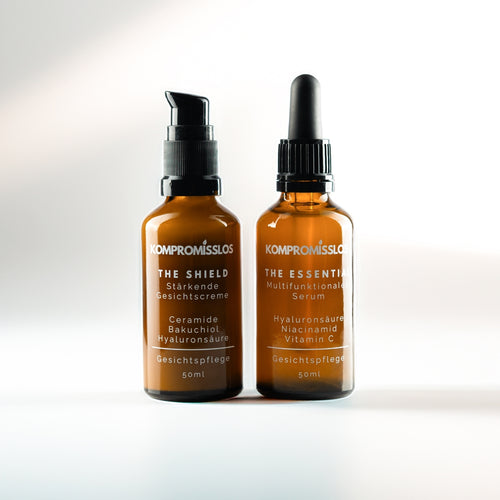
Evening skincare can keep the skin more supple overnight, so that pillow creases often fade more quickly in the morning, but it does not prevent them. The pressure from the pillow is mechanical, and no cream can counter it. What skincare does influence is the condition of the skin’s outer layer: if it is well hydrated and sealed with lipids, it stays more flexible and loses less water overnight. That is why dry skin with age in particular needs both humectants and barrier lipids. In the Duo of serum and cream, the serum takes care of moisture with hyaluronic acid in three molecular sizes, while The Shield cream adds a lipid layer on top with ceramide NP, squalane and jojoba oil. This can soften the appearance of fine lines. Sleep wrinkles that have already set remain a question of position and time. You do not need a separate night cream for this; the reasons are explained in the article night cream or one cream for day and night.
In her review on Judge.me, Birgit L. writes: “My face feels very well cared for in the morning when I get up” (review translated from German). That describes how the skin feels, not a finding about wrinkles, and that is exactly how honestly evening skincare should be assessed when it comes to sleep wrinkles.
I did not add a separate night cream to our range, because the skin does not need a fundamentally different cream at night than during the day. The Shield is meant for morning and evening and, like the serum, is massaged into the face and neck as set out in our guide on how to use the serum and cream. It can do nothing against the pressure of the pillow, and I would rather say so straight away. We do not make a product for the chest; the Duo is designed for the face and neck. What matters most for the chest is a separate sunscreen during the day, because our cream contains no SPF. So your chest does not need yet another cream – it needs a good sunscreen that you apply there every morning too.
Frequently asked questions
How do you get rid of sleep wrinkles quickly?
Fresh sleep wrinkles smooth out on their own; all you can do is help them along a little. Give your skin time after you get up, apply serum and cream and move your face normally. Well-hydrated skin may return to its shape more quickly. There is no trick that makes ingrained lines disappear in minutes. The longer a crease lasts, the more your sleeping position matters.
Are sleep wrinkles the same as expression lines?
No. Expression lines are caused by muscle movement, for example when you laugh or frown, and usually look similar on both sides of the face. Sleep wrinkles are caused by pressure and shifting against the pillow and are more pronounced on the side you sleep on. A review in the Aesthetic Surgery Journal describes them as types of wrinkle with different causes, locations and patterns.
Does sleeping on your back prevent wrinkles?
Sleeping on your back prevents the overnight pressure wrinkles on your face and chest, because nothing is pressing on the skin. It does not help against expression lines or UV-related skin ageing. Hardly anyone stays on their back all night: in the Danish study with motion sensors, adults spent more than half of their time in bed on their side. Even a few more hours on your back make a difference.
At what age do sleep wrinkles become permanent?
There is no fixed age. Many people only notice over the years that pillow creases stay visible until mid-morning, because the skin’s elasticity measurably declines with age. When this happens depends on sun damage, smoking and sleeping habits. Creases that last longer can be among the first signs of skin ageing and are no reason to panic.
Does a rich night cream help with sleep wrinkles?
A rich night cream keeps the skin more supple overnight but does not prevent sleep wrinkles, because the pressure is mechanical. A very greasy cream may even partly rub off onto the pillow. What matters is that your skincare provides moisture and lipids, not whether the word “night” is on the packaging.
Are sleep wrinkles on the chest a sign of sun damage?
Not directly. The lines are caused by the skin being pushed together when you lie on your side. Whether they smooth out again after you get up, however, depends heavily on how much elasticity the skin has lost through years of UV exposure. That is why sun protection on your chest is the most important form of prevention, together with a sleeping position that folds the skin less.
What can The Duo do for sleep wrinkles in the evening?
Applied to the face and neck in the evening, the Duo provides the skin with moisture and lipids, so that it stays supple overnight and creases often fade more quickly in the morning. It does not prevent the pressure from the pillow, and for the chest, a separate sunscreen during the day is what matters most. You do not need an extra night cream alongside The Duo.
Sources
- Anson G, Kane MA, Lambros V. Sleep Wrinkles: Facial Aging and Facial Distortion During Sleep. Aesthetic Surgery Journal, 2016. Source
- Poljsak B, Godic A, Lampe T, Dahmane R. The influence of the sleeping on the formation of facial wrinkles. Journal of Cosmetic and Laser Therapy, 2012. Source
- Sarifakioğlu N, Terzioğlu A, Ates L, Aslan G. A new phenomenon: ‘sleep lines’ on the face. Scandinavian Journal of Plastic and Reconstructive Surgery and Hand Surgery, 2004. Source
- Skarpsno ES, Mork PJ, Nilsen TIL, Holtermann A. Sleep positions and nocturnal body movements based on free-living accelerometer recordings: association with demographics, lifestyle, and insomnia symptoms. Nature and Science of Sleep, 2017. Source
- Ryu HS, Joo YH, Kim SO, Park KC, Youn SW. Influence of age and regional differences on skin elasticity as measured by the Cutometer. Skin Research and Technology, 2008. Source