Face masks: how often to use one and which you can skip
ROUTINE
How often you should use a face mask depends on the type: as a rule of thumb, once or twice a week is enough. Most skin can handle mild hydrating and sheet masks more often, while clay and acid masks are best kept to once a week or less. What matters more than frequency is how long you leave the mask on: studies on sheet masks point to less than 20 to 25 minutes. If you use a serum and cream morning and evening, you do not need a mask – but you are free to use one.
How often should you use a face mask?
For most skin types, a face mask once or twice a week is enough, and less often for sensitive skin. This figure does not come from a study; it is a rule of thumb that follows from how masks work. A mask is a concentrated short burst: in 10 to 20 minutes, it delivers a lot of one thing, such as moisture, oil absorption or exfoliation. The more strongly that one thing acts on the skin, the longer the gap between masks should be. A purely hydrating mask is mild, a clay mask draws out oil, and an acid mask loosens dead skin cells. The sensible frequency varies accordingly. A review in the Journal of Cosmetic Dermatology that summarises what is known about cosmetic face masks notes that extensive research is still needed before successful and precise clinical trials can be carried out. Presenting an exact number of masks per week as scientifically established would therefore be an exaggeration.
Your skin is a more reliable guide: if it feels calm and supple the day after a mask, the rhythm is right. If it feels tight or turns red, the masks are too close together. Where the mask fits into your evening is quickly explained: after cleansing and before serum and cream. The details of which step goes where in your skincare order are covered in a separate article.
Can you use a face mask every day?
Technically, you can use a mild hydrating or sheet mask without acids every day, but there is no need to, and you should not do it with clay or acid masks. What matters is less how often you use a mask than how long you leave it on. A randomised study from West China Hospital, published in the Journal of Tissue Viability, compared sheet masks soaked in pure water, in hyaluronic acid and in a bifida ferment lysate, worn for 5, 15, 25 and 40 minutes. Skin hydration and transepidermal water loss first rose and then fell again. The researchers conclude that short use of under 25 minutes improves hydration, whereas longer use can lead to more dryness and redness.
A second paper, published in Scientific Reports, reached a similar conclusion from a different angle. From 25 minutes of wear onwards, exposure to two preservatives from the mask rose sharply, so the authors recommend less than 20 minutes. A quarter of an hour a day is therefore not the same as an hour a day on the sofa with a sheet on your face. The real question remains, though: what is a daily mask supposed to do that your normal skincare does not already do?
What types of face mask are there, and how often should you use each?
The more strongly a type of mask acts on the skin, the less often you should use it: skin tolerates hydrating masks more often, but clay, acid and peel-off masks only occasionally. The review in the Journal of Cosmetic Dermatology mentioned above divides face masks into four groups: sheet masks, peel-off masks, rinse-off masks and hydrogels. In everyday use, there are also overnight masks, which are really rich creams, and exfoliating or acid masks, which are rinsed off but work quite differently from a hydrating mask. The table is a guide for healthy skin, not a rule. For sensitive or irritated skin, stick to the lower end of each range or go below it.
| Type of mask | What it does | As a guide | What to watch out for |
|---|---|---|---|
| Hydrating or sheet mask | Humectants under a sheet that slows evaporation | 1 to 3 times a week, very mild ones more often | Under 20 minutes, then serum and cream |
| Hydrogel mask | Like a sheet mask, but clings better and cools | 1 to 2 times a week | Use only once, do not let it dry on your skin |
| Clay mask | Absorbs sebum and mattifies | Once a week, rarely or never for dry skin | Only on oily areas, do not let it dry out completely |
| Exfoliating or acid mask | Loosens dead skin cells | Once a week at most | Count it together with exfoliants and acid toners |
| Peel-off mask | A film that takes dead skin cells with it as you peel it off | Rarely | Pulls mechanically at the skin’s surface |
| Overnight or sleeping mask | A rich layer left on overnight | On the odd evening instead of your cream | Replaces your cream rather than going on top of it |
Homemade masks are a topic of their own. What home remedies for dry skin such as honey, quark and oat masks can do, and why they do not keep, is covered in a separate article.
What does a hydrating or sheet mask do that serum and cream cannot?
For 10 to 20 minutes, a hydrating mask delivers in concentrated form what a good daily layering of serum and cream does twice a day anyway. It puts humectants such as hyaluronic acid or glycerin on the skin and keeps them moist under a sheet or a layer of gel. The outer layer of the skin absorbs water, and the skin looks plumper and smoother afterwards. This effect is real, but temporary. A study in the Journal of Investigative Dermatology shows that more water does not automatically mean more benefit: after four and after 24 hours of contact with water, the lipid layers between the cells of the outer skin layer were clearly disrupted. That cannot be equated with a 15-minute mask, but it fits the picture from the sheet mask study, in which the values first rose and then fell again.
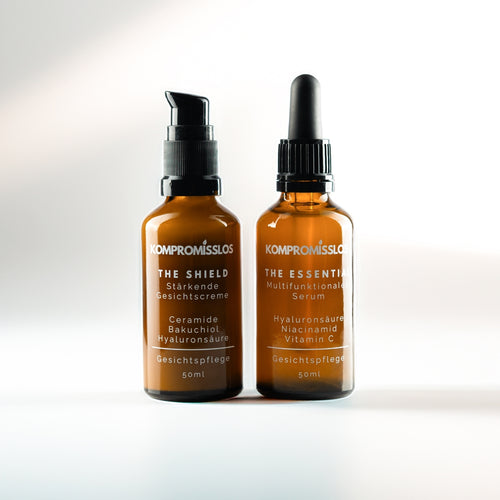
Skin holds on to moisture in the long term when humectants are replenished every day and a cream on top slows evaporation. That is exactly what The Duo of serum and cream is built for: hyaluronic acid in three molecular sizes in the serum, plus glycerin and tamarind seed in the Duo, topped by a cream with ceramide NP, squalane and jojoba oil. If you have this foundation every day, you do not need a mask, but you are free to use one and then apply your serum and cream as usual. In her review on Judge.me, Andrea G. writes: “Just two products that combine everything necessary. My skin feels cared for and soft, but not overloaded” (review translated from German). If your skin constantly feels tight despite your skincare, it is worth reading up on dehydrated skin and how to recognise it before you buy a mask on top.
Which face masks can you skip?
Above all, you can skip masks that duplicate a job your routine already does or that ask something of your skin that it does not need right now. Masks are an optional extra, not a compulsory step, and the more complete your daily skincare, the truer that is. These six cases come up particularly often:
- Clay masks for dry or mature skin: they absorb oil that this skin is already short of.
- Acid masks on top of an exfoliant or acid toner: exfoliation adds up. First find out whether you need to exfoliate your face at all.
- Peel-off masks for sensitive skin: peeling them off stresses the skin’s surface, and the smoothing effect does not last long.
- Overnight masks when your cream is already enough: they replace your cream, they do not improve on it.
- Masks with fragrance or essential oils if your skin reacts easily: the scent makes the mask more pleasant, not more effective.
- A daily sheet mask as a substitute for serum and cream: it lasts 20 minutes, but your skin needs care around the clock.
If you want to cut back on more than just masks, it helps to ask the more fundamental question of how many products your skin really needs.
How can you tell you are using face masks too often?
You are using masks too often if your skin feels tight or rough after you take the mask off, or if your serum stings afterwards. That sounds contradictory, since a hydrating mask is supposed to add moisture. But the study in the Journal of Tissue Viability shows exactly this pattern: it names dryness as the most common side effect (57.14 per cent), well ahead of redness (10.71 per cent), especially with pure water masks worn for more than 25 minutes. With clay and acid masks, other signs come into play: fine flaking, shiny, tight patches on the cheeks or forehead, and redness that does not fade quickly. If you notice several of these signs, a break from masks will help more than the next, milder mask. You can read more about the signs of skincare overload and how your skin recovers in a separate article. If redness, stinging or spots persist even without masks, or if you have a skin condition such as rosacea, acne or eczema, have it looked at by a dermatologist. A mask is no substitute for that.
Take a sheet mask off while it is still damp, and do not let it dry on your skin. Briefly massage in what is left, then apply your serum and cream straight away so that the moisture your skin has just gained does not evaporate again.
There is no mask at Kompromisslos, and that is a deliberate decision. For me, two products instead of eight means focusing on what you use every morning and every evening, not on a weekend product that feels nice and duplicates part of the work. If your skin is dry, I would rather recommend a little more serum and cream, as described in the instructions for use, than an extra step. Both products are fragrance-free, because skincare that stays on your skin every day does not need a scent. And to be honest: a mask on a Sunday evening is not a mistake. If it does you good, go ahead. It is just not a compulsory step.
Frequently asked questions
How long should you leave a face mask on?
As long as it says on the packaging, which for sheet masks is usually 10 to 20 minutes. Longer is not better: in a study on sheet masks, hydration improved with less than 25 minutes of wear, while longer use increased dryness and redness. Take clay masks off before they dry out completely and start to feel tight.
Do I need to moisturise after a face mask?
Yes, after a rinse-off or sheet mask, follow with serum and cream as you would on any other evening. The mask has given your skin a short burst of moisture; the cream makes sure it does not evaporate again straight away. Only an overnight mask replaces your cream on that evening.
Can I reuse a sheet mask?
No, a sheet mask is designed for a single use. Once worn, the sheet has been in contact with sebum and dead skin cells, and it dries out unevenly if you store it. You can spread the leftover liquid from the packet on your neck or the backs of your hands the same evening, but you should not keep it.
Is an overnight mask the same as a night cream?
Essentially, yes: an overnight mask is a rich cream or gel that stays on your skin overnight. On that evening, it is used instead of your cream, not in addition to it. Whether you need a separate night cream at all is a different question from the one about masks.
Can I exfoliate and use a face mask on the same evening?
A mild hydrating mask after gentle exfoliation is fine for resilient skin. An acid or clay mask straight after exfoliating, on the other hand, is too much at once. If your skin is sensitive, spread the two over different evenings and add up the exfoliation across the whole week.
How often should I use a clay mask on combination skin?
For combination skin, a clay mask once a week is enough, and only on the oily areas such as the forehead, nose and chin. With combination skin, the cheeks are often normal to dry and do not need any oil absorbed. If your skin feels tight afterwards, leave longer between masks or skip the mask altogether.
Do I need a face mask if I use The Duo?
No. With serum and cream morning and evening, The Duo covers what a hydrating mask provides in the short term: humectants and a layer that slows evaporation. Using a mask is still not a mistake. Apply it after cleansing, take it off and then use The Duo as usual.
Sources
- Wang Y, Cao Y, Huang X, Zhang M, Hu J, Li L, et al. Short-term skin reactions and changes in stratum corneum following different ways of facial sheet mask usage. Journal of Tissue Viability, 2024. Source
- Zhou L, Chen J, Chen T, Chang H, Cui W, She Y, et al. Investigation of actual exposure to facial sheet mask preceding its risk assessment. Scientific Reports, 2022. Source
- Nilforoushzadeh MA, Amirkhani MA, Zarrintaj P, Salehi Moghaddam A, Mehrabi T, Alavi S, et al. Skin care and rejuvenation by cosmeceutical facial mask. Journal of Cosmetic Dermatology, 2018. Source
- Warner RR, Stone KJ, Boissy YL. Hydration disrupts human stratum corneum ultrastructure. Journal of Investigative Dermatology, 2003. Source