Face cream over 70: what matters for thin, dry skin
SKINCARE BY AGE
A face cream over 70 should be chosen on three criteria: it supplies skin-like lipids such as ceramides and squalane, it binds moisture with ingredients such as hyaluronic acid, and it makes do with a short, low-irritation ingredients list. Then there is an often overlooked point: the texture and packaging need to be easy to handle every day.
The general criteria, whatever the decade: the best face cream for mature skin.
What skincare does skin over 70 need?
Skin over 70 needs lipids, moisture and, above all, consistency. The question of active ingredients itself barely differs from ten years earlier: ceramides, squalane, hyaluronic acid and niacinamide remain the sensible basis, just as they do for a face cream over 60. What shifts is something else. The skin barrier takes much longer to close up again after stress, the epidermis becomes thinner and more mechanically sensitive, and the number of influences outside your skincare increases: medication, dry central-heating air in winter, a hot shower as a treat on cold days. That is why, over 70, what matters is less the density of active ingredients than whether you have found skincare you can use twice a day without effort and without irritation. A good cream that sits in the cupboard loses out to a simple one that gets used every morning.
At this age, dryness rarely affects only the face. How dry skin in later life behaves is covered in its own article.
What actually still changes over 70 compared with 60
For most women, the big jump in dryness didn’t happen at 70 but years earlier. According to a review in Clinical and Experimental Dermatology, sebum production in women falls mainly after menopause and hardly changes further after the seventh decade of life. If you have dry skin at 70, you are usually not experiencing a new drop but a situation that has built up over years. What does continue to decline is the speed of repair. A study in the Journal of Clinical Investigation compared the barrier function of 20- to 30-year-olds with that of people over 80. After a controlled disruption of the stratum corneum, the barrier in the younger participants had recovered by around 50 per cent after 24 hours; in the older ones, by only about 15 per cent. So a cleanser that is too harsh or one exfoliation too many doesn’t cost you a day of recovery but more like a week.
Then there is the mechanical side.
| Factor | From 60 | Additionally from 70 |
|---|---|---|
| Sebum production | Already markedly reduced | Hardly any further change; the level stays low |
| Barrier recovery | Noticeably slower | Mistakes have an after-effect over days rather than hours |
| Skin thickness | Slowly decreases | Rubbing and pulling during application make a difference |
| External influences | Climate and cleansing dominate | Medication and other conditions are added |
| Handling | Rarely an issue | Grip strength determines consistency |
How to recognise a good face cream over 70
Five checkpoints are enough to assess a face cream over 70. First: it contains skin-like lipids, above all ceramides and squalane, and not just water, thickeners and fragrance. Second: it combines these lipids with a humectant; otherwise the water the lipids are meant to hold in is missing. Third: the ingredients list is short, and alcohol is not near the top. Fourth: the texture spreads in a few seconds without you having to pull at your skin, and it leaves no film that sticks to your collar when you get dressed. Fifth: the container can be opened and dispensed with little effort – a pump dispenser is more practical here than a jar with a screw lid. The last point sounds trivial, but in practice it decides the outcome more often than any list of active ingredients, because it determines whether the cream really gets used every day.
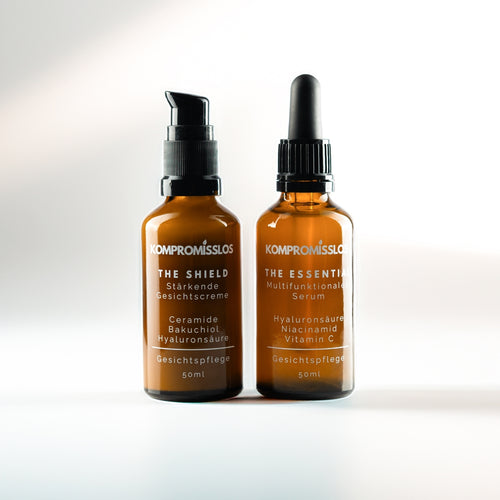
For us, that means: The Duo of The Essential serum and The Shield cream contains 2% hyaluronic acid, 5% niacinamide and 0.3% bakuchiol, plus ceramides, squalane, panthenol, jojoba oil and vitamin E, without a stated percentage. All percentages apply to The Duo as a whole, never to a single product. The full list is on the page about the ingredients in our two products.
Why application technique matters almost as much as the cream over 70
On thin skin, it is not only what you apply that matters, but how. Spread the cream with flat fingers in short, light movements from the centre outwards, rather than massaging it in. Rubbing puts strain on a stratum corneum that recovers more slowly and causes exactly the redness that then gets blamed on the product. Also apply your skincare to slightly damp skin, straight after washing and before your skin has dried completely. The difference is noticeable, because humectants then actually have water to bind. On very dry areas, a second thin layer after ten minutes makes more sense than a single thick dollop that just sits on the surface. And run warm rather than hot water: hot water dissolves exactly the lipids you then put back on. These four points cost nothing and work faster than any change of product.
The order stays simple: first 3 to 6 drops of serum, then 3 to 6 pumps of cream, morning and evening. That is exactly what our two-step routine is built for; a bottle lasts 2 to 4 months. Whether you really need both depends on the condition of your skin, not the year you were born; the steps are on the how-to-use page.
What a face cream over 70 cannot do
No face cream smooths deep wrinkles, tightens sagging contours or removes dark spots. This is not a question of formulation but of how deep it penetrates: cosmetics work in the stratum corneum and the upper layers of the skin, whereas wrinkle depth and elasticity originate in the dermis. What is realistically achievable is skin that feels cushioned without tightness, less flaking and a more even appearance. Dehydration lines can look visibly softer, because a well-supplied stratum corneum reflects light differently. Deep expression lines remain, and any promise to the contrary ends in disappointment after a few months. Just as honestly: if your skin doesn’t currently feel tight, itch or flake, and you have been happy for years with a simple, well-tolerated cream, you don’t need a new product. A change is worthwhile if something isn’t right – not because a number on the label matches your age.
I am regularly asked whether I would like to offer a richer version for older skin. I decided against it, and the reason is inconvenient for marketing: between 60 and 75, the sensible composition barely changes; what changes is dosage and tolerability. Instead of making a third age version, I deliberately chose 0.3% bakuchiol rather than retinol for The Duo, because thin skin often pays the price for retinol with flaking. And the cream comes in a pump dispenser, because a routine you can manage in two minutes with stiff fingers is worth more than any extra bottle.
When to see a specialist about your skin
Cosmetics have a clear limit, and over 70 it is reached more often than at 40. Make a dermatology appointment if your skin itches for weeks despite consistent skincare, if fine cracks or weeping areas appear, if a spot doesn’t heal, if a mark changes in colour, size or border, or if the dryness coincides with starting a new medication. Changes like these need to be assessed, not covered up with more skincare. A cream can still make sense alongside, but it is no substitute for a diagnosis. The reverse applies just as much: if a specialist prescribes a particular basic skincare product, it takes priority over any cosmetic product. If in doubt, take the ingredients list of your skincare with you to the appointment; that is more helpful than any product description. And if you are just finding your way, the overview of skincare for mature skin gives you the basic structure first.
Frequently asked questions
Which face cream is right over 70?
The right face cream over 70 contains skin-like lipids such as ceramides and squalane, combines them with a humectant such as hyaluronic acid and makes do with a short, low-irritation ingredients list. Handling is just as important: a texture that spreads without pulling, and a container that needs little effort.
Does skin over 70 need a richer cream than at 60?
Not necessarily richer, but used more consistently and more gently. In women, sebum production falls mainly after menopause and hardly changes after the seventh decade of life. What comes in over 70 is the slower recovery of the skin barrier. So what matters is less the amount of lipid than avoiding irritating steps.
Does retinol still make sense over 70?
Retinol remains a well-studied active ingredient, but on thin skin it is more often poorly tolerated. Bakuchiol is considered a gentler alternative, and The Duo contains 0.3%, based on serum and cream together. If you have tolerated retinol well for years, there is no reason to stop.
How often should you moisturise your face over 70?
Twice a day, morning and evening, is enough in most cases. Consistency matters more than frequency, because a cream that gets used every day does more than a more expensive one used now and then. With a lot of central heating, an extra thin layer during the day can make sense.
Does a face cream still help with wrinkles over 70?
A face cream doesn’t smooth deep wrinkles or tighten sagging contours, because cosmetics work in the stratum corneum and the upper layers of the skin. Dehydration lines can look visibly softer once your skin is getting enough moisture and lipids again. Deep expression lines remain, whatever the product.
Does hyaluronic acid still make sense over 70?
Yes, but only together with lipids. Hyaluronic acid binds water in the upper layers of the skin but doesn’t hold it there. Without a lipid layer on top, some of it evaporates again, especially in dry central-heating air. The Duo contains 2% hyaluronic acid, based on both products together.
How much does The Duo cost and how long does it last?
The Duo of The Essential serum and The Shield cream costs CHF 109.90. A bottle lasts 2 to 4 months. Delivery costs CHF 3.70 and is free on orders over CHF 60; delivery takes 1 to 3 working days. You have a 100-day right of return.
Sources
- Zouboulis CC, Boschnakow A. Chronological ageing and photoageing of the human sebaceous gland. Clinical and Experimental Dermatology, 2001. Source
- Ghadially R, Brown BE, Sequeira-Martin SM, Feingold KR, Elias PM. The aged epidermal permeability barrier. The Journal of Clinical Investigation, 1995. Source