Upper lip wrinkles: what a cream can do and where it stops
SKIN OVER 40
Upper lip wrinkles are fine vertical lines above the lips, caused by the constant movement of the ring muscle around the mouth, thin skin, UV light and often smoking. A cream cannot smooth them away. What it can do is supply the skin with moisture and lipids, so that fine lines are less noticeable and the area looks plumper. If the lines that bother you stay visible even when your mouth is relaxed, a dermatologist is the right person to see.
What causes upper lip wrinkles?
Upper lip wrinkles form because the skin above the lip contracts countless times a day and, over the years, no longer springs back completely. Directly beneath it lies the ring muscle around the mouth, which is at work whenever you speak, eat, drink or smile. The skin is closely attached to this muscle, and every contraction folds it at right angles to the direction of the muscle fibres – in other words, vertically. As long as there is enough collagen and elastic fibre, these expression lines smooth out again straight away. With age, years of UV exposure and smoking, this supporting framework weakens, and the expression line becomes a line that stays. Lines that run diagonally from the corners of the mouth towards the chin have a different cause – more on that in our article on marionette lines and drooping mouth corners.
Smoking takes a double toll here: through the constant pursing of the lips and through the strain it puts on the connective tissue. A twin study in Plastic and Reconstructive Surgery compared 79 pairs of identical twins with different smoking histories. Among other things, the twins who smoked scored worse for upper lip wrinkles than their non-smoking siblings. That is where the name smoker’s lines comes from, even though women who have never smoked get them too. Upper lip lines usually appear later than the first signs of skin ageing, such as loss of moisture or a dull complexion.
Why do lines on the upper lip often appear earlier than elsewhere?
The skin above the upper lip has little protection of its own and a great deal of movement, which is why it often shows lines earlier than the cheeks or chin. In women, an anatomical difference also plays a part. A study in the Aesthetic Surgery Journal compared skin samples from the upper lip region of female and male body donors: the skin impressions taken from the women showed more and deeper wrinkles, and the men’s skin contained significantly more sebaceous and sweat glands. The researchers see the lower number of these skin appendages as a possible explanation for why women are more prone to upper lip wrinkles. It also stands to reason that fewer sebaceous glands produce less of the skin’s own sebum, so the area can dry out more quickly.
This becomes more pronounced during the menopause. As oestrogen levels fall, the skin tends to become thinner and drier, and in an area that has few reserves to begin with, this shows first. On top of that, the upper lip is often skipped when people apply sunscreen. If the skin around your mouth also feels tight, flakes or burns, the cause is more likely dryness or irritation than wrinkles. What helps in that case is covered in the article on dry skin around the mouth.
What can a cream really do for upper lip wrinkles?
A cream can make fine lines above the upper lip less visible, but it cannot smooth out lines that are deeply etched. What matters is how deep a line sits. Fine lines that are mainly down to dryness are plumped up by humectants and lipids. The skin’s surface becomes smoother, light is reflected more evenly and the line is less noticeable. This effect sets in relatively quickly, but fades again once you stop using the skincare. How to tell dehydration lines from real wrinkles is explained in the article on dehydration lines vs wrinkles. A line that stays visible even when your mouth is relaxed sits deeper in the connective tissue, and no cream reaches that far, however well it is formulated. Whether hyaluronic acid in a cream fills in lines is discussed in the comparison hyaluronic acid or retinol: on the skin it binds water, but it is no substitute for filler injections.
One customer described this limit in her own words. In her review on Judge.me, Nicole B. writes: ‘The little lines don’t go away, which isn’t the idea anyway […], but the overall look becomes softer!’ (review translated from German).
| Type of line | How to recognise it | What skincare can do | What skincare cannot do |
|---|---|---|---|
| Dehydration lines | Vary from day to day, disappear when the skin is gently stretched | Become much less noticeable with regular skincare | Stay away for good once you stop using skincare |
| Expression lines | Only visible when you purse your lips, speak or drink | Skin looks more supple and bounces back better | Stop the muscle movement |
| Etched-in upper lip lines | Visible even when your mouth is relaxed | Edges look softer, the area less dry | Smooth out the line |
| Deep wrinkles with volume loss | Upper lip looks thinner and longer | Little, apart from moisture and protection | Replace lost volume |
Which ingredients suit the skin above the upper lip?
The skin above the upper lip is best served by ingredients that bind water, replenish lipids and do not irritate it any further. The area is thin, constantly in motion and reacts to harsh active ingredients with flaking and stinging more quickly than the cheeks do. That gives you four criteria:
- Humectants such as hyaluronic acid in several molecular sizes. In a study in the Journal of Drugs in Dermatology, 76 women each applied one of five hyaluronic acid creams with different molecular sizes: all of them improved skin hydration and elasticity, but wrinkle depth only decreased with the two low-molecular-weight versions. The study looked at the eye area, though, not the upper lip.
- Lipids such as ceramides and squalane, which top up the thin film of sebum in this area and support the skin barrier.
- Bakuchiol instead of retinol if the skin around your mouth and nose is easily irritated. A study in the British Journal of Dermatology compared 0.5% bakuchiol twice daily with 0.5% retinol once daily in 44 people over 12 weeks: both reduced wrinkle surface area and pigmentation with no statistical difference between them, while the retinol group reported flaking and stinging more often.
- No fragrance, because a thin, often dry area reacts more sensitively to additional irritants.
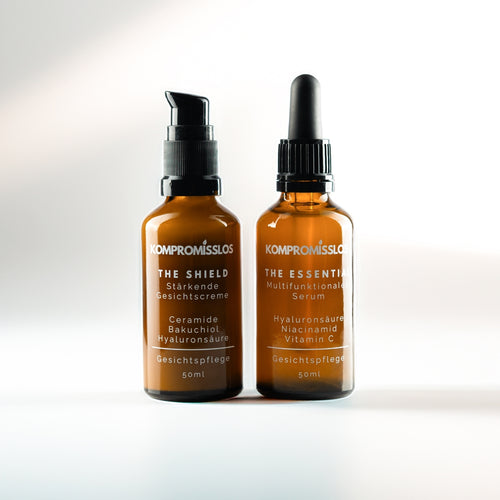
What exactly bakuchiol does in the skin is explained in the article on bakuchiol benefits. For an overview of all the wrinkle ingredients with evidence behind them, see whether anti-wrinkle creams actually work. Whether you need a serum as well as a cream is covered in the article on serum over 50. The Duo of serum and cream is built on exactly these criteria: the serum provides hyaluronic acid in three molecular sizes, the cream ceramides, squalane and bakuchiol, and both are fragrance-free. Applied to the face as described in the instructions for use, it can make the skin look plumper and more supple. Deeply etched lines will still remain.
What can you do when the lines get deeper?
If the lines stay clearly visible even when your mouth is relaxed, or your upper lip looks thinner and longer, the right place to go is a dermatologist, not the next cream. Specialist practices offer procedures that work at a deeper level than any skincare, such as laser treatments, peels or fillers. Which method suits you depends on how deep the lines are, how much volume has been lost and how your skin reacts. All of these procedures come with risks, downtime and costs that should be discussed openly during the consultation. Ask how many sessions are realistic, how long the result lasts and what happens if you do not repeat the treatment. A good specialist will also tell you if a procedure is not worth it in your case. Skincare still makes sense afterwards because it nourishes the skin, but it does not replace such a procedure, nor does it reliably make the results last longer.
Small red bumps, flaking or burning around the mouth are not a wrinkle issue. Have them checked before you try new products, as rich creams can make this kind of irritation worse.
How can you prevent upper lip wrinkles in everyday life?
What helps most is sunscreen right up to the lip line, not smoking and skincare that keeps the area from drying out. Upper lip lines build up over years, and prevention works just as slowly. Even so, it is the part you have the most control over. Which habits make the biggest difference overall is covered in the article on how to slow down skin ageing. For the upper lip, this means in practice:
- Apply sunscreen to the upper lip too, as it is often missed, and use a lip balm with SPF for the lips themselves.
- Do not smoke, or stop, because smoking puts a double strain on the upper lip.
- Use skincare morning and evening so that an area with little lipid film of its own does not dry out.
- Avoid constantly licking your lips, because saliva dries the skin out further as it evaporates.
- Take your facial skincare right up to the sides of your nose and do not skip the skin above your lip, because that is exactly where people tend to skimp.
I deliberately used bakuchiol rather than retinol in the cream. The reason has to do with areas like the upper lip in particular: the skin there is thin, and retinol often causes flaking and stinging, especially at the start. Bakuchiol is the gentler choice for a cream you use morning and evening. But I am just as clear about where that ends: no cream smooths out a line that has etched itself in over the years, and ours is no exception. What the serum and cream can do together is give you skin that is better supplied with moisture and lipids and therefore looks softer. If you want to get rid of deep lines, you are better off seeing a specialist than buying a third jar. How to apply the two products to your face is explained on the page on how to use The Duo.
Frequently asked questions
Do lip balms help with upper lip wrinkles?
No, lip balms do not help with the lines above your lip, because they are made for the lips themselves and barely reach the skin above them. They are still worth using, though: a balm with SPF protects your lips from UV light, and an oil-based balm helps prevent chapped lips. For the skin above your upper lip, you need facial skincare, not lip care.
Do smoker’s lines go away after you stop smoking?
Etched-in smoker’s lines do not disappear on their own after you stop smoking, but stopping slows down the formation of new ones and, alongside sunscreen, is one of the most effective steps you can take to slow down skin ageing.
Is retinol too irritating for the upper lip?
Not necessarily, but the area reacts more sensitively than the forehead or cheeks. Retinol often causes flaking, tightness and stinging at the start, and around the mouth and the sides of the nose the product easily collects in the creases of the skin. If you use retinol, start with a low concentration on a few evenings a week and leave out the corners of your mouth and your lips. If your skin still becomes irritated, bakuchiol is the better-tolerated alternative.
Do facial exercises help with upper lip wrinkles?
Facial exercises make little sense for upper lip lines. The lines are caused precisely by the repeated movement of the ring muscle around the mouth, and exercises such as pursing your lips train exactly that movement. Reliable evidence that facial exercises soften upper lip wrinkles is largely lacking. Your time is better spent on sunscreen and consistent skincare.
Why does lipstick bleed into the fine lines?
Lipstick creeps into the lines because oily textures soften with body heat and are drawn into the fine grooves above the lip. The drier the skin along the lip line, the more noticeable this becomes. A lip liner that creates a boundary, a more matte texture and skincare that has fully absorbed before you apply your lipstick can all help. Very glossy, creamy formulas are more likely to bleed.
Do lip plumpers help with upper lip wrinkles?
Lip plumpers make the lips swell briefly with irritants such as menthol or hot plant extracts, and the effect only lasts a few hours. They have no effect on the lines above the upper lip and can further irritate the sensitive skin along the lip line.
What can the ingredients in The Duo do for upper lip wrinkles, and what can they not do?
The ingredients in The Duo work where skincare can make a difference: hyaluronic acid in three molecular sizes binds water, ceramides and squalane replenish lipids, and bakuchiol is a well-tolerated alternative to retinol. Applied to the face as described on the instructions page, they can make the skin look plumper and more supple, and fine dehydration lines become less noticeable. The Duo does not smooth out etched-in upper lip lines – for that, a specialist is the right person to see.
Sources
- Okada HC, Alleyne B, Varghai K, Kinder K, Guyuron B. Facial changes caused by smoking: a comparison between smoking and nonsmoking identical twins. Plastic and Reconstructive Surgery, 2013. Source
- Paes EC, Teepen HJ, Koop WA, Kon M. Perioral wrinkles: histologic differences between men and women. Aesthetic Surgery Journal, 2009. Source
- Pavicic T, Gauglitz GG, Lersch P, Schwach-Abdellaoui K, Malle B, Korting HC et al. Efficacy of cream-based novel formulations of hyaluronic acid of different molecular weights in anti-wrinkle treatment. Journal of Drugs in Dermatology, 2011. Source
- Dhaliwal S, Rybak I, Ellis SR, Notay M, Trivedi M, Burney W et al. Prospective, randomized, double-blind assessment of topical bakuchiol and retinol for facial photoageing. British Journal of Dermatology, 2019. Source