Marionette lines and drooping mouth corners: what a cream can do and where it stops
SKIN OVER 40
A cream for marionette lines can make the skin around the corners of your mouth and chin look smoother, plumper and more even, but it cannot lift the line itself. Marionette lines do not form in the skin alone: a muscle that pulls the corners of the mouth downwards, fat pads that have slipped lower and a jawbone that loses height with age all play a part. Skincare only reaches the uppermost of these layers. For the rest, daily sunscreen as prevention and, if it bothers you, advice from a specialist doctor are the more honest routes.
What are marionette lines, and how do you tell them apart from nasolabial folds?
Marionette lines are lines that run diagonally down from the corners of the mouth towards the chin and give the face a downward pull. They are named after marionettes, whose chin section hinges up and down along two vertical seams. Colloquially, they are also simply called lines at the corners of the mouth, and in German-speaking countries ‘Merkel lines’. The easiest way to tell them apart from nasolabial folds is by where they sit: the nasolabial fold runs from the side of the nose to the corner of the mouth, while the marionette line starts roughly where the nasolabial fold ends and continues towards the chin. The two often appear together, but their causes are partly different. Marionette lines typically only show at first with certain expressions, in side lighting or in profile, and later stay visible even when the face is relaxed. They often come with corners of the mouth that point slightly downwards. This article stays with the area between the corners of the mouth and the chin. Fine vertical lines directly above the upper lip are a separate topic with causes of their own, covered in the article on upper lip wrinkles and what a cream can do about them.
Why do the corners of the mouth droop with age?
The corners of the mouth droop over the years because several layers give way at the same time: skin, muscle pull, fat pads and bone. In the skin, collagen and elastic fibres decline, so it springs back less after every movement. Underneath sits the depressor anguli oris, a small muscle that pulls the corners of the mouth down and outwards. When the supporting tissue around it slackens, its pull carries more weight. At the same time, the cheeks lose fullness higher up, and tissue gathers lower down at the sides of the chin. The bone changes too: a study in Plastic and Reconstructive Surgery analysed CT scans of 120 women and men in three age groups. The height and length of the body of the lower jaw decreased significantly with age in both sexes, and the jaw angle widened. The authors conclude that these changes, together with those in the soft tissue, shape the appearance of the ageing lower third of the face. How this loss plays out across the whole face is explained in the article on why the skin on your face sags and loses firmness.
When it comes to what a cream can achieve, this breakdown is crucial. The table shows which layer skincare can reach at all.
| Layer | What happens over the years | What skincare can achieve |
|---|---|---|
| Skin, surface | Less moisture, fine dryness lines, a less even complexion | A lot: moisture and lipids make the skin look smoother and plumper |
| Skin, dermis | Collagen and elastic fibres decline, and UV light speeds this up | Some: well-researched active ingredients can soften fine lines, and sunscreen slows further breakdown |
| Muscle | The depressor anguli oris pulls the corners of the mouth downwards | Nothing |
| Fat pads | Volume shifts downwards, and tissue gathers at the sides of the chin | Nothing |
| Bone | The lower jaw loses height and length | Nothing |
Can a cream soften marionette lines?
A cream can visibly soften marionette lines, but only to the extent that the line is shaped by the skin’s surface. Well-cared-for skin reflects light more evenly, looks plumper and makes the line appear less harsh. That is often exactly the part that bothers you in the mirror: the groove itself is not that deep, but dry, slightly crinkled skin around it traces its outline. That is the part skincare can reach. What no cream can reach is the pull of muscle, fat and bone underneath. A product that promises to lift the corners of your mouth is promising something that does not happen at the skin’s surface. Film-formers that smooth the surface for a few hours do not change that either. What is realistic is a softer, fresher overall look after a few weeks of regular care, not a line that has vanished. In her review on Judge.me, Nicole B. sums up this expectation quite precisely: “The fine lines don’t go away, which isn’t the idea anyway […], but the overall expression becomes softer” (review translated from German).
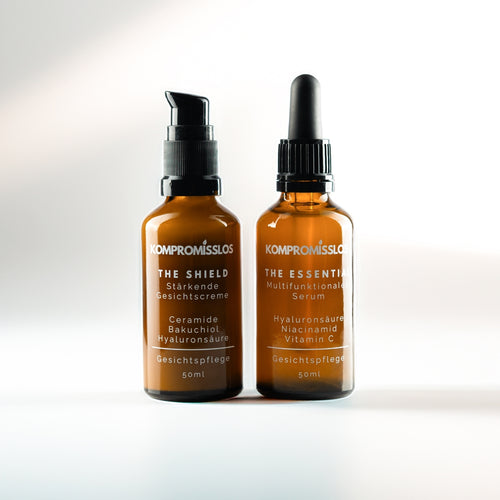
You do not need a special cream just for the corners of your mouth. The skin there is facial skin, and if your routine extends over your chin and neck, the area is already covered. The Duo of serum and cream is massaged in from the centre of the face outwards and over the neck, the corners of the mouth and the chin included. The Essential serum provides niacinamide (5% in the Duo) and hyaluronic acid in three molecular sizes, and The Shield cream on top adds bakuchiol, ceramide NP and squalane.
Which active ingredients make sense for the skin around the mouth and chin?
Around the corners of the mouth and on the chin, the same active ingredients make sense as on the rest of the face, with a particular eye on how well they are tolerated. The area is constantly moving, comes into contact with saliva and food, and products tend to collect in the line. That is why well-tolerated ingredients are worth more than high doses. Humectants such as hyaluronic acid bind water in the outermost layer of the skin and make fine lines look flatter. Lipids such as ceramides and squalane support the skin barrier so that this moisture does not evaporate straight away. Niacinamide is one of the better-researched molecules: in a study in Dermatologic Surgery, 50 women with signs of photoageing applied 5% niacinamide to one half of the face and a base without the active ingredient to the other, twice a day for twelve weeks. On the niacinamide side, fine lines and wrinkles, pigment spots, red blotches and sallowness decreased, and skin elasticity, measured with an instrument, improved. The strongest evidence against wrinkles overall exists for retinoids. How well each active ingredient is supported, and what to look for when buying, is covered in the article on which anti-wrinkle ingredients are actually proven.
Around the corners of the mouth in particular, the potential for irritation matters. A randomised, double-blind study in the British Journal of Dermatology compared a cream with 0.5% bakuchiol, applied twice a day, with a cream with 0.5% retinol, applied once a day, in 44 people over twelve weeks. Both reduced wrinkle surface area and pigmentation, with no statistical difference between the groups. The retinol group, however, reported scaling and stinging of the facial skin more often. That does not make retinol bad; it simply means you should go slowly on sensitive areas. If you are thinking about it, start by reading when to start retinol and how to ease into it.
What can sunscreen and everyday habits do for the lower half of the face?
Daily sunscreen is the most effective prevention for the lower half of the face that is within your own control, because UV light speeds up the breakdown of collagen and elastic fibres. In a randomised trial in the Annals of Internal Medicine involving 903 adults under 55 in Australia, the group using sunscreen daily showed no detectable increase in skin ageing after 4.5 years. Compared with the group that used sunscreen at their own discretion, skin ageing was 24 per cent lower. Sunscreen does not lift the corners of the mouth, but it does slow the part of ageing that takes place in the skin itself. The chin and the area around the mouth are often skipped when applying it, because many people stop at the cheeks. How much to use and which sun protection factor makes sense is covered in the article on sunscreen for your face. Beyond that, a few habits put less strain on the area:
- Take your skincare and sunscreen over your chin and down your neck instead of stopping at the jawline.
- Do not keep wiping the corners of your mouth with napkins or moistening them with your tongue – both dry the skin out.
- Do not smoke: the smoke and the pursing movement of drawing on a cigarette strain the whole mouth area.
- Be patient with active ingredients: in studies, changes in the skin’s appearance show after weeks, not days.
A simple self-test: lie flat on your back and look into a hand mirror. If the line becomes noticeably shallower lying down, that suggests sagging tissue accounts for a large part of it – and no cream can reach that.
When is it no longer a skincare issue, and what can treatments do?
It is no longer a skincare issue when the line stays clearly visible even when your face is relaxed, the corners of your mouth point clearly downwards and this bothers you in everyday life. At that point it is about volume, muscle pull and tissue, and that is where treatments come in, not creams. Broadly speaking: hyaluronic acid fillers replace lost volume, botulinum toxin can weaken the pull of the depressor anguli oris, and lasers and energy-based procedures such as HIFU target deeper layers of skin and tissue. Which method suits you, whether any does at all, and what the risks are, is a matter for a consultation with a specialist in dermatology or plastic surgery. A reputable consultation will also explain which layer is responsible in your case and what a treatment cannot achieve. Either way, the skin on top still needs moisture, an intact barrier and sun protection. A treatment does not replace skincare, and skincare does not replace a treatment.
One important exception: if a corner of the mouth droops suddenly, within hours or days and only on one side, that is not skin ageing. It can be a sign of a stroke or facial paralysis and needs to be checked by a doctor immediately – if in doubt, call the emergency number 144.
I deliberately did not make a separate product for the corners of the mouth, nor a chin or neck cream. The skin there is facial skin, and the same two products cover it too. The Shield contains bakuchiol instead of retinol, because a cream meant for use twice a day should cause as little irritation as possible, even on sensitive areas such as the corners of the mouth. To be honest, neither bakuchiol nor any other active ingredient in my products lifts drooping mouth corners. What the Duo can do is care for the skin at the surface so that it looks suppler and calmer. Because the cream has no sun protection factor, a separate sunscreen belongs in your daytime routine, and for prevention it does more than any specialist cream. How you apply serum and cream from the centre of your face outwards and over your neck is deliberately kept simple.
Frequently asked questions
At what age do marionette lines appear?
There is no fixed age. For many people, marionette lines become more pronounced from around midlife, for some earlier, depending on genetics, sun exposure, weight fluctuations and face shape. The first signs often appear as a faint shadow at the corners of the mouth that is only noticeable with certain expressions or in side lighting. The earlier you start using sunscreen consistently, the more you slow the part that develops in the skin.
Can you get rid of marionette lines without injections?
As a rule, they cannot be removed completely without treatment, but they can be softened. Skincare with moisture, barrier-supporting lipids and well-researched active ingredients makes the skin along the line look smoother and softer, and daily sunscreen slows further skin ageing. It does nothing for sagging tissue. For that, besides injections, there are also lasers and energy-based procedures, which are best discussed with a specialist doctor.
Do facial exercises help with drooping mouth corners?
There are hardly any reliable studies on this specifically for the corners of the mouth, and the existing research on facial exercises is small and short. They do not usually do any harm, but you should not expect them to replace sunscreen or a treatment.
Does sleeping on your side make marionette lines worse?
Possibly, but the evidence is weak. If you lie on the same side every night, you press skin and tissue in the same direction for hours, and these sleep lines can become etched in over the years. That side sleeping causes marionette lines has not been shown. If you already sleep well on your back, that does no harm. Changing the way you sleep just for this is hardly worth it.
Why do drooping mouth corners make you look sad or tired?
Because downturned corners of the mouth resemble an expression we read as sadness or displeasure. We interpret faces in a split second from a handful of features, and the corners of the mouth are among the most noticeable. That is why a face with marionette lines looks serious even when you are relaxed and in a good mood. It has nothing to do with your mood, only with anatomy.
Can I apply retinol right up to the corners of my mouth?
Yes, but carefully. The corners of the mouth are easily irritated, because product collects in the line and saliva puts extra strain on the skin. Apply retinol thinly there and, to begin with, leave a little distance from the corners of the mouth themselves. If they are cracked, flaky or burning, leave retinol off there. What helps in that case and when to get it checked is covered in the article on dry skin around the mouth.
What can The Duo do for marionette lines, and what can’t it do?
The Duo can hydrate the skin around the corners of the mouth and on the chin, support the skin barrier and give a more even-looking complexion, so that the line can look softer. It does not reach sagging tissue, muscle pull or bone loss. You do not need an extra product for the corners of your mouth: the Duo’s serum and cream extend over your chin and neck, complemented by a separate sunscreen during the day.
Sources
- Shaw RB, Katzel EB, Koltz PF, Kahn DM, Girotto JA, Langstein HN. Aging of the mandible and its aesthetic implications. Plastic and Reconstructive Surgery, 2010. Source
- Bissett DL, Oblong JE, Berge CA. Niacinamide: A B vitamin that improves aging facial skin appearance. Dermatologic Surgery, 2005. Source
- Dhaliwal S, Rybak I, Ellis SR, Notay M, Trivedi M, Burney W et al. Prospective, randomized, double-blind assessment of topical bakuchiol and retinol for facial photoageing. British Journal of Dermatology, 2019. Source
- Hughes MC, Williams GM, Baker P, Green AC. Sunscreen and prevention of skin aging: a randomized trial. Annals of Internal Medicine, 2013. Source