Apple cider vinegar on your face: why the home remedy is risky for sensitive skin
ROUTINE
Apple cider vinegar on your face is not a good idea if you have sensitive skin. It consists mainly of acetic acid, whose strength varies from bottle to bottle, and it lowers your skin’s pH only briefly. In a study using diluted apple cider vinegar on the forearms, almost three quarters of participants reported mild side effects, and case reports describe chemical burns. There is no solid evidence that it works against spots. A carefully dosed, well-tolerated active ingredient is the calmer choice.
Is apple cider vinegar on your face a good idea?
For most faces, apple cider vinegar is not a good idea, and for sensitive skin even less so. The home remedy seems harmless because it comes from the kitchen, but it is an acid of unclear strength. Online, it is recommended as a toner, for spots, for clearing large pores and sometimes even neat on moles. The reasoning almost always follows the same pattern: skin is acidic, so acid must be good for it, and vinegar inhibits germs, so it must help with blemishes. Both sound logical, but neither has been properly studied for use on the face. What research there is paints a more sober picture: a small study of forearm soaks in diluted apple cider vinegar that found no benefit for the skin barrier but frequent irritation, and case reports of chemical burns after it was applied to the skin. If your skin quickly turns red, feels tight or stings, the risk outweighs any possible benefit.
This article deliberately sticks to vinegar. How lemon, bicarbonate of soda, honey and oils fare is covered in our overview of home remedies for dry facial skin.
What is apple cider vinegar made of, and why does that matter for your skin?
At its core, apple cider vinegar is diluted acetic acid, and it is precisely this acid that determines how your skin reacts. It is made in two fermentation steps: yeasts turn the sugar in apple juice into alcohol, then acetic acid bacteria turn the alcohol into acetic acid. On top of that come water, small amounts of other fruit acids such as malic acid, some polyphenols and minerals, and in unfiltered varieties the so-called mother of vinegar. A case report in the Journal of Clinical and Aesthetic Dermatology notes that common vinegars contain 4 to 8 per cent acetic acid, which can attack the skin and cause significant chemical burns, especially when the area is covered. What matters most for your skin, though, is what is missing: vinegar is a food and is not formulated for the skin. Its pH has not been adjusted for use on the skin, there is no information on how well it is tolerated, and there is no guarantee that your home-made dilution will be as strong the second time as it was the first. There is no evidence that polyphenols from a highly diluted vinegar mixture do anything measurable on the skin.
| Criterion | Apple cider vinegar from the kitchen | Formulated facial skincare |
|---|---|---|
| Purpose | A food, meant for seasoning | Developed for use on the skin |
| Acid strength | Varies by product and dilution | Fixed in the formula, disclosed by some brands |
| pH | Not stated, strongly acidic | Adjusted for use on the skin |
| Shelf life of the mixture | Mixed at home, without preservatives | Preserved and in stable packaging |
Does apple cider vinegar balance your skin’s pH?
No, apple cider vinegar lowers your skin’s pH only briefly and does not bring it into balance in the long term. The skin’s surface is naturally slightly acidic: a study in the International Journal of Cosmetic Science estimates its natural value at 4.7 on average. The same paper describes how even tap water raises the pH for up to six hours before it returns to its natural level on its own. In other words, the skin regulates itself. A study in Pediatric Dermatology looked at what vinegar changes in this balance. Twenty-two people, 11 with atopic dermatitis and 11 with healthy skin, soaked one forearm in diluted apple cider vinegar containing 0.5 per cent acetic acid for ten minutes a day over 14 days, and the other forearm in water. Immediately afterwards, the pH dropped, but water loss through the skin rose at the same time – exactly the opposite of a stronger barrier. After 60 minutes, both effects had disappeared. The authors concluded that the soaks did not improve the barrier but caused irritation in the majority of participants.
If what you are really wondering is whether you need a toner at all to restore your pH after cleansing, you will find the detailed answer there. In short: healthy skin does not need an extra step for this.
Does apple cider vinegar help with spots and blemishes?
There is no evidence that apple cider vinegar helps with spots. The argument rests on laboratory observations showing that acetic acid can inhibit bacteria. But a lab experiment says little about what a diluted mixture does on living facial skin. In a second analysis published in PLOS One, the research group behind the forearm study took a closer look, at least on the forearms: after two weeks of daily soaks in 0.5 per cent apple cider vinegar, participants with atopic dermatitis showed neither a change in the bacterial community on their skin nor a lower amount of the bacterium Staphylococcus aureus. What is more, spots are not just a question of bacteria. Sebum production, a build-up of dead skin cells in the pores and inflammatory processes all play a part, and an acid that irritates the skin further can leave your complexion looking more unsettled rather than clearer. What a calm routine looks like is covered in our article on what actually helps blemish-prone skin. Inflamed, painful or scarring spots need to be assessed by a dermatologist, not dealt with from the kitchen cupboard.
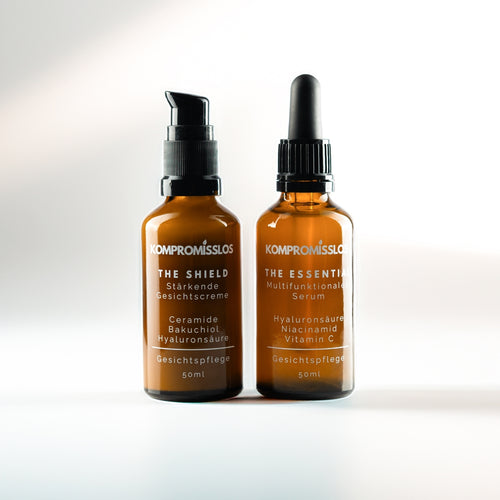
The honest alternative to a vinegar toner is an active ingredient with a known dose. The Duo discloses its concentrations, including 5% niacinamide and 1% zinc PCA for a more even-looking complexion. These two active ingredients are in The Essential serum, while The Shield cream contributes ceramide NP and squalane to support the skin barrier. Both products are fragrance-free. This is skincare, not therapy, but you know exactly what ends up on your skin and in what amount.
Why does apple cider vinegar make sensitive skin sting and turn red?
Apple cider vinegar makes sensitive skin sting and turn red because this skin already reacts to milder triggers, and an acid briefly makes its protective layer even more permeable. The study in Pediatric Dermatology shows the mechanism on a small scale: immediately after the vinegar soak, the skin lost more water, and 72.7 per cent of participants, 16 out of 22, reported mild side effects that improved once they stopped. That was with 0.5 per cent acetic acid on the forearms, not with undiluted vinegar on the face. The stronger the acid and the longer it stays on the skin, for example under a plaster, the more likely irritation is to turn into a chemical burn. The Journal of the American Academy of Dermatology published a case report of a chemical burn caused by apple cider vinegar applied to the skin. In the Journal of Clinical and Aesthetic Dermatology, the authors describe the case of a 14-year-old girl who followed instructions from the internet, applied a few drops of apple cider vinegar to moles on her nose every day for three days and covered the area with plasters. Open, raw sores developed. If your skin is easily irritated to begin with, it is worth looking at how to recognise a damaged skin barrier and at gentle care for sensitive skin rather than at the next home remedy.
Never try to treat moles, warts or any skin lesion that is changing yourself with vinegar. Have them looked at by a dermatologist. The case report in the Journal of Clinical and Aesthetic Dermatology lists scarring and dark marks as possible consequences of self-treatment.
If you still want to try it: how diluted, how often and where not to use it?
If you still want to try apple cider vinegar on your face, use it only highly diluted, briefly, rarely and never overnight. There is no tested safe dilution for the face. For context: with a vinegar containing 5 per cent acid, one part vinegar to nine parts water works out at the 0.5 per cent used in the forearm study, and even at that strength the majority of participants reacted with irritation. So under no circumstances should you go any stronger than that. The only way to find out whether your skin tolerates the mixture at all is to test it on a small area before it goes on your whole face. And because vinegar is an acid rather than skincare, follow it with a mild cream.
- Test first: do a skincare patch test at home and wait to see how your skin reacts before using the mixture on your face.
- Dilute: no more than one part vinegar to nine parts water, freshly mixed every time.
- Keep it short: apply, rinse off with water after a few minutes, never leave it on overnight and never use it under a plaster or mask.
- Leave out: the eye area, lips, open or inflamed areas, freshly shaved skin, moles and warts.
- Do not combine: no acid products or retinoids on the same day.
- Stop: if it stings, wash it off immediately and do not try it again.
I have not included a toner or an exfoliant in our range. Not because acids are bad in principle, but because healthy skin rebalances its own pH after cleansing with water. It does not need an in-between step to do that work for it. What bothers me about home remedies like apple cider vinegar is their unknown strength: you never know exactly how much acid ends up on your skin. That is why I disclose the concentrations, such as 5% niacinamide and 1% zinc PCA in the Duo, and leave out fragrance entirely. That does not turn our skincare into a remedy for spots, and it is no substitute for a dermatologist’s assessment. But you do know what you are putting on your skin. You can look up which active ingredients are in it and in what amounts at any time.
Frequently asked questions
How much should I dilute apple cider vinegar for my face?
There is no tested safe dilution for the face. If you do try it, use no more than one part vinegar to nine parts water, which with 5 per cent acid gives roughly 0.5 per cent acetic acid. In a study using exactly this strength, 16 of 22 participants reported mild side effects after forearm soaks. If you have sensitive skin, it is better to leave it out altogether.
Can I leave apple cider vinegar on my skin overnight?
No, apple cider vinegar should not be left on your skin overnight. The longer the acid stays on and the more tightly the area is covered, the greater the risk of a chemical burn. In the published case of a teenager with burns on her nose, the vinegar had been kept under plasters, in other words covered. If you use it at all, rinse the mixture off after a few minutes.
Does apple cider vinegar help with dark spots or acne marks?
There is no solid evidence that it does. If anything, the risk runs the other way: irritated or burnt skin can leave dark marks once it has healed. Dark spots are a skincare topic of their own, with better-studied active ingredients. Have any marks that are new, growing or changing checked by a dermatologist before you put anything on them.
Is apple cider vinegar better than a shop-bought toner?
No, apple cider vinegar is not a better toner, just a less predictable one. A shop-bought toner is formulated for the skin, with a fixed composition and an adjusted pH. With vinegar, the strength depends on the bottle and on your measuring jug. Whether you need a toner at all is a different question, and for healthy skin the answer is usually no.
What should I do if apple cider vinegar stings on my face?
Rinse the area straight away with plenty of lukewarm water, without rubbing. Then leave out all active products and apply only a mild, fragrance-free cream until your skin has settled. If blisters, weeping or open areas develop, if vinegar has got into your eye or if the pain persists, have it checked by a doctor.
Can I combine apple cider vinegar with acids such as AHA or BHA?
No, you should not. Apple cider vinegar is an acid itself, and combined with an AHA or BHA product the strain on your skin adds up without you knowing the total amount. If you want to exfoliate in a targeted way, use a product formulated for that purpose. Which acid suits which skin type is explained in our overview of AHA, BHA and PHA compared.
Do I need apple cider vinegar if I use The Duo?
No. With The Duo, you cleanse your face with water and then apply serum and cream, morning and evening. This routine does not need an acid step in between, and vinegar would be more likely to strain sensitive skin than complement it. You can see what is in the two products and at what concentration on the page for The Duo, our serum and cream.
Sources
- Luu LA, Flowers RH, Kellams AL, Zeichner S, Preston DC, Zlotoff BJ, et al. Apple cider vinegar soaks [0.5%] as a treatment for atopic dermatitis do not improve skin barrier integrity. Pediatric Dermatology, 2019. Source
- Luu LA, Flowers RH, Gao Y, Wu M, Gasperino S, Kellams AL, et al. Apple cider vinegar soaks do not alter the skin bacterial microbiome in atopic dermatitis. PLOS One, 2021. Source
- Feldstein S, Afshar M, Krakowski AC. Chemical Burn from Vinegar Following an Internet-based Protocol for Self-removal of Nevi. The Journal of Clinical and Aesthetic Dermatology, 2015. Source
- Bunick CG, Lott JP, Warren CB, Galan A, Bolognia J, King BA. Chemical burn from topical apple cider vinegar. Journal of the American Academy of Dermatology, 2012. Source
- Lambers H, Piessens S, Bloem A, Pronk H, Finkel P. Natural skin surface pH is on average below 5, which is beneficial for its resident flora. International Journal of Cosmetic Science, 2006. Source