Shea butter on your face: does it nourish dry skin or clog pores?
ACTIVE INGREDIENTS
Shea butter on your face is a solid choice for very dry, fairly resilient skin: the solid plant fat forms a film on the skin, makes it supple and slows down moisture loss. For oily, blemish-prone or combination skin it is often too heavy, especially when used neat and in a thick layer. Whether it clogs your pores depends less on the raw ingredient itself than on the amount, the formula and your skin. Shea butter cannot do everything, but it is not a problem ingredient either.
Is shea butter good for your face?
Shea butter is good for your face if your skin lacks oil, and unnecessary or even a nuisance if it already produces plenty of its own. It is obtained from the nuts of the African shea tree. At room temperature it is solid and only melts once it touches warm skin. The reason lies in its composition: according to a review in Frontiers in Pharmacology, the fat consists of 30 to 45 per cent saturated stearic acid and 40 to 60 per cent monounsaturated oleic acid. Stearic acid is what makes shea a butter rather than an oil, and it is responsible for the rich, slightly waxy film.
One point matters for putting this in context: shea butter contains no water. It does not give your skin moisture; it holds on to the moisture that is already there. If your skin feels tight because it lacks water, a layer of fat on its own will do little. In that case, a water-based product with humectants needs to go on underneath first. Whether your skin needs water or oil more is explained in detail in the article on rich vs light moisturisers.
What does shea butter do for your skin?
Above all, shea butter makes skin more supple and protects it from drying out by smoothing rough patches and reducing evaporation through the skin’s surface. Technically, it is an emollient with a mildly occlusive effect. What stands out is its unsaponifiable fraction, meaning the accompanying substances alongside the actual fatty acids. The Frontiers in Pharmacology review mentioned above puts this at 3 to 10 per cent, compared with 0.5 to 1 per cent for almond oil and 0.7 to 1 per cent for argan oil. These accompanying substances include triterpene esters. A paper in the Journal of Oleo Science isolated eight such compounds from shea fat and found marked anti-inflammatory activity in all of them – though in mouse ears and with isolated pure compounds, not with shea butter on human facial skin.
An older study in the British Journal of Dermatology shows how wide the gap between the lab and everyday life can be. In 21 healthy people, nine lipids, including shea butter and its unsaponifiable fraction, were tested on skin that had first been irritated with the surfactant sodium lauryl sulphate. Only a sterol-rich fraction of rapeseed oil led to visibly less irritation. Shea butter did not change the degree of irritation. The honest summary: shea butter is a good source of lipids for dry skin, but on the current evidence it does not qualify as a proven soothing active ingredient for the face.
Does shea butter clog pores?
Shea butter does not necessarily clog pores, but it can be too much of a good thing for oily, blemish-prone skin. On the widely shared comedogenicity lists, it usually sits towards the bottom. These lists are a weak yardstick, however, because they are based on old tests of raw ingredients and say nothing about the finished product you use. The article on what comedogenic means explains what lies behind them. In practice, three things decide: how much you apply, where you apply it and what else is on your skin.
One finding from the Frontiers in Pharmacology review is worth noting: on skin that is already inflamed, oils high in oleic acid and low in linoleic acid can put additional strain on the stratum corneum, whereas oils rich in linoleic acid and saturated fatty acids tend to come out more favourably. According to the same paper, healthy skin generally does not react badly to oils rich in oleic acid. Shea butter sits somewhere in between: plenty of oleic acid, only 4 to 16 per cent linoleic acid, but also a generous share of saturated stearic acid. That is why breakouts from shea butter are usually caused not by the ingredient itself but by the way it is used.
- Pure, raw shea butter in a thick layer on your forehead, nose and chin.
- Shea butter on top of an already rich cream, which means a double layer of fat.
- A heavy film during the day under sunscreen, make-up and sweat.
- Skin that turns shiny quickly anyway and is prone to clogged pores.
Which skin types suit shea butter, and which do not?
Shea butter suits very dry, mature or cold-stressed skin best and oily, blemish-prone skin least. In between, it depends on where you use it and how much. Combination skin, for example, can benefit from a thin layer on the cheeks, while the same amount on the T-zone causes problems. Sensitive skin often tolerates pure shea butter well because it contains no fragrance. Unrefined shea butter does, however, have a nutty, smoky smell, and any plant ingredient can cause irritation in individual cases. If you have persistent redness with a burning sensation, the question of whether rosacea is behind it belongs with a dermatologist first.
| Skin condition | Shea butter on your face | How to use it |
|---|---|---|
| Very dry, flaky, feels tight | A good fit | In the evening as a thin final layer over your skincare |
| Mature and fairly dry | Usually a good fit | In the evening in winter, often unnecessary in summer |
| Normal | Rarely needed | On dry patches only, or in cold weather |
| Combination | Only in places | Cheeks yes, leave out the T-zone |
| Oily, blemish-prone | Better not | Choose lighter lipids or skip it altogether |
Can you leave shea butter on your face overnight?
Yes – overnight is actually the most sensible time to use shea butter on your face, because the rich film then sits under neither make-up nor sunscreen. Take a pea-sized amount, melt it between your fingertips and press it gently onto the dry areas as the last step instead of rubbing it in. Your usual skincare can go on underneath, ideally something that provides moisture for the film to lock in. The principle is similar to slugging with a layer of petroleum jelly overnight, but milder, because shea butter seals less completely and is partly absorbed.
There are two things to keep an eye on. First, the amount: if you wake up with shiny skin and marks on your pillow, you used too much. Second, your skin over the next two or three weeks: if new blemishes appear on your chin or forehead, leave the shea butter off those areas and keep it for your cheeks and dry patches only. In the morning, your usual cleanse with water is generally enough to remove any residue.
Before using a new shea butter all over, test it for a week on just one half of your face or a small area. That way you can see whether your skin reacts with blemishes or redness before you apply it everywhere.
Which lighter lipids can you use instead?
If shea butter feels too heavy for you, squalane, jojoba oil and ceramides are the obvious alternatives, because they are closer in structure to the skin’s own lipids and do not leave a thick film. Squalane is the stable form of a lipid the skin produces itself and absorbs with almost no residue. Jojoba oil for your face is chemically a liquid wax and smooths the skin without feeling greasy. Ceramides are among the lipids of the stratum corneum itself and replenish what a stressed barrier is missing there. For sensitive or combination skin, this combination often feels more comfortable than a butter.
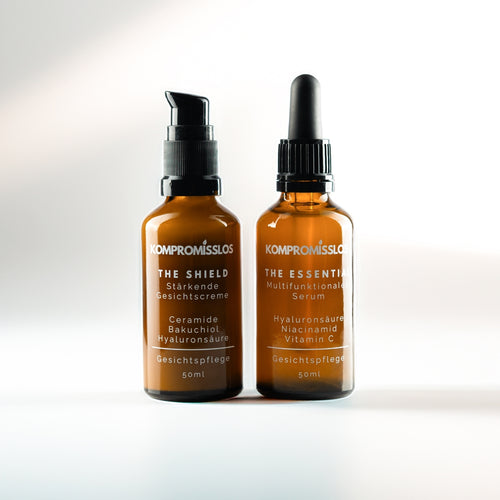
Still, shea butter is not necessarily the worse choice, as a small study in the Hong Kong Medical Journal involving 34 children with eczema shows: a cream with shea butter extract did not differ statistically in acceptability or efficacy from a product with ceramide precursors from an earlier study. That proves nothing about facial skincare for adults, but it does suggest that what matters is not any single lipid but whether the skincare suits your skin and whether you enjoy using it. Eczema should be treated by a dermatologist in any case. Our cream, which is part of The Duo, contains squalane, jojoba oil and ceramide NP, but no shea butter. For very dry skin in winter, that may not be enough oil. Some customers with dry, mature skin write in their reviews that they top up the cream with an oil. That is exactly where a thin layer of shea butter is a legitimate option.
There is no shea butter in our Duo – you can check that in the full list of our ingredients. That is not a statement against shea butter. I wanted two products that carry a routine together, instead of eight that you have to layer on top of each other. What I am not promising is that every skin type will get enough from them in every season. If you have very dry, mature skin, you may need more oil in winter than a cream designed for morning and evening use should deliver. In that case, a touch of shea butter in the evening is an honest addition. You do not need a third product from me for that – and I do not sell one anyway.
Frequently asked questions
Is raw shea butter better than refined?
Not automatically. Raw, unrefined shea butter contains more of its natural accompanying substances, but it smells distinctly nutty and varies more in quality. Refined shea butter is more neutral in scent and more consistent, but loses some of those accompanying substances in the process. If your skin is sensitive or you are sensitive to smells, refined shea butter or shea butter in a finished cream is often the gentler choice.
Does shea butter help with wrinkles?
There is no solid evidence that shea butter works against wrinkles. What you can see is an immediate effect: well-nourished skin looks smoother, and fine lines caused by dryness are less noticeable. This lasts as long as the film stays on your skin. When it comes to skin ageing, daily sunscreen does far more than any butter.
Is shea butter suitable for sensitive, redness-prone skin?
Often yes, but not as a remedy for the redness. Pure shea butter contains no fragrance, and many sensitive skin types tolerate it well. In a study in the British Journal of Dermatology, however, it did not reduce irritation on previously damaged skin. Test it on a small area first. If the redness persists for weeks, have it checked by a dermatologist.
Can I combine shea butter with retinol?
Yes, the two combine well. Apply your retinol product first, let it absorb and then add the shea butter as a thin final layer on dry areas. It can ease the tight feeling that retinol often causes at the start. It does not belong underneath the retinol. The simple rule: thin, watery textures first, oils and butters last.
Does shea butter help in winter?
Yes, winter is when shea butter is most likely to show its strengths. Cold air outdoors and dry heated air indoors draw moisture out of the skin, and a rich film slows this loss. A thin layer on your cheeks and dry areas in the evening is usually enough. For a day out in the cold, you can also apply a little to your cheeks and nose in the morning.
Can you be allergic to shea butter?
Yes, a contact allergy is possible, as with any plant ingredient, but with shea butter it is not one of the commonly discussed problems. The Cosmetic Ingredient Review expert panel considers shea-derived ingredients safe, provided the finished product is formulated to be non-sensitising. If your skin itches or turns red after applying it, stop using it and see a doctor if necessary.
Does The Duo contain shea butter?
No, The Duo does not contain shea butter. The cream contains squalane, jojoba oil and ceramide NP, among other ingredients, while the serum that goes on before it mainly provides moisture. If you need more oil in winter, you can apply a thin layer of shea butter over The Duo as the last step in the evening. If you have combination skin or are prone to blemishes, the cream on its own is usually enough.
Sources
- Poljšak N, Kočevar Glavač N. Vegetable Butters and Oils as Therapeutically and Cosmetically Active Ingredients for Dermal Use: A Review of Clinical Studies. Frontiers in Pharmacology, 2022. Source
- Akihisa T, Kojima N, Kikuchi T, Yasukawa K, Tokuda H, Masters ET, et al. Anti-inflammatory and chemopreventive effects of triterpene cinnamates and acetates from shea fat. Journal of Oleo Science, 2010. Source
- Lodén M, Andersson AC. Effect of topically applied lipids on surfactant-irritated skin. British Journal of Dermatology, 1996. Source
- Hon KL, Tsang YC, Pong NH, Lee VW, Luk NM, Chow CM, et al. Patient acceptability, efficacy, and skin biophysiology of a cream and cleanser containing lipid complex with shea butter extract versus a ceramide product for eczema. Hong Kong Medical Journal, 2015. Source
- Burnett CL, Bergfeld WF, Belsito DV, Hill RA, Klaassen CD, Liebler DC, et al. Safety Assessment of Butyrospermum parkii (Shea)-Derived Ingredients as Used in Cosmetics. International Journal of Toxicology, 2024. Source