Caffeine eye cream: does it really work, and for how long?
ACTIVE INGREDIENTS
Caffeine eye cream can make morning puffiness under the eyes a little less visible for a short time, but it does not change dark circles or eye bags for good. Around 3 per cent is the usual amount. Caffeine penetrates the skin well, yet in a placebo-controlled study a caffeine gel under the eyes was not significantly more effective than the same gel without caffeine. The researchers saw the cooling effect as the main factor. The result is temporary: stop using the product and everything is back to how it was the next morning.
What does caffeine do on the skin?
On the skin, caffeine is above all an ingredient that crosses the skin barrier easily and can influence blood flow in the tiny vessels of the skin. A review in Skin Pharmacology and Physiology describes caffeine as a highly biologically active substance, mentions its antioxidant properties and states that in cosmetics caffeine increases the microcirculation of blood in the skin. That is worth noting, because advertising for eye products usually argues the opposite: caffeine supposedly constricts the blood vessels and that is why puffiness goes down. Both explanations are doing the rounds, and neither is properly supported for the thin skin under the eye.
For everyday purposes, it can be summed up simply: how caffeine gets into the skin has been studied very thoroughly. What you then see in the mirror has been studied far less. Beyond the eye area, caffeine is also found in cellulite creams and caffeine shampoos, but those are separate topics with their own body of research. Here, the focus is solely on the skin under the eyes.
Does caffeine reduce puffiness under the eyes, and how long does it last?
For puffiness under the eyes, a caffeine product helps only briefly at best, and a good share of that effect comes not from the caffeine but from the coolness of the product as you apply it. The typical scenario is a slightly puffy eye area in the morning, often after a short night. That is exactly what caffeine products are advertised for, and it is also where expectations are most realistic. Firm eye bags that are still there in the evening, on the other hand, are usually down to anatomy, and caffeine cannot do anything about them either.
None of the studies cited here measured how long a caffeine-induced reduction in puffiness lasts. So the only honest thing to say is this: it is a temporary effect, not a change in the skin itself. There is nothing to suggest that an effect builds up over weeks and stays once you stop using the product. On top of that, morning puffiness goes down on its own over the course of the morning for many people anyway. Some of what gets credited to a caffeine cream would therefore have happened without it. Once you know this, you can use a caffeine product for what it is: a short-term cosmetic helper for days when your eye area matters to you.
What percentage of caffeine makes sense in eye cream, and does it actually penetrate?
Around 3 per cent caffeine is the usual range, and penetrating the skin is not where caffeine falls short. The review in Skin Pharmacology and Physiology notes that commercially available caffeine formulations for the skin normally contain 3 per cent. A review in the International Journal of Women’s Dermatology considers caffeine at up to 3 per cent to be safe and easily absorbed. That caffeine passes through the skin barrier is so well established that researchers use it as a model substance in penetration experiments. A study in the British Journal of Clinical Pharmacology detected caffeine in the blood just 5 minutes after application when the hair follicles were open, and after 20 minutes when they were blocked, in each case in nanogram amounts. So caffeine does get in and is also carried onwards quickly. Whether more than 3 per cent does any more good has not been shown.
When choosing and applying a caffeine product, a few straightforward criteria are all you need:
- Concentration: if it is stated, around 3 per cent is a sensible figure. If it is not, and “Caffeine” appears far down the ingredient list, there is probably not much in it.
- Texture: a gel or a light fluid cools more when applied than a rich cream does. Going by the research, this is not a side effect but a large part of what you see.
- Amount: a small amount is enough. Dab it onto the bone under the eye, not right up to the lash line, so that nothing runs into your eye.
- Timing: in the morning, because that is when the puffiness you want to tackle is present.
- The rest of the formula: fragrance-free and without essential oils is the calmer choice around the eyes, especially if your skin reacts quickly.
What do studies say about caffeine under the eyes, and where does marketing overstate it?
The research on caffeine under the eyes is thin, and one placebo-controlled study that tested a caffeine gel against the same base without caffeine has sobering results. In the Journal of Applied Pharmaceutical Science, a gel with 3% caffeine was tested on 34 volunteers (18 women, 16 men) who quickly develop puffy eyes after a night without sleep. The study was randomised, double-blind and placebo-controlled. Overall, the caffeine gel was not significantly better than the same gel base without caffeine. The authors conclude that the cooling effect of the water-based gel was the main factor in reducing the puffiness, not the constriction of blood vessels by caffeine.
Other studies paint a more favourable picture but have typical weaknesses. The review in the International Journal of Women’s Dermatology does list caffeine as a promising ingredient in eye products, but one of the studies it cites in support involved 11 women and a pad with 3% caffeine. According to the original paper in Advanced Biomedical Research, this pad also contained 1% vitamin K, which means the effect of caffeine alone can no longer be separated out. The review itself explicitly names the lack of clinical studies looking specifically at eye products and the skin around the eyes as a weakness. So if a pack says “clinically tested”, it is worth asking whether the product was compared against the same base without caffeine. Often you will find no information on this.
Do coffee grounds, tea bags or coffee pads do the same as a caffeine cream?
Cold tea bags probably do about as much as a caffeine cream, and mainly because of the cold, not the caffeine. This very home remedy was the starting point for the gel study in the Journal of Applied Pharmaceutical Science: chilled, damp tea bags on the eyelids are said to reduce puffiness thanks to caffeine’s vessel-constricting effect. The study’s result suggests that the cold does most of the work. A cool, damp flannel is therefore likely to do something similar, with no caffeine at all.
You can skip coffee grounds under your eyes. You are rubbing granules over the thinnest skin on your face, the amount of dissolved caffeine is completely unclear, and crumbs easily end up in your eye. Coffee pads and home-made masks have the same problem: nobody knows how much caffeine gets through, and the skin is more likely to be irritated than cared for. If you want to weigh up home remedies and products side by side, it is worth looking at what helps against dark circles under the eyes and what doesn’t.
Who is a caffeine product worth it for, and who can skip it?
A caffeine product is worth it for you if your eye area is regularly a little puffy in the morning and a short-lived fresher look is worth an extra product to you. You can skip it if what bothers you is more brown discolouration, shadows or firm eye bags, because caffeine is not the right ingredient for those. For pigmentation, the better question is what vitamin C can realistically achieve for your skin, and the answer plays out over months, not hours. Whether you need a separate product for the eye area at all depends mainly on how well your facial skincare is tolerated there. A separate article looks at whether you really need an eye cream or your facial skincare is enough.
| Concern | What caffeine can realistically do | For how long |
|---|---|---|
| Slightly puffy eyes in the morning | Can reduce puffiness a little; the coolness of the product contributes a large part | Temporary, starting afresh each morning |
| Bluish dark circles showing through the skin | Possibly slightly less visible for a short time | Temporary |
| Brown discolouration and shadows | Not a suitable ingredient for this | No proven effect |
| Firm eye bags | Nothing; this is usually anatomy | No proven effect |
| Fine lines | Thin evidence, mostly only tested in combination products | Unclear |
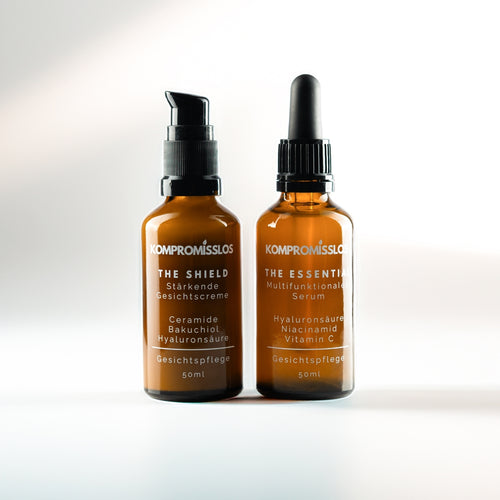
To be honest about our own routine: The Duo contains no caffeine and is not an eye cream, and we do not sell an eye cream either. The foundation of your skincare is still moisture and the skin barrier. The Essential serum contains niacinamide, 3-O-Ethyl Ascorbic Acid as a stable form of vitamin C and hyaluronic acid in three molecular sizes, followed by The Shield with Ceramide NP and squalane, both applied to the face and neck. If you also want a caffeine product for the eye area, you can keep The Duo as your everyday skincare and add a separate eye product. If the puffiness comes with itching or redness, affects only one side or lasts for days, it is a matter for a doctor or a dermatology practice, not for your skincare drawer.
I deliberately did not put caffeine into the Duo, and I did not make an eye cream of our own either. An ingredient that mainly reduces puffiness temporarily, and whose effect in a controlled study could not be separated from the cooling of the gel, does not justify an extra product for me. I would rather disclose what is in it: 5% niacinamide, 2% vitamin C as 3-O-Ethyl Ascorbic Acid and 1% zinc PCA, all fragrance-free. I will be just as open about the limit: when it comes to puffy eyes in the morning, The Duo cannot do what cold or a caffeine gel can. What each of the active ingredients in the Duo is meant to do, and what not, is set out plainly on one page.
Frequently asked questions
Does caffeine help with dark circles too?
Where dark circles have a bluish component caused by blood vessels, caffeine can soften their appearance a little for a short time; with pigmentation and shadows it does nothing visible. Which component dominates in your case, and why that determines your skincare, is covered in the article on what causes dark circles under your eyes.
Is caffeine in skincare suitable for sensitive skin?
Caffeine itself is considered safe at the usual concentrations of up to 3 per cent. Problems are more likely to come from fragrances, essential oils or alcohol in the formula. If your skin reacts quickly, it is worth reading up on caring for sensitive skin and what to leave out. Before you use a new eye product every day, you can patch test the new product at home on a small area of skin first.
Does caffeine still work if I drink a lot of coffee?
Yes – insofar as a caffeine cream does anything at all, how much coffee you drink plays no known role in it. Caffeine from your cup and caffeine from a cream take separate routes, and an eye cream is no substitute for coffee, or vice versa. Whether the puffiness around your eyes goes down after you apply it in the morning depends mainly on what happens directly on the skin, including the coolness of the product.
Should I apply a caffeine cream in the morning or the evening?
The morning is the more sensible time, because that is when puffiness is most noticeable and the effect is temporary. If you apply it in the evening, little is likely to be left of a short-lived effect by the morning. If you use a gel, the coolness as you apply it strengthens the visible effect, so storing it somewhere cool can help, unless the packaging says otherwise.
Does caffeine help with wrinkles or crow’s feet?
The evidence for that is thin. Studies showing improvements in fine lines around the eyes mostly test combination products with several active ingredients, so the caffeine’s share cannot be separated out. If crow’s feet are what bother you most, caffeine is not the ingredient to rely on. Moisture and daily sun protection are the more solid foundation there.
Can caffeine in skincare irritate the eyes?
Yes, if the product gets into your eye it can sting, but that applies to almost any skincare product. So only apply it to the bone under the eye, not right up to the lash line. If you notice redness, itching or swelling on one side, stop using the product. If it persists, see a doctor or a dermatology practice.
Do I need a caffeine eye cream if I use The Duo?
No, not necessarily. The Duo is designed as everyday skincare for the face and neck and contains no caffeine. If puffy eyes in the morning bother you and you want a short-term effect for them, you can use a separate caffeine product as well. For daily care with moisture and barrier lipids, the Duo of serum and cream is enough.
Sources
- Herman A, Herman AP. Caffeine’s mechanisms of action and its cosmetic use. Skin Pharmacology and Physiology, 2013. Source
- Amnuaikit T, Maneenuan D, Boonme P. Evaluation of Caffeine Gels on Physicochemical Characteristics and In Vivo Efficacy in Reducing Puffy Eyes. Journal of Applied Pharmaceutical Science, 2011. Source
- Otberg N, Patzelt A, Rasulev U, Hagemeister T, Linscheid M, Sinkgraven R, et al. The role of hair follicles in the percutaneous absorption of caffeine. British Journal of Clinical Pharmacology, 2008. Source
- Hamie H, Yassine R, Shoukfeh R, Turk D, Huq F, Moossavi M. A review of the efficacy of popular eye cream ingredients. International Journal of Women’s Dermatology, 2024. Source
- Ahmadraji F, Shatalebi MA. Evaluation of the clinical efficacy and safety of an eye counter pad containing caffeine and vitamin K in emulsified Emu oil base. Advanced Biomedical Research, 2015. Source