HIFU facial: what results to expect and how long they last
SKIN OVER 40
According to the clinical evidence, a HIFU facial delivers moderate tightening for mildly to moderately sagging skin, but not a facelift-level result. The effect builds over around three months and, in studies, is still measurable up to about a year after a single treatment; there is no data beyond that. The treatment itself is noticeably painful, and redness and swelling for a few days afterwards are normal. In Switzerland, HIFU belongs in the hands of a doctor.
What happens during a HIFU facial?
During a HIFU treatment, a device focuses ultrasound waves so that they generate intense heat at specific points below the skin’s surface, while the top layer of skin stays largely intact. HIFU stands for high-intensity focused ultrasound; in studies on the face, the procedure is usually called micro-focused ultrasound, or MFU for short. The applicator is moved line by line over the treatment areas with contact gel, typically the jawline, cheeks, chin, forehead or neck. According to a review in the International Journal of Environmental Research and Public Health, this creates many tiny heat zones of roughly one cubic millimetre at a set depth. The heat damages the collagen there, which is gradually replaced by newly formed collagen fibres, and it is precisely this remodelling that is meant to make the skin look firmer over the following weeks. A prospective study in Aesthetic Plastic Surgery measured the collagen signal on skin ultrasound in 28 women aged 33 to 55: after a single treatment it rose step by step, peaked at nine months and was still raised at twelve months.
Worth knowing to set your expectations: HIFU works deep down and needs time. What you see straight after the session is mainly swelling, not the result.
What does HIFU achieve according to studies, and who is it suitable for?
According to studies, HIFU gives most people visible but rather mild tightening, and works best on mildly to moderately sagging skin. The review in the International Journal of Environmental Research and Public Health mentioned above analysed 16 studies, all of which included only women. After 90 days, the investigators found an improvement in firmness or fine lines in 92 per cent of cases. The patients themselves rated the improvement as mild, with their reported figures rising from 42 per cent on day 90 to 53 per cent on day 360. It is worth being aware of this gap between the experts’ assessment and what you see in the mirror before you book a treatment. A meta-analysis in Aesthetic Plastic Surgery covering 13 studies and 477 participants found a response rate of 0.77 after 90 days and 0.69 after 180 days. A review in the Aesthetic Surgery Journal describes improvements in skin laxity of between 18 and 30 per cent, particularly on the lower face, the neck and around the eyes.
According to the review in the International Journal of Environmental Research and Public Health, HIFU is less suitable for severely sagging skin and for people with a BMI over 30, because results were weaker as laxity and BMI increased. Before you consider a device, it is worth looking at what skincare can and can’t do for sagging skin and where its limits lie. If your main concern is your neck, you will find more on neck wrinkles and sagging neck skin in a separate article.
| Question | What the studies show | What it means for you |
|---|---|---|
| Does it work at all | Measurable tightening in most people after one treatment | Realistically, “a little fresher and firmer”, not “ten years younger” |
| How much | Patients rate the improvement as mild | Photos taken before and after three months help you compare honestly |
| Who for | Mild to moderate sagging; weaker results with severe sagging and a BMI over 30 | If there is a lot of excess skin, discuss the alternatives with a doctor |
| How long | Data goes up to about a year | Claims of much longer-lasting results are not backed by evidence |
How long do HIFU facial results last?
In studies, the results of a HIFU treatment can be detected for up to about a year after a single session; there is no reliable data for longer periods. The review in the International Journal of Environmental Research and Public Health states explicitly that the improvement lasted for up to a year and that longer follow-up is lacking. The review in the Aesthetic Surgery Journal also names the long-term effect as an open research question. The study of 28 women in Aesthetic Plastic Surgery shows the course in detail: the improvement was greatest after three months and still clearly present after nine to twelve months, but no longer at its peak. The meta-analysis fits this picture, as the response rate after 180 days was slightly lower than after 90 days.
If a clinic promises you results that last eighteen months or two years, ask for the source. On top of that, your skin keeps ageing in the meantime. HIFU does not turn back the clock; it shifts the starting point. So how long you notice a difference also depends on what the evidence shows slows down skin ageing, above all daily sunscreen for your face.
What side effects and pain are normal with HIFU?
With HIFU, pain during the treatment is normal, as are redness and swelling that subside within days. In the meta-analysis in Aesthetic Plastic Surgery, pain averaged 3.10 on a 10-point scale, and in no case was the pain during treatment intolerable. The review in the International Journal of Environmental Research and Public Health describes the treatment as moderately painful. In the study of 28 women, redness occurred in 67.9 per cent and swelling in 28.6 per cent, and all of it resolved within a week. Less commonly, in 2 per cent of cases according to the review, numbness or hypersensitivity, bruising, stinging, streak-like skin marks, burns along the jawline and contact dermatitis occur.
- Normal: redness, mild swelling and tenderness in the treated areas.
- Report to the clinic: numbness or tingling that does not fade, blisters, streaks or crusts on the skin.
- Seek medical advice straight away: problems with your vision, severe pain or swelling that gets worse rather than better after a few days.
Who is allowed to perform HIFU in Switzerland, and what should you look for in a clinic?
In Switzerland, HIFU may only be performed by doctors, or by practice staff under their direct instruction, supervision and responsibility. This is set out in the Ordinance to the Federal Act on Protection against Hazards from Non-Ionising Radiation and Sound, known as the V-NISSG. Annex 2 of the ordinance lists high-intensity focused ultrasound among the procedures that beauty salons may not offer without a doctor taking responsibility, alongside ablative lasers and laser lipolysis. What this means for you: an offer with no doctor behind it is not a bargain but a warning sign. Whether HIFU is suitable for you, for example if you have implants or a skin condition or are pregnant, is something a dermatologist will clarify in a consultation before the treatment. Prices vary widely depending on the clinic and the number of areas treated, so a written quote is part of the deal.
- Ask who will carry out the treatment and which doctor is responsible.
- Expect a consultation with questions about pre-existing conditions, medication and implants.
- Ask for realistic goals and for photos taken before and three months after treatment.
- Insist on a written quote covering all areas and a follow-up appointment.
- Be sceptical of promises such as “just like a facelift” or “lasts two years”.
How should you care for your skin after a HIFU facial?
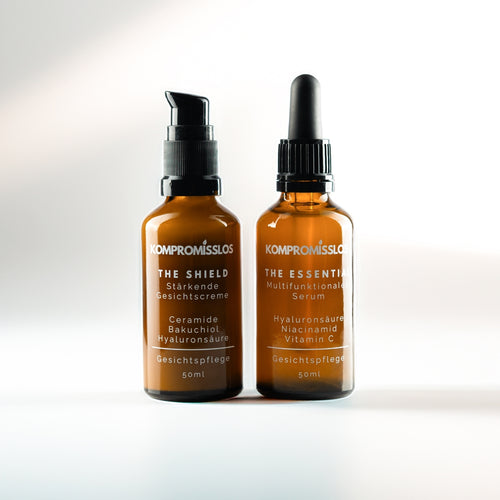
After a HIFU treatment, your skin does not need a new specialist routine, just a calm, fragrance-free basic routine and sun protection. Your clinic’s instructions always take priority, including on how long to wait. For the first few days, skip exfoliants, strong acids and anything that stings. The same principle applies as when you care for sensitive skin gently: few products, no fragrance, plenty of moisture and lipids. There is no evidence that an expensive collagen or firming cream prolongs the result, and once you know whether collagen from a cream can actually get into your skin, you can save yourself that purchase. HIFU works deep down, skincare works on the surface; one does not replace the other. Once your clinic gives you the go-ahead, The Duo fits in as a calm everyday routine: The Essential with hyaluronic acid in three molecular sizes and niacinamide, followed by The Shield with Ceramide NP and squalane. The Duo does not contain SPF, so you add a separate sunscreen during the day.
Before the treatment, take photos in the same light and from the same angles, and repeat them after three months. Without this comparison, mild tightening is hard to judge with any certainty, both for you and for the clinic.
A cream does not tighten the skin the way a device does, and I don’t sell The Duo as an alternative to HIFU. Anyone who has a treatment doesn’t need a new ten-step programme afterwards either. That is why I made a deliberate decision: two products instead of eight, fragrance-free, with no exfoliant or toner in the range. That keeps the routine simple and gentle, especially when your skin is more sensitive after a treatment. I didn’t put an SPF in the cream, so a separate sunscreen belongs in your daytime routine. What The Duo cannot do: prolong or replace the result of a treatment. What it can do: give your skin moisture every day and support the skin barrier. How the two steps build on each other is explained in the how-to-use guide.
Frequently asked questions
When will I see results after HIFU?
You only see the actual result of HIFU after a few weeks, and it is most visible around three months after the treatment. Straight afterwards, your face often looks fuller, but that is swelling. In a study in Aesthetic Plastic Surgery, the improvements were greatest after three months and still clearly present after nine to twelve months.
How often should HIFU be repeated?
There is no generally accepted schedule for HIFU. Most studies follow a single treatment for up to a year, and experts point out that treatment protocols and energy settings have not yet been standardised. Whether and when a repeat makes sense is best decided with your doctor on the basis of comparison photos rather than the calendar.
How much does a HIFU facial cost in Switzerland?
The cost of a HIFU facial varies widely in Switzerland, depending on the clinic, the device and the number of areas treated. As an aesthetic treatment, it is usually something you pay for yourself. Ask for a written quote in advance that covers all areas, the consultation and a follow-up appointment, so that you can compare offers fairly.
Is HIFU or radiofrequency better for sagging skin?
Both procedures heat tissue, but in different ways. HIFU focuses ultrasound on individual points at a defined depth, while radiofrequency uses electrical current to heat tissue over a broader area. Which one suits your skin, your starting point and your budget better cannot be answered across the board. That is a decision to make with a dermatologist.
Can HIFU break down facial fat and make your face look hollow?
The concern is not unfounded, because HIFU is used on the body for contouring: a review in the Aesthetic Surgery Journal describes a reduction in circumference of 2.5 to 4.5 centimetres on the abdomen and thighs. How often this leads to visible volume loss in the face cannot be read from these data. If you have a slim face, raise it openly during the consultation. Why cheeks become hollow over the years is explained in the article on sagging skin on the face.
Does HIFU replace a facelift?
No, HIFU does not replace a facelift. Studies show mild to moderate tightening in mildly to moderately sagging skin. Results were weaker where sagging was severe, and an ultrasound device cannot remove excess skin. Anyone expecting a surgical result will be disappointed after HIFU, and that is something to clarify openly before the treatment.
Can I use The Duo after a HIFU treatment?
Yes, as soon as your clinic says you can return to your normal skincare. The Duo is fragrance-free and consists of two steps, serum and cream, with no exfoliant or acid toner. That keeps your routine calm after a treatment. It does not prolong the HIFU result, and because it contains no SPF, you also need a sunscreen during the day.
Sources
- Contini M, Hollander MHJ, Vissink A, Schepers RH, Jansma J, Schortinghuis J. A Systematic Review of the Efficacy of Microfocused Ultrasound for Facial Skin Tightening. International Journal of Environmental Research and Public Health, 2023. Source
- Ling J, Zhao H. A Systematic Review and Meta-Analysis of the Clinical Efficacy and Patients' Satisfaction of Micro-focused Ultrasound (MFU) Treatment for Facial Rejuvenation and Tightening. Aesthetic Plastic Surgery, 2023. Source
- Haykal D, Sattler S, Verner I, Madhumita M, Cartier H. A Systematic Review of High-Intensity Focused Ultrasound in Skin Tightening and Body Contouring. Aesthetic Surgery Journal, 2025. Source
- Li X, Xie G, Yang Z, Li S, Liao X, Lu J et al. Evaluating the Long-term Effects of Microfocused Ultrasound on Facial Tightening Using Quantitative Instruments: Efficacy and Safety. Aesthetic Plastic Surgery, 2026. Source
- Schweizerischer Bundesrat. Verordnung zum Bundesgesetz über den Schutz vor Gefährdungen durch nichtionisierende Strahlung und Schall (V-NISSG), SR 814.711, Art. 5 and Annex 2, section 2.3. Fedlex, version of 31 August 2022. Source