Face yoga: can facial exercises really soften wrinkles
ROUTINE
Based on what we know today, face yoga does little to soften wrinkles in a targeted way, although it may make the mid-face look slightly fuller. The best-known study found fuller cheeks and a younger estimated age after 20 weeks of training, but no measurable change in forehead lines or crow’s feet. It was small, had no control group and lost many participants along the way. If you enjoy the exercises, there is no reason not to do them. As a way to tackle wrinkles, though, sun protection and consistent skincare have better evidence behind them.
Does face yoga work for wrinkles?
To this day, it has not been shown either way whether face yoga softens wrinkles. That is not because nobody has looked, but because of the quality of the studies. In 2014, a systematic review in the Aesthetic Surgery Journal gathered every study it could find on facial exercises, face building and face yoga and analysed nine reports. All nine reported positive results, yet not a single one had a control group or random allocation. In most cases, the authors or the participants themselves judged the outcome, without blinding. The review’s conclusion is correspondingly sober: the evidence is not sufficient to say whether facial exercises rejuvenate the face.
A small controlled study in Folia Phoniatrica et Logopaedica came to the same conclusion. Nine of 18 participants trained daily for seven weeks, after which lay assessors compared photos of five areas of the face. Only one significant difference emerged between the groups, at the upper lip, and the authors state that no effectiveness can be inferred from it. “Facial exercises for wrinkles” is therefore more of a hope than an established result.
What does the JAMA Dermatology study really show?
The JAMA Dermatology study shows fuller cheeks and a younger estimated age, but no effect on wrinkles. It is the paper that almost every report on face yoga refers to, so it is worth taking a close look. It enrolled 27 healthy women aged between 40 and 65. In two live sessions of 90 minutes each, a certified facial exercise instructor taught them 32 resistance exercises. They then trained at home for 30 minutes a day for eight weeks, and every other day from week 9 to week 20. Only 16 women saw it through to the end.
Two physicians assessed standardised photos blind, using validated scales. Fullness in the upper and lower cheeks improved to a statistically significant degree, and the average estimated age fell from 50.8 years at the start to 49.6 years after eight weeks and 48.1 years after 20 weeks. Forehead lines at rest and crow’s feet, on the other hand, showed no significant change. The researchers name the limitations themselves: a small group, only middle-aged women, many dropouts and no control group. The result is an interesting pointer, but no more than that yet.
How is training your facial muscles supposed to change your skin?
The training is not meant to change the skin directly, but what lies beneath it. The authors of the JAMA study suspect that the exercises make the cheek muscles and other facial muscles grow slightly, much like strength training does for arms or legs. A stronger muscle takes up more space and can therefore partly make up for the loss of volume in the mid-face that comes with age. The skin on top then looks better supported. That explains why it was cheek fullness that changed in the study, and not the fine lines on the skin’s surface.
What matters just as much is what this model does not explain. The skin’s elasticity, its moisture and the texture of its surface depend on collagen, the skin barrier and UV exposure, not on the muscle mass underneath. If it is mainly loss of firmness that bothers you, the article on what skincare can and can’t do for sagging skin explains why cheeks hollow out and what role fat and bone play. Face yoga works on a different layer from any cream.
Can face yoga make expression lines worse?
No study has looked directly at whether face yoga deepens expression lines, but the risk is plausible. Expression lines such as frown lines, horizontal forehead lines and crow’s feet form where muscles contract in the same direction over and over for years and fold the skin above them. This is exactly where botulinum toxin comes in, by temporarily relaxing these muscles. Exercises in which you raise your forehead hard, pull your brows together or squeeze your eyes tightly shut do the opposite: they train precisely the movement that creates these lines.
That is why many routines work with resistance, for example with your fingers holding the skin on your forehead gently flat while the muscle works. Whether that is enough to prevent extra folding has not been studied. If you already have pronounced expression lines, you are better off skipping forehead and eye exercises and focusing, if at all, on the cheeks and mouth area.
Which areas of the face are exercises worth doing for – and which are not?
Exercises are most likely to be worthwhile for the cheeks, but probably not for the forehead, eye area or upper lip. The cheeks are the only area in which a study with blinded assessment by doctors found a difference. There are exercises for the jawline and neck, but no robust data. On the forehead and around the eyes, the lack of results and the risk of extra folding argue against them. With upper lip wrinkles, the single finding from the small controlled study does little to change the fact that exercises make hardly any sense there, because these fine lines are caused precisely by the work of the muscle that rings the mouth.
| Area | What the exercises aim to do | Evidence | Verdict |
|---|---|---|---|
| Cheeks and mid-face | Build muscle volume | One small study without a control group, fuller cheeks | Most worth trying |
| Jawline and neck | Firm up contours | No robust results | Unclear |
| Forehead and frown lines | Smooth out lines | No effect on forehead lines measured | Better left out |
| Eye area | Soften crow’s feet | No effect measured | Better left out |
| Upper lip | Smooth fine lines | One isolated finding in a small study, not robust | Of little use |
Two distinctions belong here. Passive tools such as gua sha or facial rollers are something other than muscle training and are not the subject of this article. And lines that are still there in the morning from your pillow have little to do with your muscles – more on that in the article on sleep wrinkles on the face and chest. If you have facial paralysis or jaw problems, exercises belong in the hands of a specialist, not an online programme.
How long does face yoga take to show results?
According to the only meaningful study, face yoga takes months rather than weeks before you see anything. In the JAMA study, estimated age was slightly lower after eight weeks of 30 minutes a day, but only the comparison between the start and week 20 was tested statistically. That is a considerable effort: around 28 hours in the first eight weeks, then every other day after that. The controlled study with seven weeks of daily training, by contrast, found no robust effect. If you only practise now and then, you should not expect much.
The fact that 11 of the 27 participants dropped out of the study also tells you something. A programme that asks for half an hour every day often falls down in everyday life not because it does not work, but because of the time it takes. The realistic question is therefore what you would most like to spend your time on.
- Allow four to five months before you judge the results.
- Take photos in the same light and with the same head position rather than relying on the mirror.
- Leave out exercises that make your forehead or eye area crease heavily.
- Stop if your jaw or chewing muscles hurt, and get it checked.
Where does face yoga fit alongside sun protection and skincare?
Face yoga sits alongside sun protection and skincare as an optional extra, not as a replacement. Unlike facial exercises, daily sun protection is backed by a randomised trial: in the Annals of Internal Medicine, the group of adults under 55 who used a broad-spectrum sunscreen every day showed no detectable increase in skin ageing after 4.5 years. Compared with the group that used sunscreen at their own discretion, skin ageing was 24 per cent lower. How to put this into practice day to day is covered in the article on sunscreen for your face, and you will find a separate overview of what the evidence shows on slowing skin ageing.
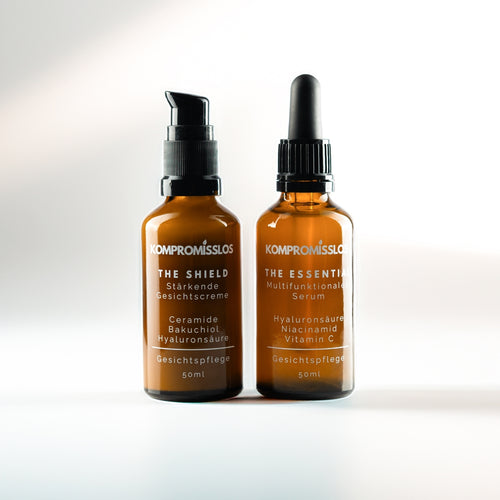
Skincare, in turn, works on the skin’s surface, where face yoga cannot reach at all. The Duo, made up of The Essential and The Shield, combines niacinamide and hyaluronic acid in three molecular sizes in the serum with bakuchiol, ceramide NP and squalane in the cream. This can soften the appearance of fine lines and support the skin barrier, but it does not train muscles. Which active ingredients are best researched is explained in the article on which anti-wrinkle ingredients are actually proven. In his review on Judge.me, Silas writes: “The skincare routine is really simple and therefore ideal for me, as I have no desire to spend a lot of time in the bathroom” (review translated from German). That is the honest calculation: exercises cost time, two skincare steps cost hardly any.
I deliberately limited Kompromisslos to two products, and face yoga shows why that matters. If you want to invest 20 to 30 minutes a day in exercises, go ahead, but you do not also need to build an eight-step skincare routine alongside them. Serum and cream, morning and evening, plus sunscreen during the day. The cream contains bakuchiol instead of retinol. I deliberately left out any SPF, so sun protection remains a separate step, and for wrinkles it has better evidence behind it than any facial exercise. I am just as open about what my products cannot do: they do not train muscles, and they do not plump up the mid-face. How the two steps work is set out in the directions for using the serum and cream.
Frequently asked questions
How often should you do face yoga?
If you follow the JAMA study, 30 minutes a day for eight weeks, then every other day. An effect has only ever been measured at that level. Nobody knows whether less training also does something. Five minutes here and there will do no harm, but you should not expect visible results from it.
At what age is face yoga worth it?
There is no recommended age. The best study to date only looked at women between 40 and 65, so it says nothing about younger or older people. At 25 or 30, consistent sun protection will in all likelihood do more for your future skin than any muscle training for the face.
Does face yoga help with frown lines and forehead lines?
Probably not. In the JAMA study, forehead lines did not change measurably despite 20 weeks of training. Frown lines and forehead lines are caused precisely by muscle activity, so exercises in this area could in theory even deepen them. Here, sun protection, skincare for the appearance of the skin and, if needed, advice from a dermatologist are the more realistic routes.
Should I do face yoga with or without cream?
For most exercises you do not need a cream, because it is mainly the muscle that works and the skin is not rubbed. Clean hands and gentle pressure, without stretching or shifting the skin, matter more. It is best to apply your skincare only after your training, so it stays on your face rather than on your fingers.
Can face yoga replace Botox or fillers?
No, the three work in completely different places. Botulinum toxin relaxes muscles, fillers replace lost volume and face yoga trains muscles. Robust studies comparing the three methods are lacking. The promise made by some creams is similarly overblown, as the article on what so-called botox creams can really do shows.
What happens if I stop doing face yoga?
There are no robust data on this so far. If the effect really is based on building muscle, you would expect it to fade slowly, as with any strength training. Stopping does no harm. Skin ageing carries on regardless, with or without training.
Can I combine face yoga with The Duo?
Yes, the two go well together. Do your exercises first, cleanse your face with water and then apply 3 to 6 drops of serum and 3 to 6 pumps of cream, each time working from the centre of your face outwards and down over your neck. The Duo cares for your skin, while the exercises work on the muscle.
Sources
- Alam M, Walter AJ, Geisler A, Roongpisuthipong W, Sikorski G, Tung R, et al. Association of Facial Exercise With the Appearance of Aging. JAMA Dermatology, 2018. Source
- Van Borsel J, De Vos MC, Bastiaansen K, Welvaert J, Lambert J. The effectiveness of facial exercises for facial rejuvenation: a systematic review. Aesthetic Surgery Journal, 2014. Source
- De Vos MC, Van den Brande H, Boone B, Van Borsel J. Facial exercises for facial rejuvenation: a control group study. Folia Phoniatrica et Logopaedica, 2013. Source
- Hughes MC, Williams GM, Baker P, Green AC. Sunscreen and prevention of skin aging: a randomized trial. Annals of Internal Medicine, 2013. Source