Sunken cheeks: what causes the volume loss and what skincare can visibly soften
SKIN OVER 40
The causes of sunken cheeks usually lie beneath the skin: over the years, the fat pads in the midface shift downwards and lose volume, and weight loss, missing teeth or smoking can add to the effect. The skin itself is rarely the main reason. That is why skincare cannot bring volume back. What it can do: well-hydrated skin reflects light more evenly and looks plumper, so shadows in the midface can appear a little softer. If a cheek hollows quickly, on one side only or for no obvious reason, have it checked by a doctor.
Why do cheeks look sunken with age?
Cheeks look sunken with age because the volume in the midface shifts downwards: it goes missing just below the eye and gathers further down. A study in Plastic and Reconstructive Surgery compared CT scans of twelve heads from deceased body donors in two age groups, 54 to 75 and 75 to 104. In the older group, the midface fat compartments sat further away from the lower rim of the eye socket, with more volume in the lower third of the compartments and less in the upper third. On top of that, the deep inner cheek fat lost volume. Exactly where the curve below the eye used to be, a hollow forms and catches the shadow. This is a different process from loss of firmness: if you want to know what skincare can and can’t do for sagging skin, that article covers it. Here, the focus is on the volume underneath.
For women, menopause also brings thinner, drier skin that draws shadows more sharply; there is more on this in the article on why skin ages so quickly after menopause.
Is it your skin, fat or bone – and how can you tell the difference?
Most of the time it is fat and bone, and you can tell because the hollow looks the same on good days and bad days. If it is mainly your skin, the impression varies: after a short night, after a day of dry central heating or on a dry winter’s day, your face looks more gaunt, and after a good week it looks fuller again. A volume hollow, on the other hand, changes over months and years, not over days. A simple self-check: stand in front of the mirror in daylight coming from the side and compare a photo from today with one from five years ago. If the shadow sits below the cheekbone or below the eye, it is volume. If the skin looks fine, dull and crêpey without the shape having changed, it is mainly the surface. Often it is both, and then it helps to look at each layer separately. The article on why skin on the face thins with age explains what is going on in the top layer.
| Layer | How you can tell | What skincare can do |
|---|---|---|
| Skin | Fine, dull, crêpey; the impression varies with sleep and dryness | Visibly improve hydration and the barrier |
| Fat | Hollow below the eye or the cheekbone; changes with body weight | Nothing for the volume, only for the surface |
| Bone | The midface looks flatter over many years, the eye socket larger | Nothing |
| Teeth and jaw | Thinner lips, sunken mouth area, after tooth loss or with dentures | Nothing – this is one for your dentist |
What causes sunken cheeks apart from age?
Apart from age, the main causes of sunken cheeks are weight loss, missing teeth, smoking, a lot of endurance training and the natural shape of your face. These causes affect people in their thirties too, and some of them are within your control:
- Weight loss: your face loses weight along with the rest of you. In a twin study in Plastic and Reconstructive Surgery with 186 pairs of identical twins, twins with a body mass index four points higher looked older than their sibling before the age of 40, but younger after 40. Anyone who loses a lot of weight with a weight-loss injection also loses fat in the face.
- Tooth loss and dentures: when teeth are missing, the support from inside is missing too. A study in BMC Geriatrics used 3D scans to compare the faces of 90 people over 65: participants without teeth had a flatter profile, and their lips sat further back than those of people with their own teeth.
- Smoking: in a second twin study in the same journal with 79 pairs of twins, the twins who smoked scored worse on features including malar bags and jowls. The authors describe the changes mainly in the middle and lower thirds of the face.
- Intensive endurance sport: people who run or cycle a lot and have very little body fat often look gaunt in the face. There are hardly any good studies on this; the effect is probably driven mainly by body fat and many hours in the sun rather than by the exercise itself.
- Genetics: high cheekbones and a narrow face make the hollow beneath them visible earlier. That is anatomy, not a skincare mistake.
When should you see a doctor about sunken cheeks?
You should have sunken cheeks checked by a doctor if they appear within a few weeks or months, affect only one side or come with weight loss you cannot explain. Ageing changes the face slowly and in much the same way on both sides. Anything that happens faster, on one side only or alongside other symptoms does not fit this pattern. Unintentional weight loss, ongoing tiredness or loss of appetite are a matter for your GP. If you notice fat loss in your face after a change of medication, discuss it with the doctor who prescribed it. A change in the shape of the face on one side belongs with your GP or a dermatologist. Pain when chewing, jaw problems, dentures that no longer fit properly or a sunken mouth area after tooth loss are a case for your dentist. No mirror and no article can give you a diagnosis, and no cream replaces getting it checked.
A rule of thumb: slow, on both sides and in line with your age is usually normal. Fast, on one side or together with other symptoms is a reason to book an appointment, not to buy a new skincare product.
What can a cream do for sunken cheeks – and what can’t it do?
A cream cannot fill out sunken cheeks, because it reaches neither fatty tissue nor bone, but it can make the skin over them look plumper and more even. That may not sound like much, but visually it is not nothing: dry, dull skin draws every hollow more sharply, while a smooth, well-hydrated surface makes the shadow look a little softer. With products that promise volume, it is therefore worth taking a sober look at the ingredients. Collagen in a cream stays on the surface; there is more on this in the article on whether collagen from a cream can get into your skin. And hyaluronic acid binds water in the top layer of the skin, nothing more. What it can realistically achieve is covered in the article on what hyaluronic acid really does for skin.
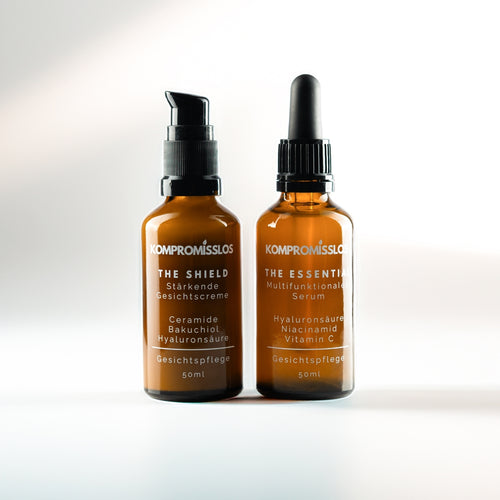
That surface is exactly what The Duo is designed for. The Essential provides niacinamide and hyaluronic acid in three molecular sizes, and The Shield adds Ceramide NP, squalane and jojoba oil on top and supports the skin barrier; in total, The Duo contains 5% niacinamide. According to the application guide, you massage in the serum first and then the cream, morning and evening, working from the centre of your face outwards and down over your neck. Anyone who wants real volume back ends up looking at fillers or fat grafting. Whether either is right for you, and with what risks and costs, is something to discuss at a medical practice.
What can you do yourself to make the midface look fuller?
There are three main things you can do yourself: keep your weight stable, avoid smoking, and care for and protect your skin so that it stays smooth and well hydrated. Everything else is cosmetic, and there is nothing wrong with letting that help. These are the points that make the most difference:
- Keep your weight stable: large fluctuations do not leave the fat in your face untouched, and after 40, weight loss is more likely to show in the face, as the twin study on body mass index suggests.
- Stop smoking: in the twin study, the effects of smoking showed up mainly in the middle and lower thirds of the face – right around the cheeks.
- Sun protection: UV light speeds up the ageing of the skin over the hollow. Daily sunscreen for your face is one of the simplest measures on this list.
- Have your teeth checked: gaps, dentures and bite height change the mouth area. It is worth checking this before you spend money on skincare.
- Light instead of contour: dark contouring below the cheekbone visually deepens the hollow. A slightly lighter shade or a fine shimmer on the upper cheekbone draws the light upwards.
I do not promise volume from a jar, because no cream reaches fat pads or bone. The Duo hydrates and supports the skin barrier, nothing more, and I would rather say that before you buy than after. The cream contains bakuchiol instead of retinol, because mature skin is often sensitive and I did not want an active ingredient that it first has to get used to. I deliberately left out sun protection, which is why you need a separate sunscreen in the morning. We do not make a third product in the form of a firming or volumising serum: it would change nothing about the hollow, and serum and cream are enough for the surface. I have disclosed which active ingredients are in the two products and what they are for.
Frequently asked questions
Can you fill sunken cheeks without injections?
Real volume rarely comes back without injections or a procedure if fat and bone are the cause. There are exceptions: after major weight loss, putting on a little weight can make the face fuller again, and after tooth loss, suitable dental replacements can support the mouth area. Skincare and make-up only improve how the surface reflects light.
Does face yoga help with sunken cheeks?
Face yoga has so far only been looked at in small studies, and there is no evidence that it visibly makes up for lost fat volume. It does no harm if you enjoy it, but it is no substitute for sunscreen, or for getting cheeks checked that are hollowing quickly.
Do cheeks stay sunken after weight loss?
Not necessarily: your face follows your body weight, and if you put a little back on, it usually fills out a little again too. The older you are, the more noticeable a loss there becomes. In the twin study in Plastic and Reconstructive Surgery, twins with a body mass index four points higher looked older than their sibling before 40, but younger after 40.
Can missing teeth make your cheeks sunken?
Yes, missing teeth can visibly change the face, especially the mouth area. Without teeth, the support from inside is gone, the jawbone recedes over time, the profile becomes flatter and the lips move back. A dentist can check whether dental replacements or adjusted dentures would give more support again.
Does endurance sport make your face gaunt?
Endurance sport itself is rarely the reason for a gaunt face; very low body fat and a lot of sun are more likely. There are hardly any robust studies on this. If you train outdoors a lot, the best way to protect your face is consistent sunscreen, not less training.
Does hyaluronic acid in a cream make your cheeks look fuller?
Hyaluronic acid makes the skin look plumper, but not the cheeks fuller. It binds water in the top layer of the skin, so the surface looks smoother and fresher. It does not reach the fat pads and bone underneath. So expect fresher-looking skin, not a new face shape.
What can The Duo do for sunken cheeks?
The Duo can hydrate the skin over your cheeks better and support its barrier, so that it looks plumper and more even. It cannot bring back volume, because no cream reaches fat or bone. With realistic expectations, the Duo of serum and cream is a simple foundation, not a substitute for medical advice.
Sources
- Gierloff M, Stöhring C, Buder T, Gassling V, Açil Y, Wiltfang J. Aging changes of the midfacial fat compartments: a computed tomographic study. Plastic and Reconstructive Surgery, 2012. Source
- Guyuron B, Rowe DJ, Weinfeld AB, Eshraghi Y, Fathi A, Iamphongsai S. Factors contributing to the facial aging of identical twins. Plastic and Reconstructive Surgery, 2009. Source
- Okada HC, Alleyne B, Varghai K, Kinder K, Guyuron B. Facial changes caused by smoking: a comparison between smoking and nonsmoking identical twins. Plastic and Reconstructive Surgery, 2013. Source
- Skomina Z, Kočevar D, Verdenik M, Hren NI. Older adults’ facial characteristics compared to young adults’ in correlation with edentulism: a cross sectional study. BMC Geriatrics, 2022. Source