Facial steaming benefits: what steam really does for your skin and when to skip it
ROUTINE
The real benefits of facial steaming are simple: it warms the skin, softens sebum and makes the outermost layer of skin swell slightly for a short while. That is why your skin feels soft and looks rosy afterwards, and why blackheads are easier to loosen. Beyond that, there is not much to it: steam does not detox, does not cleanse from the inside and does not replace skincare. For normal, oily and combination skin, it can be a pleasant ritual once a week for five to ten minutes. If you have rosacea, couperose, eczema or very dry skin, you are better off skipping it.
What are the real benefits of facial steaming?
The main things facial steaming gives your skin are warmth and a short-lived dose of water, and both only last as long as your skin stays warm and damp. The warmth makes sebum more fluid. An older study in the British Journal of Dermatology measured how sebum output on the forehead changes with skin temperature: warming and cooling changed it by around 10 per cent per degree Celsius. The authors suspect the main reason is that warm sebum is less viscous. That fits with the fact that hardened plugs of sebum are easier to loosen after steaming. At the same time, the outer layer of the skin, the stratum corneum, absorbs water, swells a little and feels smoother. Blood flow increases, which is why your face looks fresher and rosier afterwards.
What steam cannot do is still often promised: it does not flush ‘toxins’ out of the skin, it does not clear up blemishes, and a pore does not swing open in the heat like a door. There is more on this below in the frequently asked questions. The verdict is unspectacular but honest: a feel-good step with a handy side effect for blackheads, not a skincare benefit in its own right.
| Claim | What is true |
|---|---|
| Steam opens your pores | No. Warmth softens sebum; the pore itself stays as it is. |
| Steam cleanses your skin from the inside | No. It loosens sebum but does not remove anything on its own. |
| Steam detoxes | No. Your skin is not an organ for flushing out ‘toxins’. |
| Steam hydrates your skin | Only briefly. Without skincare afterwards, the water evaporates again. |
| Steam makes blackheads easier to remove | Yes, because warm sebum is less viscous. |
Which skin types does facial steaming suit, and who should skip it?
Facial steaming is most likely to suit normal, oily and combination skin that responds well to warmth and is prone to blackheads. This type of skin benefits most from the softened sebum and usually copes with the brief heat without feeling tight. The more sensitive and dry your skin is, the less there is to be said for it. Heat dilates the blood vessels, and on skin that already reddens easily, that is exactly the opposite of what you want. How facial skin reacts to intense heat in general is covered in the article on what sauna heat does to the skin on your face. In the following cases, you are better off leaving facial steaming out:
- Rosacea, couperose or skin that quickly flushes red all over in the warmth. There is more on this in the guide to rosacea skincare.
- Eczema, atopic dermatitis on the face or acutely irritated, flaky patches: these need to be looked at by a dermatologist.
- Very dry skin that feels tight after contact with hot water.
- Straight after a peel or laser treatment, with sunburn or during retinoid therapy prescribed by a doctor.
- Inflamed, painful spots or nodules: acne belongs with a dermatologist, not over a steaming bowl.
If you do not tolerate warm, humid steam well, for example because your breathing feels tight, you do not need the ritual either. Your skin is not missing out on anything that cannot be achieved another way.
How often and for how long should you steam your face?
Steaming your face once a week for five to ten minutes is sensible, or at most twice a week if you have oily skin. This is not a figure from studies but a rule of thumb based on a simple consideration: the benefit comes quickly, because the sebum is warm after just a few minutes. Steaming for longer brings no additional effect, only more heat and more redness. Safety matters more than duration. An analysis in the British Journal of General Practice looked at scalds from steam inhalation treated in Dutch burn centres: on average, three people a year were admitted there with such scalds, most of them children, who needed skin grafts more often than adults did. A bowl of hot water is therefore not a harmless spa prop.
- Clean your face beforehand with lukewarm water or your usual mild cleanser.
- Bring the water to the boil and let it cool briefly, then put the bowl on a stable table, never on your lap.
- Lean over the bowl, keeping enough distance for the steam to feel warm but not hot, with a towel draped loosely over your head and your eyes closed.
- Stop after five to ten minutes, or sooner if it burns or stings.
- Rinse your face with cooler water and apply your skincare straight away.
Keep children and pets well away from the bowl while you are steaming.
Chamomile, herbs or essential oils in the steam: which of them is a good idea?
Plain water is the best choice, because chamomile, herbs and essential oils bring your skin no proven extra benefit in steam, only additional allergens. Chamomile belongs to the daisy family, also known as Compositae, and this plant family is a well-known source of contact allergies. A study in Contact Dermatitis tested people with a Compositae allergy using cosmetics and herbal remedies: 8 out of 12 people sensitised to chamomile reacted positively to preparations containing chamomile, including tea. A second paper by the same research group concludes that sensitisation can also develop, for example, through applying chamomile tea to the skin. That does not mean every bowl of chamomile steam will trigger an allergy. But chamomile’s soothing reputation is no reason to steam it regularly onto warm, irritated skin.
Essential oils add a second problem: they are volatile and travel with the steam to exactly where they have the least business being – onto warm skin, into your eyes and into your airways. The article on essential oils in skincare explains which oils cause problems particularly often. When it comes to steaming, the water needs no additives for the steam to do its job.
Is it worth steaming your face before extracting blackheads?
Yes, a short steam before extracting blackheads is worthwhile, because warm sebum slides out of the pore more easily and less pressure is needed. Less pressure means less risk of redness, broken capillaries and marks. That is the real reason facialists use steam before extractions. There are two things you should be clear about first. One: not everything that looks dark on your nose is a blackhead. Whether you are looking at sebaceous filaments or blackheads decides whether squeezing is worth it at all, because sebaceous filaments fill up again quickly. Two: an open blackhead is not the same thing as an inflamed spot.
Even after steaming, the reasons why you should leave spots alone still apply: with red, swollen spots, you are more likely to push inflamed material deeper than to get it out. If you regularly have lots of clogged pores, you are better off with a facialist, or with a dermatologist if inflammation keeps coming back, than with a steaming bowl in the bathroom.
Only extract with clean hands and tissues wrapped around your fingertips, never with your fingernails. If a blackhead does not give way under gentle pressure, leave it alone and do not try a second time.
What should you put on your skin after facial steaming?
After facial steaming, your usual skincare goes on, and it goes on straight away, as soon as you have rinsed your face and gently patted it dry. Your skin may feel plump and soft after steaming, but it has not actually been cared for. The water it has absorbed evaporates quickly, and without skincare afterwards, skin often feels tighter than before. Water is not a neutral substance for the stratum corneum. An electron microscopy study in the Journal of Investigative Dermatology showed that prolonged contact with water disrupts the lipid layers between the cells of the stratum corneum; after 4 hours of contact with water, the stratum corneum had tripled in thickness. A short steam is a far cry from that, but the direction is clear: more water is not automatically better for the outer layer of your skin.
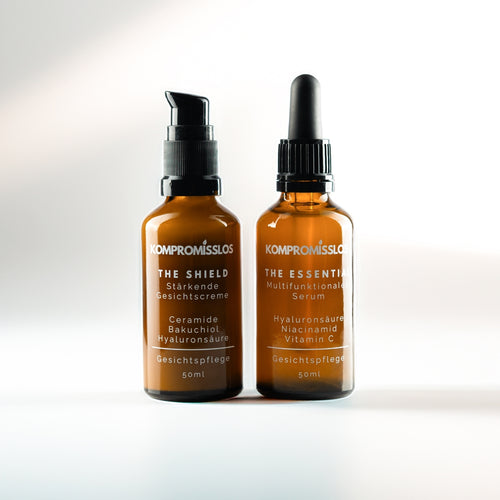
That is why the same order as every other day makes sense: first a light serum that binds moisture, then a cream that holds it in. With The Duo, that means The Essential with hyaluronic acid in three molecular sizes, followed by The Shield with ceramide NP and squalane on top. You do not need an extra mask, a toner or a ‘pore-closing’ water after steaming. In his review on Judge.me, Silas writes: ‘The skincare routine is super simple and therefore ideal for me, as I have no desire to spend a lot of time in the bathroom’ (review translated from German). Facial steaming does not turn this routine into a different programme.
I did not add an exfoliant or a toner to our range, because I believe a routine of two products instead of eight makes more sense. Facial steaming does not change that. It is a ritual if you enjoy it, but not an extra skincare step your skin needs. Afterwards, the same routine applies as on any other day: cleanse your face with water, then 3 to 6 drops of serum, followed by 3 to 6 pumps of cream, as described under how to use The Duo. Both products are fragrance-free, and for the same reason I advise against adding fragrant oils to your steaming water. I do not leave fragrance out of both products only for it to end up on your face via the bowl after all.
Frequently asked questions
Does steam open your pores?
No, steam does not open your pores, because pores have no muscle that could open and close them. Warmth softens the sebum inside them, which makes it easier to loosen. And why pores look bigger has to do with sebum, elasticity and age, not with warmth.
Does facial steaming help with spots?
No, facial steaming is not a remedy for spots. It can make open blackheads easier to loosen, but it does nothing for inflamed spots, and the warmth can even make redness worse. If you have recurring or painful spots, a dermatologist is the right person to see.
Is a facial steamer better than a bowl of hot water?
A facial steamer is not more effective, but it is often safer and more convenient. The device produces an even flow of steam, and you do not have an open bowl of boiling water in front of you. For your skin, the result is the same: warmth and a brief dose of moisture. So you do not need a device, as long as you handle the bowl carefully.
Can I steam my face if I have rosacea or couperose?
If you have rosacea or couperose, you are better off skipping facial steaming. Heat dilates the blood vessels and can make redness and burning worse. Whether any skincare suits rosacea, and if so which, is best discussed with your dermatologist; cosmetics can only accompany treatment, not replace it.
Should I cleanse my face before steaming?
Yes, cleanse your face first so that make-up, sunscreen and dirt are not worked into warm, softened skin. Lukewarm water or your usual mild cleanser is enough. Hot water and vigorous rubbing are unnecessary, as the warmth comes afterwards anyway.
Can facial steaming dry out your skin?
Yes, facial steaming can dry out your skin, especially if you steam for too long, too often or skip skincare afterwards. The water from the steam evaporates quickly and takes moisture with it. That is why dry and sensitive skin often feels tighter afterwards instead of looking plumper.
When do I apply The Duo after facial steaming?
Straight afterwards, as soon as you have briefly rinsed your face and gently patted it dry. First 3 to 6 drops of serum, then 3 to 6 pumps of cream, just as on any other day. No extra step is needed: The Duo with serum and cream is all the skincare you need after steaming.
Sources
- Cunliffe WJ, Burton JL, Shuster S. The effect of local temperature variations on the sebum excretion rate. British Journal of Dermatology, 1970. Source
- Baartmans M, Kerkhof E, Vloemans J, Dokter J, Nijman S, Tibboel D, et al. Steam inhalation therapy: severe scalds as an adverse side effect. British Journal of General Practice, 2012. Source
- Paulsen E, Christensen LP, Andersen KE. Cosmetics and herbal remedies with Compositae plant extracts – are they tolerated by Compositae-allergic patients? Contact Dermatitis, 2008. Source
- Paulsen E, Otkjaer A, Andersen KE. The coumarin herniarin as a sensitizer in German chamomile. Contact Dermatitis, 2010. Source
- Warner RR, Stone KJ, Boissy YL. Hydration disrupts human stratum corneum ultrastructure. Journal of Investigative Dermatology, 2003. Source