Sauna and your face: cleanse before, moisturise after and when to skip it
ROUTINE
The right skincare after a sauna is simple: moisturise your face, but only after your last round, once you have rinsed off the sweat with lukewarm water and your skin has stopped sweating. The products you normally use are all you need – a little more of them if your skin is dry. Before the sauna, wash off make-up, sunscreen and skincare; afterwards, water is enough. You do not need special masks. Take care if you are prone to redness, if your skin has just been exfoliated or if you have recently had a treatment.
Should you moisturise your face after a sauna?
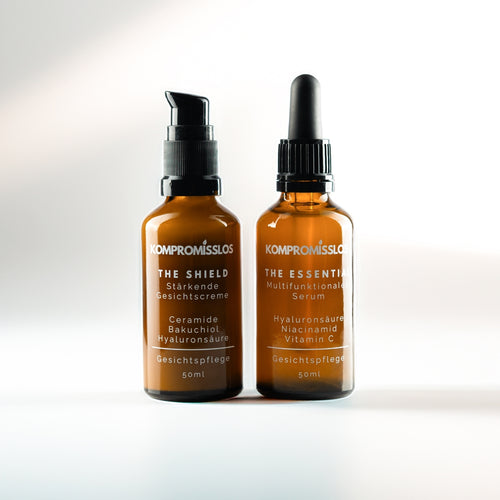
Yes, you should moisturise your face after a sauna – once at the end, not after every round. While you are in the heat, your skin sweats and blood flow is turned right up, so anything you apply at this stage mixes with sweat or simply runs back down your forehead. Skincare only makes sense once you have cooled down after your last round, rinsed off the sweat with lukewarm water and your skin is no longer beading with moisture. At that point, a cream helps cushion the loss of moisture that comes with the heat, the shower and the often dry air afterwards. What you do not need is a dedicated sauna regime with a mask, a booster and a special oil. The routine your skin tolerates well day to day is also the right one after a sauna. For us, for example, that means the serum and cream in The Duo; for you, it might be another routine that has proved itself. Trying out new products on a sauna day, on the other hand, is not a good idea: when your skin is warm and flushed, you cannot tell whether a stinging sensation is coming from the heat or from the product.
A general tip for serums with active ingredients: apply them after your time in the sauna rather than before. Before you sweat, a serum spreads unpredictably, and on hot skin with heightened blood flow, sensitive skin is more likely to tingle in response to certain active ingredients.
Should you wash your face before or after a sauna?
You wash your face both before and after a sauna, but for different reasons. Beforehand, the aim is to remove everything that gets in the way in the heat: make-up, sunscreen, your day cream and the grime of the day. Otherwise these layers mix with sweat and sebum to form a film that can run into your eyes and puts unnecessary strain on your skin. A mild cleanser is enough for this; you do not need a second round with an exfoliant or a cleansing brush. Afterwards, lukewarm water is enough in the vast majority of cases to rinse off sweat and salt. A second thorough wash with cleanser straight after the sauna strips even more lipids from your skin – precisely when heat and showering are already putting it under strain. If you take a cold shower between rounds, you do not need to cleanse your face every time; a quick rinse is enough. How mild ‘mild’ should be, and how to tell when a cleanser is too harsh, is covered in the article on what kind of cleanser your skin really needs.
- Before your first round: remove make-up, sunscreen and skincare with a mild cleanser, then pat your face dry.
- In the sauna: apply nothing, keep your hair off your face and get out sooner if you feel unwell.
- Between rounds: briefly rinse your face with cold or lukewarm water, without rubbing.
- After your last round: rinse off the sweat with lukewarm water and let yourself cool down until you have stopped sweating.
- Then: apply your usual skincare, a little more generously if your skin is dry.
What does sauna heat do to the skin on your face?
Sauna heat increases blood flow to the skin, makes it sweat and causes the stratum corneum, the skin’s outermost layer, to release more water for a short time. The blood vessels widen so that the body can get rid of heat, which is why your face turns red. At the same time, sweat evaporates from the surface. For healthy skin, this is generally not a problem – if anything, quite the opposite. A controlled study in the journal Dermatology compared 41 healthy people aged between 20 and 49: one group who used the sauna regularly and one who did not. The regular sauna-goers showed a more stable barrier function and higher hydration of the stratum corneum. After two 15-minute sauna rounds at 80 degrees Celsius, their elevated water loss and the pH of their skin’s surface recovered more quickly. They also had less sebum on their foreheads.
Two caveats apply. It was a small, exploratory study that only shows how the groups differ, not that saunas improve the skin. And it looked at healthy skin, not skin prone to redness. In skin like that, the widening of the blood vessels is exactly the part that causes trouble. If you already deal with facial redness in everyday life, you will often experience the sauna differently from someone with more robust skin.
Why does your skin feel dry after a sauna?
Your skin usually feels dry after a sauna because sweat evaporates, hot showers and cleansers remove lipids and the air afterwards is often dry – not because the sauna itself dries out your skin. A review in the American Journal of Medicine states that sauna bathing does not dry out the skin. At the same time, the study in Dermatology shows that the skin’s water loss is elevated after sauna rounds and then levels off again. So the tightness you feel after a sauna is often the result of several things together: a long hot shower, a second go with a cleansing gel, then winter cold or central heating on the way home. It is precisely at this moment that the stratum corneum is more prone to losing water than usual. Where the feeling of tight skin comes from is a topic in its own right. On a sauna day, the main thing is to cut down on irritants, not to add extra products.
If you also feel that tightness on days without a sauna, a lack of moisture is often the more likely cause. In that case, it is worth taking a closer look at how to recognise dehydrated skin and why it is not the same as dry skin. And because sauna season usually means winter: what mature, dry skin needs in the cold is covered in the article on winter face cream. If you combine your sauna day with a dip in a brine or thermal pool: what brine, sulphur and warm water do to your face is covered in the article on thermal baths and skin.
| Trigger | What happens | What to change |
|---|---|---|
| A long, hot shower afterwards | Even more skin lipids are dissolved | Rinse briefly with lukewarm water |
| A second wash with cleanser | The barrier is put under double strain | Use only water after the sauna |
| Cold air or central heating afterwards | Water evaporates faster from the stratum corneum | Moisturise before heading home |
| A new product on a sauna day | A reaction is hard to tell apart from the heat | Only use skincare you know your skin tolerates |
When should you be careful with saunas?
You should be careful with saunas above all if your skin reacts to heat with lasting redness, if it is currently irritated or has just been treated, or if sweat makes it itch. Heat is one of the well-known triggers for sensitive blood vessels. In an online survey in the Journal of Clinical and Aesthetic Dermatology, completed in full by 600 people who said they had been diagnosed with rosacea by a doctor, participants reported avoiding sun, hot baths and saunas, among other things, to prevent flare-ups. The review in the American Journal of Medicine also points out that sweating can make itching worse in atopic eczema. This does not mean saunas are off-limits for everyone with sensitive skin, but it is worth watching your own reaction honestly.
- With visible thread veins or couperose and broken capillaries: keep your rounds shorter, do not sit with your face at the top of the hottest bench, and if the redness lingers for days every time, talk it through with a professional.
- With diagnosed rosacea: whether a sauna is right for you is a question for your dermatologist. What skincare can do is covered in the article on rosacea skincare.
- With atopic eczema: if your skin itches more after sweating, discuss saunas with your dermatologist.
- After an acid peel, a course of retinoids or a scrub: better to skip a sauna day until your skin no longer stings.
- After laser treatment, microneedling, injections or a professional peel: stick to the break your practitioner recommends.
- With sunburn, broken skin or fresh inflammation: postpone the sauna.
Redness that fades once you have cooled down is the normal reaction to heat. If it lasts until the next day, or if stinging, pustules or swelling appear, that is a reason to get it checked, not to buy a new cream.
Does a sauna really open your pores?
No, a sauna does not open your pores in the sense of a gate that swings open and shut. Pores are the openings of hair follicles and their sebaceous glands; they have no sphincter muscle that warmth could open or cold could pull shut. A review in Dermatologic Surgery names three main causes of visibly enlarged facial pores: high sebum production, declining elasticity around the pore and increased follicle volume. Heat does not change any of these three causes in a lasting way. What warmth does do is soften sebum slightly, while increased blood flow makes the skin look plumper for a short time. That is why skin often looks smoother straight after a sauna. But the effect only lasts as long as the skin stays warm. The same goes for facial steaming at home. The popular idea that sweating flushes pores clean from the inside is not accurate either. Sweat comes from separate glands, not from the sebaceous duct. Why pores look larger over the years and what skincare can visibly refine is covered in the article on enlarged pores with age. For your sauna day, this means no squeezing on warm, softened skin – it tends to leave redness and marks rather than clearer skin.
We do not make a dedicated sauna product, and that is intentional. I built Kompromisslos on two products instead of eight, without an exfoliant and without a toner. So after a sauna, the same routine applies as on any other day: cleanse your face with water, apply 3–6 drops of serum, then 3–6 pumps of cream, working from the centre of your face outwards and down over your neck. If your skin is dry, use a little more. Making both products fragrance-free was a deliberate decision, especially for skin that reacts quickly. What skincare cannot do is prevent the redness that heat triggers in sensitive blood vessels. How to apply the serum and cream is deliberately kept simple, sauna days included.
Frequently asked questions
Why does my face go so red in the sauna?
Your face goes red in the sauna because the blood vessels in your skin widen so that your body can release heat. This is a normal reaction and fades once you have cooled down. If the redness lasts until the next day, stings or comes with pustules, you should have it checked by a dermatologist.
Can I wear make-up in the sauna?
Better not. In the heat, make-up mixes with sweat and sebum, runs and can put extra strain on your skin. Remove your make-up with a mild cleanser before your first round, and only put it back on once you have cooled down and moisturised after the sauna.
Is a face mask in the sauna a good idea?
It is not necessary. In the heat, a mask evaporates quickly or mixes with sweat, and on skin with heightened blood flow, sensitive skin types are more likely to react to active ingredients. If you like using a mask, it is better applied to cooled skin after your last round than on the sauna bench.
Can I go in the sauna after exfoliating?
After a strong acid peel or a scrub, it is better to skip the sauna until your skin no longer stings or feels tight. Heat and sweat intensify the irritation on freshly exfoliated skin. After a professional peel or laser treatment, stick to the break your practitioner gives you.
Is a sauna good for spots?
There is no solid evidence for that. Sweating does not cleanse your pores, because sweat comes from separate glands. In one study, regular sauna-goers did have less sebum on their foreheads, but that says nothing about spots. What matters is rinsing off the sweat afterwards. For persistent acne, a dermatologist is the right person to see.
How often is a sauna safe for your skin?
There is no fixed upper limit as far as your skin is concerned. Healthy skin generally copes well with regular sauna use; one study even found a more stable skin barrier in regular sauna-goers. What matters is how your skin reacts: if redness or tightness lasts longer each time, less frequent or shorter rounds make sense.
When do I apply The Duo after a sauna?
There is no special sauna rule for The Duo. You apply it the same way as usual: cleanse your face with water, then apply 3–6 drops of serum followed by 3–6 pumps of cream, working from the centre of your face outwards and down over your neck. If your skin is dry, use a little more. You can find out more about the serum and cream in The Duo on the product page.
Sources
- Kowatzki D, Macholdt C, Krull K, Schmidt D, Deufel T, Elsner P, et al. Effect of regular sauna on epidermal barrier function and stratum corneum water-holding capacity in vivo in humans: a controlled study. Dermatology, 2008. Source
- Hannuksela ML, Ellahham S. Benefits and risks of sauna bathing. American Journal of Medicine, 2001. Source
- Del Rosso JQ, Tanghetti EA, Baldwin HE, Rodriguez DA, Ferrusi IL. The Burden of Illness of Erythematotelangiectatic Rosacea and Papulopustular Rosacea: Findings From a Web-based Survey. Journal of Clinical and Aesthetic Dermatology, 2017. Source
- Lee SJ, Seok J, Jeong SY, Park KY, Li K, Seo SJ. Facial Pores: Definition, Causes, and Treatment Options. Dermatologic Surgery, 2016. Source