Thermal bath skin benefits: what brine, sulphur and warm water really do to your face
ROUTINE
For the skin on your face, a thermal bath is above all one thing: a great deal of warm water. It softens the skin’s outer layer and washes out lipids, which is why your skin often feels dry or tight afterwards. Brine can make it pull even more as it dries on your skin, while sulphur water has a mild peeling effect. None of this is dangerous for healthy skin. The solution is unspectacular: do not keep dunking your face, rinse briefly with lukewarm water after your last soak and apply your usual skincare as soon as you have dried off.
What does a thermal bath do to the skin on your face?
A thermal bath puts your facial skin under strain mainly through heat and time spent in the water, rather than through the minerals it contains. The skin’s outermost layer, the stratum corneum, absorbs moisture in the water and swells. At the same time, some of the skin lipids that sit between its cells like mortar between bricks are dissolved. Warm water does this faster than cool water. A study in the Journal of Clinical Medicine with 50 healthy volunteers shows how pronounced the effect can be: after soaking their hands for 10 minutes in water at an average of 41.29 °C, water loss through the skin rose from 25.75 to 58.58 g/h/m², whereas in cold water at around 11 °C it only rose to 34.96. The authors conclude that prolonged, continuous contact with water weakens the barrier function and that hot water does more damage.
The measurements were taken on the hands and after a single soak, not on the face. Even so, the direction is clear: an afternoon in a warm pool is a strain on the stratum corneum, not a restorative treatment. Whether a pool is also treated, for example with chlorine, varies from one spa to the next, and where it is, that adds to the strain.
Why does your skin feel dry after a thermal bath?
Your skin feels dry after a thermal bath because the water it has absorbed evaporates quickly once you get out, and the lipids that were washed out are no longer there to hold it in. In the pool your skin looks plump; ten minutes later it feels tight. That is not a contradiction but the same process in two phases. In winter, the cold, dry air in the outdoor pool or on the way home draws even more water out of skin that has just been soaking in warm water. Highly mineralised water also leaves fine residues behind as it dries, much like hard tap water at home. What happens there is explained in the article on what hard water does to your skin.
If the pulling feeling only appears after bathing and disappears once you apply your skincare in the evening, that is normal. If it lasts for days, it is worth understanding where the feeling of tight skin comes from. And if you go into the sauna between soaks, the heat is a second, separate issue. There is more on that in sauna and your face.
Is brine good for the skin on your face?
There is no evidence that brine has any particular benefit for healthy facial skin, but a brine bath does not usually harm intact skin either. Brine is salt water; in Swiss brine baths it is usually obtained from rock salt, so it consists mostly of common salt. A study on salt baths looked at something different: in the International Journal of Dermatology, volunteers with atopic dry skin bathed one forearm for 15 minutes at a time over six weeks in a solution of 5 per cent Dead Sea salt, and the other in tap water. On the salt side, the skin was better hydrated, less rough and less red. The authors attribute this mainly to the high magnesium content, which clearly sets it apart from the ordinary common salt in brine.
On the face, brine tends to show its less pleasant side. It stings in your eyes, in small cracks and on skin that has just been exfoliated or shaved. If you let it dry on your skin, it leaves a fine layer of salt behind that makes the tight feeling worse. That is the main reason to rinse your face briefly with clean water after a brine bath.
What does sulphur water do to your skin?
Sulphur water mainly has a mild peeling effect on the skin: the sulphur loosens the bonds between the cells of the outer layer and so helps the top layer of skin to shed more quickly. That is how a review in Evidence-Based Complementary and Alternative Medicine describes it, which also summarises the antimicrobial and anti-itch properties of sulphurous waters. The typical smell of rotten eggs comes from hydrogen sulphide, which is the form that matters here. Not every thermal water with sulphur on the label contains it: many springs contain sulphate, which is chemically something different and does not smell.
The same review also notes that concentrated sulphur water, and bathing in hot sulphur springs in particular, can irritate the skin, ranging from irritant dermatitis to chemical burns, which have been described in isolated cases. Sensitive skin that is prone to redness often reacts to the combination of heat and a mild peeling effect alone. If you are prone to facial redness, keep your face above the water and rinse it after bathing.
| Water | What it does to facial skin | What to watch out for |
|---|---|---|
| Warm thermal water | Softens the outer layer of skin, washes out skin lipids | Do not keep your face under water, take breaks |
| Brine | Can sting in cracks and eyes, dries the skin out further as it evaporates | Rinse with clean water after your last soak |
| Sulphur water | Has a mild peeling effect, can irritate sensitive skin | Keep your face above the water, rinse afterwards |
| Outdoor pool in winter | Cold, dry air draws extra water out of warm skin | Dry off and moisturise quickly, think about UV during the day |
Should you shower after a thermal bath or leave the mineral water on your skin?
After a thermal bath you should take a short, lukewarm shower, especially after brine and sulphur water and especially on your face. The widespread idea that the minerals should be left to work for as long as possible belongs to spa therapy, where baths are used under medical supervision specifically for certain skin conditions. Whether leaving mineral water on healthy facial skin brings any benefit has not been studied. What is clear, on the other hand, is that salt residue and the smell of sulphur on the skin are unpleasant and that sensitive skin is more likely to react to residues.
Rinsing does not mean scrubbing. Clean, lukewarm water is enough, and you do not need soap or a cleansing gel on your face if you removed your make-up before bathing. Then pat your skin dry with a towel instead of rubbing it. And water alone does not keep your skin hydrated – it evaporates. That is why what comes straight afterwards matters.
How should you care for your face before and after a thermal bath?
Before a thermal bath, cleanse your face; afterwards, moisturise it just as you would on any other day, only without delay. You do not need special products for your spa day. What matters is getting moisture and lipids onto your skin before it dries out further after towelling off. A simple routine looks like this:
- Before bathing: remove make-up and skincare with water or your usual cleanser, so that nothing softens on your skin in the warm water.
- In the outdoor pool during the day: apply sunscreen, because in warm water you barely notice the sun. There is more on this in sunscreen for your face.
- In the pool: keep your face above the water as much as possible and take breaks out of the water every so often.
- After your last soak: rinse your face briefly with lukewarm water and pat it dry with a towel.
- Straight afterwards: apply serum and cream, a little more than usual if your skin is dry.
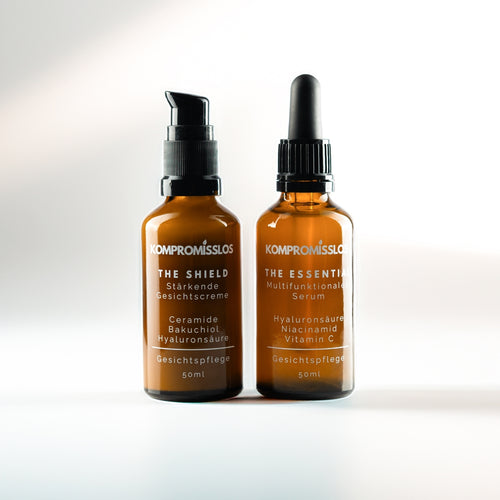
For the last step, a routine of a hydrating serum and a cream containing lipids is all you need. In The Duo, The Essential binds moisture with hyaluronic acid in three molecular sizes, while The Shield, with ceramide NP, squalane and jojoba oil, adds a protective layer on top. Both are fragrance-free, which matters for sensitive skin that has just been soaking in warm water. In her review on Judge.me, Nicole L. writes about her mature skin: “not shiny and greasy, just right, no tightness, still nourishing” (review translated from German). If your skin feels constantly rough and irritated even without thermal baths, it helps to know how to recognise a damaged skin barrier.
If you are also going into the sauna or steam room on the same day, there is no need to reapply cream to your face after every round. Once at the end, after your final rinse, is enough.
I have not made a special product for spa days: no bath additive, no thermal water spray, no special mask. Kompromisslos consists of two products, and after bathing they go on your face just as they always do, as described on the page on how to apply the serum and cream: after cleansing with water, and a little more if your skin is dry. Both products are fragrance-free, because fragrance adds nothing to skin that has just been put through its paces. And because the cream has no SPF, you need separate sun protection in the outdoor pool. That is a deliberate choice: I would rather have two products that do their job than one cream that does a little of everything. What no cream can do is undo a soak that was too long and too hot.
Frequently asked questions
How long should I stay in a thermal bath?
For your skin, shorter stays with breaks are gentler than hours on end. Stick to the guideline times the spa displays at the pools. Several short sessions with breaks out of the water put less strain on the outer layer of your skin than one long stay.
Can I go into a sulphur bath with sensitive skin?
Yes, as a rule you can go into a sulphur bath with sensitive skin, as long as your skin is intact. Keep your face above the water, do not stay in too long and rinse your skin with clean water afterwards. If your skin reacts with burning, marked redness or itching, get out. If you have a known skin condition, check with your dermatologist before you go.
Does brine sting on your face if your skin is irritated?
Yes, brine often stings noticeably on irritated, cracked or freshly exfoliated skin. Salt gets into tiny breaks in the skin and irritates the nerve endings there. It is usually not dangerous, just unpleasant. So do not plan an exfoliation or a shave right before a brine bath, and keep your face above the water while your skin is feeling sensitive.
Should I put my face under water in a thermal bath?
You do not need to put your face under water, and it is better for your skin if you keep it above the surface most of the time. Every dip prolongs contact with warm, often mineral-rich water. With brine and sulphur water, stinging eyes and residues on the skin come on top of that. Ducking under now and then is not a problem; doing it all the time is unnecessary.
Does a thermal bath help with atopic eczema or psoriasis?
For psoriasis and atopic eczema, there are signs of improvement from bathing in thermal mineral water, but no robust evidence. A systematic review in the International Journal of Biometeorology found only eight studies on the subject, often of low quality. Whether spa therapy is an option for you is something to discuss with your dermatologist. A visit to a thermal bath is no substitute for treatment.
Do I need sunscreen in an outdoor pool?
Yes, in an outdoor pool you need sunscreen on your face during the day, even in winter and when the sky is overcast. In warm water you barely notice the sun, and you often stay outside longer than planned. Apply a water-resistant sunscreen before bathing and reapply it after drying off if you are staying outside.
When do I apply The Duo after a thermal bath?
Apply The Duo after your last soak, as soon as you have rinsed your face with lukewarm water and patted it dry. Serum first, then cream, a little more than usual if your skin is dry. There is no need to reapply between sessions. Nor do you need an extra product for your spa day: the serum and cream in The Duo are enough.
Sources
- Herrero-Fernandez M, Montero-Vilchez T, Diaz-Calvillo P, Romera-Vilchez M, Buendia-Eisman A, Arias-Santiago S. Impact of Water Exposure and Temperature Changes on Skin Barrier Function. Journal of Clinical Medicine, 2022. Source
- Proksch E, Nissen HP, Bremgartner M, Urquhart C. Bathing in a magnesium-rich Dead Sea salt solution improves skin barrier function, enhances skin hydration, and reduces inflammation in atopic dry skin. International Journal of Dermatology, 2005. Source
- Carbajo JM, Maraver F. Sulphurous Mineral Waters: New Applications for Health. Evidence-Based Complementary and Alternative Medicine, 2017. Source
- Protano C, Vitali M, De Giorgi A, Marotta D, Crucianelli S, Fontana M. Balneotherapy using thermal mineral water baths and dermatological diseases: a systematic review. International Journal of Biometeorology, 2024. Source