Milia on your face: what causes these tiny white bumps and why you shouldn’t pop them
SKIN CONCERNS
Milia on your face are tiny, harmless keratin cysts, usually 1 to 2 millimetres across, trapped just beneath the top layer of skin. They tend to appear under the eyes, on the eyelids and on the cheeks. Because they have no opening and are filled with solid keratin rather than sebum, you cannot squeeze them out. Picking at them only injures your skin. The proper way to open them is with a sterile needle or a fine blade in a dermatologist’s hands – skincare alone will not remove them.
What are milia on the face?
Milia on the face are small, white, benign cysts filled with keratin, the same tough protein that makes up the top layer of your skin. The singular is milium, and in everyday language people often just call them little white bumps. A paper in the International Journal of Women’s Dermatology describes them as pearly white, dome-shaped bumps of 1 to 2 millimetres that, under the microscope, look like miniature versions of larger skin cysts. The medical literature divides them into two groups. Primary milia appear spontaneously, with no obvious trigger, and probably originate from the sebaceous collar of fine vellus hairs. Secondary milia develop after something has injured or altered the skin. What matters for putting them in context: milia are not inflammation, and they are not a pore clogged with sebum. They do not hurt, do not turn red and do not burst open. At the same time, they are often stubborn. They are very common in newborns: the dermatology reference DermNet puts the figure at 40 to 50 per cent of babies, and they usually disappear on their own within a few weeks. In adults, by contrast, they often stay for months.
How can you recognise milia, and how are they different from spots and blackheads?
You can recognise milia by the fact that they are pearly white, firm and round, sit under a wafer-thin layer of skin with no visible opening, and barely change even over weeks. A spot, on the other hand, is red, often tender to the touch, and comes and goes within a few days. A blackhead is an open or closed pore filled with sebum and dead skin cells, and the open kind is dark at the tip. If you run your finger over a milium, it feels like a tiny grain of sand under the skin. That feel is the simplest way to tell them apart. Location helps too: in adults, milia like to sit around the eyes, on the eyelids and on the cheeks. Spots and blackheads are more likely to turn up in the T-zone. If you see small dots on your nose, you are usually looking at sebaceous filaments or blackheads on your nose, not milia. Brownish raised patches that sit on top of the skin are a different matter again and are not milia either.
| Feature | Milium | Spot | Blackhead |
|---|---|---|---|
| Appearance | Pearly white, round, like a grain of sand | Red, often with a yellowish head | Small dot, dark when open, skin-coloured when closed |
| Contents | Solid keratin in a closed cyst | Sebum, dead skin cells, inflammatory cells | Sebum and dead skin cells in the pore |
| Opening | None | Forms in a pore | Pore open or closed |
| Typical areas | Under the eyes, eyelids, cheeks | Forehead, chin, jawline | Nose, forehead, chin |
| Course | Often stays for months | Usually settles within days to a few weeks | Comes and goes with sebum production |
Deep, painful lumps without a head are something else entirely. If that is what you can feel, it is worth reading up on spots under the skin and what causes them.
What causes milia, especially around the eyes?
What causes milia is not fully understood in the case of the common primary form. They form spontaneously, according to DermNet particularly on the eyelids and cheeks. A review in the Journal of the American Academy of Dermatology states explicitly that there are only a few studies on how they originate. The assumption is that keratin around fine vellus hairs does not make its way out as it should and instead becomes encapsulated in a tiny ball. Why the eye area in particular is affected so often is something research cannot answer with certainty. The picture is clearer for secondary milia. The paper in the International Journal of Women’s Dermatology names three groups of triggers: injuries to the skin, certain medications and skin diseases. Injuries also include procedures such as laser treatments, after which milia are a known side effect. With blistering diseases, very large numbers of milia can sometimes form, and according to the paper the exact mechanisms are still not fully understood.
In everyday terms, this means that a few milia under the eyes are almost always the harmless primary form. If lots appear suddenly, after an injury, after a procedure or where there used to be blisters, that is a matter for a dermatologist.
Can a rich eye cream or face cream cause milia?
A very rich, occlusive cream may possibly encourage milia, but there is no good evidence for this with ordinary skincare. The medical literature mainly names injuries, procedures, medications and blistering diseases as triggers, not your daily face cream. The clearest indication comes from a special situation: a study in the Journal of Cosmetic and Laser Therapy compared aftercare following CO2 laser treatment. In the group that had a petroleum jelly product applied for 24 hours directly after the procedure, 11.8 per cent developed milia; in the group without petroleum jelly, the figure was 1.5 per cent. However, the two groups also differed in the laser treatment itself, and freshly lasered skin cannot be compared with healthy skin. So this is no proof against your eye cream.
In practice, the question is still a fair one. If new milia keep appearing exactly where you have been applying a thick layer of eye cream for months, it makes sense to try using less product and a lighter texture. Existing milia will not disappear as a result, but over a few weeks you will see whether new ones stop appearing. Before you buy the next specialist product, it is worth asking yourself whether you really need an eye cream. Incidentally, a label saying “non-comedogenic” is of little help here, because the term refers to blackheads, not milia. More on what comedogenic really means.
Why shouldn’t you pop or squeeze milia yourself?
You should not open milia yourself, because a milium cannot be squeezed out without cutting the skin above it, and doing that under the eye with household tools can quickly lead to inflammation, scars or marks. A spot has a pore through which its contents can escape. A milium is completely sealed. Squeezing only crushes the surrounding tissue, and the milium usually stays where it is. Using a needle means working without sterile conditions, without good light and without magnification on the thinnest skin of your face, just a few millimetres from your eye. There is also a point that is rarely mentioned: injuries to the skin are themselves among the known triggers of secondary milia. DermNet therefore advises avoiding further trauma as far as possible so that no new ones form. Aggressive scratching and scrubbing can actually make the problem worse. The logic is the same as with why you should leave spots alone, except that with milia there is even less to gain.
- No sewing needles, pins or tweezers, not even disinfected ones.
- No comedone extractor under the eye – the pressure lands on very thin skin there.
- No daily scrubbing with a grainy exfoliant – the milium sits under an intact layer of skin.
- No experimenting with gadgets from the internet that claim to “suck out” or “vaporise” milia.
Who can remove milia safely, and can skincare help prevent them?
Milia are most safely removed by a dermatologist or, for individual uncomplicated milia, by a trained beauty therapist with experience and a clean working environment. A single milium is usually just emptied at the clinic: DermNet describes how the skin above it is opened with a sterile needle or a fine blade and the contents are then pressed out. It is a minor procedure, but it belongs in practised hands and under clean conditions. For multiple milia, the paper in the International Journal of Women’s Dermatology lists options including removal with a curette, electrocautery, freezing, topical tretinoin and laser, but notes that no comparative study shows which method works best. Which one is right is decided by the specialist based on the number, location and skin type. In babies, the question belongs with the paediatrician, even though neonatal milia usually disappear on their own.
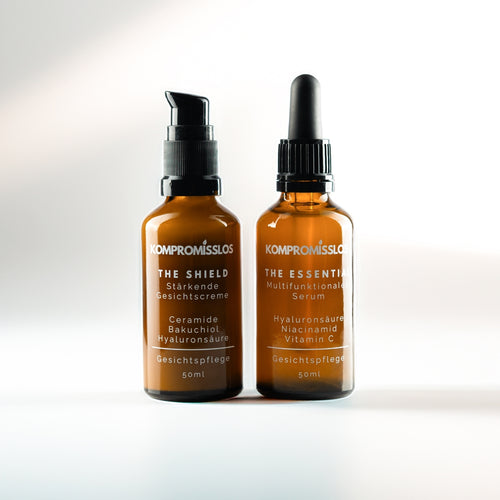
Skincare can only do so much to prevent them. What makes sense is anything that does not put extra strain on your skin: thin, measured layers rather than thick coats around the eyes, no mechanical friction, and an honest look at whether you need to exfoliate your face at all. A pared-back routine such as The Duo of lightweight serum and cream does not remove milia, nor does it prevent them. It contains neither retinol nor exfoliating acids such as glycolic or salicylic acid. The cream relies on squalane, jojoba oil and ceramide NP, without shea butter, mineral oil or petroleum jelly, and you decide the amount yourself: between 3 and 6 drops of serum and between 3 and 6 pumps of cream.
Take a photo of the area once a month in the same light. That way you can see whether new milia are appearing or whether they are the same ones, and you can show the specialist a clear progression at your appointment.
We deliberately have two products instead of eight in our range, and no separate eye product. I would rather offer facial skincare that you can dose drop by drop and pump by pump than an additional, often heavy cream just for the eye area. In the cream, I chose bakuchiol over retinol. That comes at a price, and I will say so openly: The Duo is not a remedy for milia. If you are very prone to them, it is better to discuss a retinoid with your dermatologist than to pin your hopes on a cream. What I can influence is the formula. It contains no mineral oil, paraffin, petroleum jelly or shea butter, and you will find the full list under all our ingredients from A to Z.
Frequently asked questions
Do milia go away on their own?
In babies, mostly yes – milia in newborns usually disappear within a few weeks. In adults, milia are considerably more stubborn. Some clear up after a few months, others stay for a long time. If a milium bothers you, having it removed professionally is the quicker route.
Does exfoliating help with milia?
Exfoliating does not reliably remove existing milia, because they sit under a closed layer of skin. A coarse grainy scrub can even irritate the thin skin under the eyes. Whether gentle exfoliation lowers the risk of new milia has not been well studied. If you want to try it anyway, keep it gentle and infrequent, and not directly under the eyes.
Does retinol help with milia?
Prescription retinoids such as tretinoin are considered an option in the medical literature when there are many milia. For over-the-counter retinol in cosmetics, there are no specific studies on milia, and it is also considerably weaker. Even a retinoid will not dissolve individual milia overnight. If you are badly affected, discuss retinoid treatment with your dermatologist.
Are milia dangerous?
No, typical milia are benign and medically harmless. You should have them checked if a large number suddenly appear, if they develop after an injury, a treatment or in places that previously blistered, or if you are unsure whether they are milia at all. For babies, the paediatrician is the right person to ask.
How much does milia removal cost?
That depends on the clinic, the number of milia and the method, so there is no standard price. Ask about the cost before your appointment. Purely cosmetic procedures are generally not covered by Swiss basic health insurance. Individual milia can usually be removed in a short session; laser or larger-scale treatments are more involved.
Why do I keep getting milia in the same places?
In adults, primary milia tend to form on the eyelids, under the eyes and on the cheeks – in other words, in the same areas again and again. Why they form in exactly those spots has hardly been researched. Check whether those areas are regularly exposed to friction or very thick layers of skincare. If they keep coming back despite a pared-back routine, it is worth talking about a retinoid.
Can I use The Duo if I am prone to milia?
Yes, you can use The Duo if you are prone to milia, but it does not remove or prevent them. The serum and cream contain neither retinol nor exfoliating acids such as glycolic or salicylic acid, and they are free from mineral oil, petroleum jelly and shea butter. You decide the amount yourself, between 3 and 6 drops or pumps, and can stay at the lower end. Removal remains a job for a specialist; for daily skincare, the Duo of serum and cream is enough.
Sources
- Berk DR, Bayliss SJ. Milia: a review and classification. Journal of the American Academy of Dermatology, 2008. Source
- Duplechain JK, Rubin MG, Kim K. Novel post-treatment care after ablative and fractional CO2 laser resurfacing. Journal of Cosmetic and Laser Therapy, 2014. Source
- Patsatsi A, Uy CDC, Murrell DF. Multiple milia formation in blistering diseases. International Journal of Women’s Dermatology, 2020. Source
- Gupta M, Oakley A. Milium. DermNet, 2009. Source