Spots under the skin: what causes them and what actually helps
SKIN CONDITION
Spots under the skin, often called blind spots, are inflamed nodules that sit deep in the skin and do not form a visible head. They develop when a blocked sebaceous duct ruptures deep down and the surrounding tissue reacts to it. Squeezing almost always makes them worse. Leaving them alone, gentle skincare and, if the nodules keep coming back, a dermatological assessment are the better way.
Why do spots form deep under the skin?
Spots under the skin form because the inflammation takes place not at the surface but deep in the sebaceous gland. It starts with the same process as any other spot and as blemish-prone skin in general: the duct of a sebaceous gland becomes more keratinised than it should, sebum and dead skin cells build up, and a microcomedo forms. If the wall of this duct ruptures low down rather than near the top, its contents spread into the surrounding tissue rather than onto the skin’s surface. The body responds with inflammation that has no outlet and therefore does not form a white head. That is exactly what you feel as a firm, tender lump, often days before anything is visible at all. According to the EuroGuiDerm guideline on acne treatment, four factors work together here: more sebum, altered keratinisation of the follicle, a shift in the skin microbiome and inflammatory messenger substances.
Whether a texture or an oil counts as comedogenic plays a smaller role than is often assumed. The deciding factors are the amount of sebum, keratinisation and genetic predisposition.
Why you shouldn’t squeeze a spot under the skin
Squeezing does not help with a spot under the skin, because there is nothing there that could come out. The contents sit too deep and are surrounded by inflamed tissue, not by an open duct that could be emptied. If you squeeze anyway, you push the material further into the tissue rather than out of it. The result is a larger inflammation that takes longer and affects a bigger area, and often redness that stays visible for weeks after it has subsided. This is where the real risk lies: the EuroGuiDerm guideline states that scars typically follow deep inflammatory lesions and that inflammation lasting longer is associated with more severe scarring. Every extra day of inflammation therefore increases the likelihood that something will remain permanently visible. The same logic applies to squeezing spots in general; it just carries much more weight with deep nodules.
What speeds up healing and what slows it down
A spot under the skin heals fastest if you leave it alone and do not irritate the skin around it any further. That sounds unsatisfying, but it is the only lever that skincare realistically has with a deep nodule. In concrete terms, this means: no squeezing, no checking it with your fingers, no exfoliating the area, no drying it out with alcohol, and no frequent switching of products out of impatience. What you can do instead is keep the barrier around it intact, so that the skin does not also react with redness, flaking and tightness. Many people find a warm, clean flannel held on the area for a few minutes soothing, and it takes the edge off the tenderness for a while. Active ingredients such as salicylic acid work in the upper part of the follicle and barely reach a deep nodule, which is why dabbing them on there mainly causes dryness and extra flaking without changing anything about the nodule itself.
Spot under the skin or cyst: how to tell the difference
The difference lies in size, consistency and how it develops. The EuroGuiDerm guideline defines nodules as firm, inflamed lesions more than 5 millimetres in diameter that are often painful to the touch; superficial papules and pustules measure 5 millimetres or less. A limit of 10 millimetres is also given for large nodules. A cyst, by comparison, feels plumper and softer, can sometimes be moved slightly, and often does not go away on its own but persists for months or comes back in the same place. The rule of thumb is simple: the larger, more painful and longer-lasting it is, the less it is a skincare matter and the more it needs to be looked at. The forms can only be reliably distinguished in a clinic anyway, but the table below will help you roughly assess the situation beforehand and draw the right conclusion.
| Feature | Surface spot | Nodule under the skin | Cyst |
|---|---|---|---|
| Size | up to about 5 millimetres | larger than 5 millimetres | often over 10 millimetres |
| How it feels | raised and soft | firm, deep, tender | plump and soft |
| Visible head | usually present | none | rarely |
| Typical duration | a few days | one to several weeks | months, or recurring |
| First step | continue your usual skincare | leave it alone | have it assessed by a dermatologist |
When skincare is enough and when to see a professional
A single spot under the skin every few months is not a case for a clinic, but recurring nodules or several at once are. Skincare may care for the skin, visibly calm it and support its barrier. But skincare does not treat inflammatory skin disease and is no substitute for a diagnosis. For moderate to severe nodular acne, the EuroGuiDerm guideline recommends systemic therapy, meaning prescription medication under medical supervision. That is a deliberate boundary, not small print. See a dermatologist if nodules keep appearing in the same place, if they last longer than a few weeks, if they are very painful, if they are already leaving scars, or if the situation is weighing on you emotionally. The sooner the inflammation is stopped, the lower the risk of scarring. In this case, waiting ends up costing more than a single consultation, because scars can only be tackled later with considerable effort.
What skincare makes sense for spots under the skin?
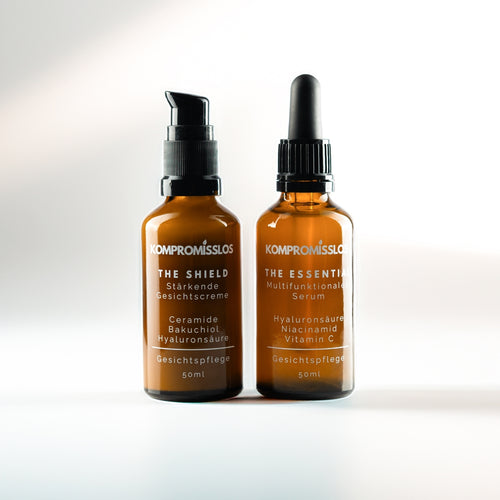
What makes sense is a calm basic routine that does not irritate the skin further – not a course of treatment with a constant stream of new active ingredients. Troubled skin is often over-treated: cleanse, exfoliate, dry out individual spots, then apply a rich cream to counter the resulting dryness. This cycle weakens the barrier and makes redness more visible instead of calming the complexion. The Duo of serum and cream is designed for exactly this: two products, morning and evening, without exfoliating acids and without alternating treatments. Among other things, the Duo as a whole contains 5% niacinamide, 1% zinc and 2% gentian root extract, plus ceramides and squalane for the barrier. The full list of active ingredients is openly available, including percentages. Three to six drops of serum and three to six pumps of cream are quite enough; more product will not change anything about a deep nodule. How to combine serum and cream is explained in the instructions for use.
Before buying, one customer wrote to tell us that for months she had repeatedly had a painful lump on her chin, always in the same place, and asked whether the Duo would help. The honest answer was no. Recurring nodules in a fixed spot need to be assessed, and no cream can replace that. In a situation like this, the Duo can be the calm foundation alongside, but nothing more.
I deliberately chose not to include salicylic acid or benzoyl peroxide in our formulas. Both have their place with troubled skin, but they belong in targeted treatment, not in a basic routine that goes on every kind of skin every morning and evening. Kompromisslos has exactly two products, and they should work just as well for sensitive skin as for troubled skin. That is why, in our two products, I rely on niacinamide, zinc and gentian root rather than exfoliating acids. If you have deep nodules, you do not need a stronger cream; you need a professional opinion. I say that even when it costs me a sale.
Frequently asked questions
How long does a spot under the skin last?
A spot under the skin usually lasts one to several weeks, much longer than a surface spot, which is often gone within a few days. The reason is its depth: the inflammation has no outlet and has to be broken down by the body. If the nodule lasts longer, it is worth having it assessed by a dermatologist.
What should you do about a painful spot under the skin?
With a painful spot under the skin, the most important thing is not to touch it. Many people find a warm, clean flannel held on it for a few minutes soothing. Avoid exfoliants, alcohol and spot-drying treatments in that area. If severe pain persists or the area keeps swelling, it should be looked at by a doctor.
Can I open a spot under the skin with a needle?
No. A needle cannot reach the source of the inflammation, because it lies too deep, but it does injure the skin above it. This increases the risk of a larger inflammation and of a visible scar. Whether a nodule needs to be opened is a decision for a dermatologist, under sterile conditions.
Do drawing ointment or home remedies help with spots under the skin?
Drawing ointment is a medicinal product, not a cosmetic, so questions about it belong at the pharmacy or the doctor’s. As for home remedies such as toothpaste or lemon: both irritate the skin further and are more likely to prolong the inflammation than improve anything. Doing less usually works better here.
Why do spots under the skin keep coming back in the same place?
Recurring nodules in the same place suggest that the same follicle or area of tissue is becoming inflamed again and again. This can point to a cyst or another skin change that is different from a single spot. This very pattern is a good reason to have the area assessed by a dermatologist.
Can skincare prevent spots under the skin?
Skincare cannot reliably prevent deep nodules, because sebum production, keratinisation and genetic predisposition are the deciding factors. However, a calm, consistent routine without constant product changes and without aggressive exfoliation helps avoid irritating the skin further. If you get nodules often, you need a medical assessment rather than a new cream.
Sources
- Nast A. et al., Update of the EuroGuiDerm evidence-based guideline for the treatment of acne, Short version, Journal of the European Academy of Dermatology and Venereology, 2026. Source
- Nast A. et al., EuroGuiDerm Evidence-based Guideline for the Treatment of Acne, long version, Update 2025, European Dermatology Forum. Source