Toothpaste on spots: why this home remedy irritates more than it helps
SKIN CONCERNS
Toothpaste on spots does not help: it contains no active ingredient designed for blemishes on the skin, but it does contain foaming agents, flavourings and additives that can irritate facial skin. The impression that the spot has shrunk overnight comes from the surface drying out, not from faster healing. More often, what you are left with is a red, flaky patch that stays visible for longer than the spot itself. You can skip the dab of toothpaste.
Does toothpaste really help with spots?
No, toothpaste does not help with spots, and there is no study showing that it works as a spot remedy. Toothpaste is made for teeth and gums: it is meant to loosen plaque, deliver fluoride to tooth enamel and leave your breath feeling fresh. None of these jobs matters for an inflamed spot. What is left on the skin is a mixture of surfactants, abrasives, flavourings and humectants that sits on an already irritated area for several hours. A spot is inflammation inside the pore. It happens beneath the surface, and that is exactly where the paste cannot reach. So the question of how long you should leave toothpaste on a spot does not even arise. The longer it stays on, the more time its ingredients have to attack the top layer of your skin. If you get spots regularly, the answer does not lie in an emergency trick but in a calm routine for blemish-prone skin that you stick to every day.
One important point for context: acne with lots of inflamed spots, painful lumps or scarring is a medical condition. It belongs with a dermatologist, not on the bathroom shelf.
Where does the toothpaste tip come from, and why does it seem to work?
Exactly where the tip comes from is not documented, but it rests on a simple idea: a spot is ‘too much oil’, and anything that dries it out will make it smaller. There is an understandable reason why it seems to work. A thick layer of paste really does draw moisture out of the skin’s surface overnight. In the morning, the spot looks flatter and less shiny, and the head has dried out. That is a surface effect. The inflammation underneath runs at its own pace, and an inflamed spot usually takes several days, whatever you put on top. Then there is a trick of perception: people tend to reach for the toothpaste when the spot has already peaked. It would have started to settle afterwards even without the paste. What often remains is not the spot but a dry, slightly flaky and reddened area around it. The next day, that area is more noticeable than the small white head was before. The tip persists all the same, because there is toothpaste in every bathroom and it gives you the feeling of doing something straight away.
Which ingredients in toothpaste irritate facial skin?
The main irritants in toothpaste are the surfactant sodium lauryl sulfate and flavourings such as peppermint, menthol or cinnamon, plus bicarbonate of soda or whitening agents in some products. Sodium lauryl sulfate (SLS) is what makes many toothpastes foam. In skin research, it is precisely the substance used to trigger irritation on purpose: a review in the journal Contact Dermatitis describes SLS as the most widely used model for studying acute and repeated skin irritation. A laboratory study in PLOS ONE tested typical toothpaste ingredients on reconstructed gum tissue. At the levels found in the toothpastes tested, lemon, peppermint, cinnamon and the surfactant (referred to there as sodium dodecyl sulfate) were above the concentration at which half of the cells die, and they caused visible tissue damage. Fluoride stayed below that level and showed no clear tissue damage. The model is the lining of the mouth, not facial skin, but it shows which substances have any irritant potential at all.
| Ingredient | Job in the toothpaste | What it can do on a spot |
|---|---|---|
| Sodium lauryl sulfate (SLS) | Foaming, spreading | Irritates the skin’s outer layer, causing redness and tightness |
| Menthol, peppermint, cinnamon | Flavour, fresh feeling | Stinging, tingling, contact allergy in some people |
| Bicarbonate of soda | Cleaning action, flavour | Alkaline, pushes the skin’s acidic pH upwards |
| Hydrogen peroxide and other whitening agents | Whitening teeth | Can sting on broken or irritated skin |
| Fluoride | Protection against tooth decay | Less irritating than the surfactant and flavourings in the lab comparison |
It is documented that toothpaste ingredients can also cause reactions around the mouth. A review in Dermatitis assessed the medical literature on contact allergy to toothpaste: the reactions usually show up as inflamed lips, with or without eczema around the mouth, and in the past they were often caused by cinnamon compounds. If you notice persistent redness or small bumps around your mouth and at the corners of your lips, have it checked by a doctor rather than layering on more home remedies.
What does the pH of toothpaste do to the skin barrier?
Toothpaste is formulated for the mouth, not for the slightly acidic pH of the skin, and alkaline varieties with bicarbonate of soda in particular can further weaken the barrier of an area that is already irritated. Healthy skin is slightly acidic. A study in the International Journal of Cosmetic Science with 330 participants puts the natural pH of the skin’s surface at an average of 4.7. In the same study, skin with values below 5 was in better condition, measured by barrier function, moisture and scaling. According to this study, even tap water with a pH of around 8 raises the skin’s pH for up to 6 hours before it recovers. A paste left on a spot overnight stays on the skin far longer than a quick splash of water. Bicarbonate of soda (sodium hydrogen carbonate) is alkaline. On a spot, it hits an area that is already inflamed and whose barrier is already weakened. The result is tightness, fine flaking and redness that spreads beyond the spot. If you want to know how to recognise a damaged skin barrier, you will find the typical signs explained in detail there.
What should you do if the area stings or turns red after toothpaste?
If the area stings or turns red after toothpaste, wash the paste off straight away with lukewarm water and do not put anything harsh on afterwards. At this point it is no longer about the spot, but about limiting the damage to the skin around it. The most common mistake is to tackle the redness with the next home remedy, such as alcohol or lemon. Every further irritant drags out the recovery.
- Wash it off: remove all the paste with lukewarm water, do not rub, and gently pat dry.
- Pause active ingredients: do not use exfoliants, acids or spot sticks on the area for a few days.
- Keep your skincare gentle: apply a fragrance-free product without essential oils that provides moisture and supports the skin barrier.
- Do not squeeze it or cover it with heavy layers: your skin needs to be left in peace now.
- Keep an eye on it: if blisters form, the area starts to weep or the redness spreads after a few days, see a doctor.
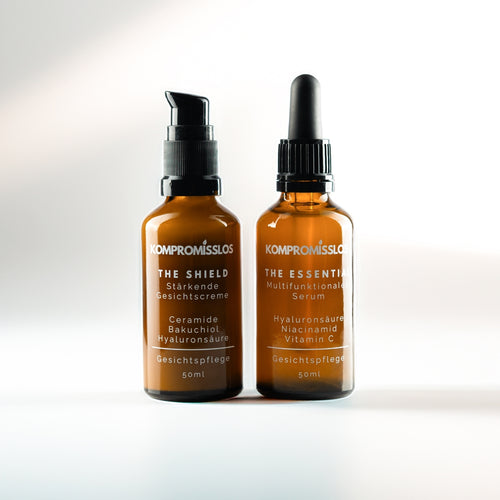
For gentle everyday skincare, a short routine with a serum and a cream is enough, such as The Duo of fragrance-free serum and cream, used morning and evening after cleansing with water. The Duo contains 5% niacinamide and 1% zinc PCA (figures for The Duo as a whole), and The Shield contains ceramide NP and squalane for the skin barrier. It is not a spot product. What else makes sense with a fresh spot, including spot patches, is covered in the guide on what helps instead of squeezing spots.
A red patch after toothpaste is usually irritated skin, not the spot getting bigger. It settles if you leave it alone. Every further product that stings resets the clock to zero.
Which other home remedies for spots irritate in a similar way?
Any home remedy that is strongly acidic, strongly alkaline, alcohol-based or heavily scented irritates in a similar way, because on an inflamed area it attacks the same barrier as toothpaste. What these remedies have in common is the instant sense that something is happening: stinging, tightening or drying out. That sensation is not a sign that they are working, but a sign of irritation. The most common candidates at a glance:
- Lemon juice: strongly acidic, and on irritated skin it stings even more.
- Bicarbonate of soda as a paste: alkaline, pushes the skin’s acidic pH upwards and dries out the area.
- Alcohol or disinfectant: strips oil from the surface and dries out the skin around the spot, not the spot itself.
- Neat tea tree oil: undiluted on the skin, it is a well-known trigger of irritation; there is more on this under tea tree oil and other essential oils on the skin.
- Vinegar: acidic and harsh when undiluted, and the concentration is hard to control at home.
Many of these remedies also crop up as tips for dry skin. Why that rarely works out is explained in the article on home remedies that tend to do your skin more harm than good.
I deliberately left a spot product, an exfoliant and a toner out of our range. There are only two products, both fragrance-free and without essential oils, because an irritated area does not need yet another harsh step. But that also means The Duo will not dry out a spot overnight, and it is not meant to. It is designed for daily skincare, morning and evening, so that your skin looks calmer overall. If you get recurring, painful spots, no cream replaces an appointment with a dermatologist. You can check for yourself what is in the Duo and what is not in the full INCI list, free from menthol and fragrance.
Frequently asked questions
Does toothpaste dry out a spot overnight?
At most, toothpaste dries out the surface of the spot, not the inflammation underneath. In the morning the head looks flatter, but the redness in the tissue remains. Often the skin around the spot is dry and flaky as well, so the area as a whole is more noticeable than before.
Is white toothpaste better than gel toothpaste?
No, neither is a spot remedy. Whether it is a white paste or a gel, both usually contain surfactants and flavourings. The irritation comes from ingredients such as sodium lauryl sulfate, menthol or bicarbonate of soda, not from colour or texture. So the distinction makes no difference to your skin.
Does toothpaste help with blackheads?
No. Blackheads are pores clogged with sebum and dead skin cells, and toothpaste does not dissolve these plugs. It only dries out the surface and can irritate the skin. Rubbing it in is more likely to leave you with red patches than with a clear pore.
Can toothpaste leave a dark mark?
Yes, it can, because any extra irritation of an inflamed spot can encourage redness or pigmentation once the inflammation has gone. Marks like these often last longer than the spot itself. You can read more about how acne marks fade in a separate guide.
Is toothpaste with bicarbonate of soda or charcoal gentler?
No, if anything it is the opposite. Bicarbonate of soda is alkaline and pushes the skin’s acidic pH upwards. Activated charcoal toothpastes often contain surfactants and flavourings too. A natural-sounding additive does not turn a product for your teeth into skincare for your face.
What works overnight instead of toothpaste?
Realistically, nothing will make an inflamed spot vanish overnight, because it usually takes several days. Cooling it and leaving it alone is the gentlest option. Spot ingredients such as benzoyl peroxide or salicylic acid are available from the pharmacy, where you can get advice. What else makes sense with a fresh spot is explained in the guide Squeezing spots: what helps instead.
Do I need an emergency spot stick if I use The Duo?
Not necessarily. The Duo is not a spot product but a serum and cream for every day, fragrance-free and without essential oils, for a more even-looking complexion over time. It will not dry out a single spot overnight. If you use an active ingredient from the pharmacy for that, apply it only to the spot itself and then carry on with your usual skincare using The Duo.
Sources
- Lee CH, Maibach HI. The sodium lauryl sulfate model: an overview. Contact Dermatitis, 1995. Source
- Kasi SR, Roffel S, Özcan M, Gibbs S, Feilzer AJ. In vitro cytotoxicity (irritant potency) of toothpaste ingredients. PLOS ONE, 2025. Source
- de Groot A. Contact Allergy to (Ingredients of) Toothpastes. Dermatitis, 2017. Source
- Lambers H, Piessens S, Bloem A, Pronk H, Finkel P. Natural skin surface pH is on average below 5, which is beneficial for its resident flora. International Journal of Cosmetic Science, 2006. Source