Dry skin and breakouts: how to care for both without making either worse
SKIN CONCERNS
Dry skin and acne breakouts are not a contradiction: the outer layer of your skin can hold on to too little oil and moisture and still develop clogged pores. What helps then is not a stronger spot treatment, but a routine that takes both problems seriously at the same time. Cleanse gently, use drying active ingredients sparingly, support the barrier with ceramides and humectants, and don’t skip your moisturiser just because you have spots. If the spots are deep, painful or leave scars, have them checked by a doctor.
Why can you have dry skin and acne at the same time?
You can have dry skin and acne at the same time because sebum production in the pore and the lipid content of the skin’s outer layer are two different things. Sebum is made in the sebaceous glands and can clog pores. The protective layer at the surface, the stratum corneum, consists mainly of ceramides, cholesterol and free fatty acids between the skin cells. If these lipids are lacking, the skin loses water, feels tight and flakes, even while spots are forming underneath. A study in the Archives of Dermatological Research compared 36 people with acne and 29 without. In both mild and moderate acne, the outer layer contained fewer ceramides, and the water barrier was correspondingly weaker. Only the people with moderate acne, however, produced more sebum than the control group.
In everyday terms, this means that breakouts are not proof that your skin is too oily and needs its oil stripped away. Often the dryness only appears because of the very products meant to fight the spots. The general causes of blemish-prone skin and what actually helps are covered in a separate guide. Here, the focus is on the special case in which dryness and spots occur together.
Combination skin or dry, spot-prone skin: what’s the difference?
The difference lies in where the problems show up: combination skin is shiny in the T-zone and dry on the cheeks, whereas dry, spot-prone skin feels tight almost everywhere, including where the spots are. With combination skin, the two problems are kept apart by area. With dry skin and blemishes, they overlap: the spot itself flakes, the skin next to it feels rough after washing, and hardly any shine appears, even by midday. A third variant is often mistaken for these: skin that is shiny and still feels tight. That is usually dehydrated, blemish-prone skin, meaning a lack of water combined with normal or increased sebum production. How to tell dehydrated skin from dry skin is a topic of its own. If it is more a question of zones, the guide on how to recognise combination skin will help.
| Skin condition | How it feels | Shine | What’s going wrong |
|---|---|---|---|
| Dry, spot-prone skin | Tight almost everywhere, flaking even around spots | Hardly any, not even at midday | Too few lipids in the outer layer plus clogged pores |
| Combination skin | Dry cheeks, oily T-zone | Forehead, nose, chin | Different amounts of sebum depending on the zone |
| Dehydrated, blemish-prone skin | Tight after washing, yet still looks oily | Yes, often by mid-morning | Lack of water with normal or increased sebum production |
Which spot treatments dry out your skin even more?
The most drying are benzoyl peroxide, retinoids such as adapalene, salicylic acid used very frequently, toners with a lot of alcohol, heavily foaming cleansers and clay masks – especially when several of them are in use at the same time. The problem is rarely a single product, but the sum of them. A study in the Journal of Drugs in Dermatology showed this clearly: all participants applied a gel containing 0.3% adapalene and 2.5% benzoyl peroxide once a day. The combination measurably damaged the skin barrier: water loss increased, and dryness, redness and scaling followed. The group that also used a ceramide-containing cleanser and lotion had lower water loss at every measurement point, less dryness and also fewer inflamed spots than the group using a simple foaming wash.
This is the most important takeaway for dry, spot-prone skin: drying out is not a sign that a product is working. If you skip your moisturiser because of flaking and tightness, you lose the very part of the routine that makes an effective spot treatment tolerable in the first place. With salicylic acid, dry skin often does better with targeted application on individual spots than with a daily toner. And when three active ingredients, two masks and an exfoliant are stacked on top of each other, the mix of spots and dryness is often down to skincare overload. Don’t stop prescribed medication on your own, though – discuss the dryness with the healthcare professional who prescribed it.
Which ingredients care for dry skin without clogging pores?
Good choices are humectants such as glycerin, hyaluronic acid and panthenol, skin-identical lipids such as ceramides and squalane, and niacinamide, because they support the barrier without leaving a heavy film. There is no guarantee, though: ‘non-comedogenic’ is not a protected term, and whether a product makes you break out also depends on the formula as a whole. Niacinamide is particularly interesting for this skin type. In a study in the British Journal of Dermatology, nicotinamide increased ceramide production in cultured human skin cells 4.1- to 5.5-fold. Applied to the skin, it raised the levels of ceramides and free fatty acids in the outer layer and reduced water loss in dry skin.
- Humectants: glycerin, hyaluronic acid and panthenol bind water in the outer layer of the skin.
- Barrier lipids: ceramides and squalane replenish what the outer layer is missing and feel light on the skin.
- Complexion: niacinamide and zinc PCA for a calmer, more even-looking complexion, without stripping oil.
- Test with care: very rich butters, thick oils and heavily occlusive balms, if your skin is quick to break out.
The limits become clear with skin that is missing a great deal of oil. What that lipid gap looks like in very dry skin on the face is covered in a separate guide. In her review on Judge.me, Michaela B. writes: ‘The only thing is that the moisture from the Duo alone isn’t enough for me, which is why I have to help things along a little with a facial oil’ (review translated from German). If your skin is missing a lot of oil, an extra layer of oil can do it good. If you are prone to spots, try the oil on a small area first.
What does a routine for dry, spot-prone skin look like?
A routine for dry, spot-prone skin consists of a gentle cleanser, a serum with humectants and ingredients for your complexion, a moisturiser with barrier lipids and, during the day, sunscreen. A targeted spot treatment is at most an addition, not the foundation. The order looks like this:
- Cleanse: in the morning, lukewarm water is often enough; in the evening, use a gentle cleanser that doesn’t foam heavily.
- Serum: on freshly cleansed skin, with humectants, niacinamide or zinc PCA.
- Moisturiser: always, including on the areas with spots, with ceramides and light lipids.
- Sunscreen: during the day as a separate step, especially if you also use acids or retinoids.
- Targeted active: if needed, just one – for example salicylic acid on individual spots a few evenings a week.
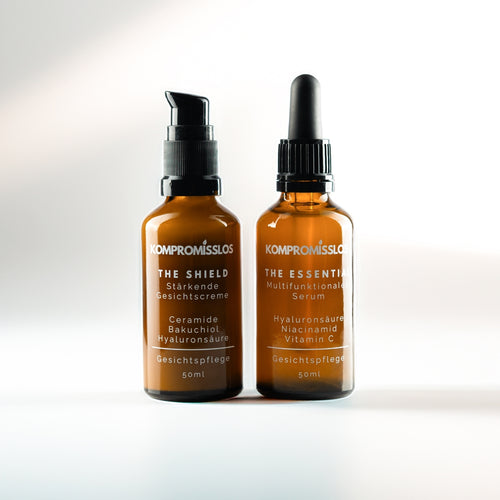
This is exactly the profile that The Duo with serum and cream covers: zinc PCA and niacinamide in the serum, at 1% and 5% respectively across the Duo as a whole, plus ceramides, squalane and hyaluronic acid in the cream – fragrance-free and without drying acne products. You will need a cleanser and sunscreen separately. Introduce new products one at a time, not all in the same week; otherwise you won’t know what is calming or irritating your skin.
If your skin is flaking and breaking out at the same time, take something away before you buy anything new. With dry, spot-prone skin, one drying active ingredient fewer often does more than a new spot treatment.
When should you have your spots checked by a doctor?
You should have spots checked by a doctor if they are painful and deep, leave scars or dark marks, don’t improve over several months despite a gentle routine, or weigh on you in everyday life. At that point, you are dealing with acne as a skin condition, and there are effective therapies for it. The 2024 guideline from the American Academy of Dermatology makes strong recommendations for benzoyl peroxide, topical retinoids, topical antibiotics and oral doxycycline. Salicylic acid and azelaic acid receive only a conditional recommendation. The topical options in particular often dry the skin out, though, which is why the skincare you use alongside them becomes not less important but more so.
You should also get small spots checked if they burn rather than hurt, cluster around your mouth or nose, or suddenly appear after you have switched products. Something other than ordinary blemishes may be behind them. And if spots only come back in midlife, there are often other reasons. There is a separate guide on breakouts in your 40s.
I decided on two products rather than eight, and that applies to dry skin with spots too: no spot gel for one patch and no heavy cream for the rest, but one routine for both. That is why zinc PCA and niacinamide are in the serum, and ceramides, squalane and hyaluronic acid are in the cream, with disclosed concentrations and no fragrance. What the Duo can’t do: it does not replace medical acne therapy, and it neither cleanses your skin nor protects it from the sun. If your skin is dry, simply use a little more cream – you don’t need a special product for that. You can see what job each ingredient does on the page with all the active ingredients in the Duo.
Frequently asked questions
Is salicylic acid too much for dry skin?
Not in principle, but used daily all over the face, it is often too much for dry skin. Salicylic acid loosens skin cells inside the pore and can put extra strain on a protective layer that is already in short supply. It works better on individual spots or on a few evenings a week, always followed by moisturiser. If your skin feels tight and stings, take a break.
Can you use a rich cream on dry, spot-prone skin?
Yes – in fact, dry, spot-prone skin needs a cream that replenishes lipids. What matters is less how rich it feels than what it is made of. Ceramides, squalane and humectants support the barrier without a heavy film. Test very thick butters or balms on a small area first before using them all over your face.
Do oils help dry, spot-prone skin?
Oils can help if your skin is missing a lot of oil, but they are not a compulsory step. Many people with blemishes tolerate light lipids such as squalane well; heavy oils, not always. An oil does not replace moisture, so it goes on top of your serum and cream, not in their place. If your skin reacts with new spots, leave it out again.
Can over-cleansing cause spots?
Over-cleansing does not cause spots directly, but it can make things worse. Frequent or heavily foaming washing strips lipids from the outer layer of the skin, which becomes rough and irritated and reacts more sensitively to other active ingredients. For dry, spot-prone skin, a gentle cleanser in the evening is enough, and in the morning lukewarm water often is too.
Does zinc help dry, spot-prone skin?
Zinc PCA can contribute to a calmer, more even-looking complexion without stripping much oil. For dry, spot-prone skin, it is therefore more of an addition to humectants and barrier lipids than a replacement for them. Zinc alone is not enough if your skin is mainly lacking oil and water.
How long does it take for skin to calm down?
Expect a few weeks, not days. The outer layer of the skin renews itself continuously, and spots that appear today have often been developing for some time. So give a calm routine time before you judge it, and don’t keep switching products in the meantime. If things get noticeably worse, have your skin checked.
Is The Duo suitable for dry skin with spots?
Yes, the combination suits this skin type: zinc PCA and niacinamide in the serum for a more even-looking complexion, and ceramides, squalane and hyaluronic acid in the cream for barrier and moisture, all fragrance-free. If your skin is very dry, use a little more cream. The Duo does not replace medical acne therapy, but it can accompany it as calm, gentle skincare.
Sources
- Yamamoto A, Takenouchi K, Ito M. Impaired water barrier function in acne vulgaris. Archives of Dermatological Research, 1995. Source
- Draelos ZD, Baalbaki N, Colon G, Dreno B. Ceramide-Containing Adjunctive Skin Care for Skin Barrier Restoration During Acne Vulgaris Treatment. Journal of Drugs in Dermatology, 2023. Source
- Tanno O, Ota Y, Kitamura N, Katsube T, Inoue S. Nicotinamide increases biosynthesis of ceramides as well as other stratum corneum lipids to improve the epidermal permeability barrier. British Journal of Dermatology, 2000. Source
- Reynolds RV, Yeung H, Cheng CE, Cook-Bolden F, Desai SR, Druby KM, et al. Guidelines of care for the management of acne vulgaris. Journal of the American Academy of Dermatology, 2024. Source