Is coconut oil good for your face? Why it doesn’t suit every skin
ACTIVE INGREDIENTS
Coconut oil is not good for every face. On dry, resilient skin it can work as a rich layer of fat, because it slows down water loss. On combination skin, oily skin and skin prone to breakouts, however, it is often too heavy and can clog pores. Coconut oil supplies neither moisture nor active ingredients – it is pure fat. If you want to try it, use very little, watch your skin for two to three weeks and stop if new spots appear.
Is coconut oil good for your face?
Coconut oil is only good for your face up to a point: it can make dry skin feel softer, but it does not replace facial skincare and is too heavy for many skin types. Coconut oil is pure fat with no water in it. It forms a film on the skin and slows down the evaporation of moisture. Right after you apply it, your skin feels soft and nourished. What it does not get are humectants such as glycerin or hyaluronic acid, or active ingredients that specifically target the skin barrier, redness or pigmentation.
The best-known study on coconut oil as a moisturiser was not carried out on the face: in a randomised double-blind trial published in the journal Dermatitis, virgin coconut oil worked as well as mineral oil over two weeks on the legs of 34 people with mild to moderate dry skin. That is a solid result for the body, but it cannot be transferred one to one to facial skin with its many sebaceous glands. How coconut oil compares with other kitchen oils is covered in the article on home remedies for dry facial skin.
What is in coconut oil, and why does it turn solid at room temperature?
Coconut oil consists mostly of saturated fatty acids, above all lauric acid, and that is exactly what makes it solid at a cool room temperature. A review in the International Journal of Molecular Sciences puts the share of lauric acid at 49 per cent, followed by myristic acid at 18 per cent and palmitic and caprylic acid at 8 per cent each. Unsaturated fatty acids hardly play a role: oleic acid accounts for 6 per cent and linoleic acid for 2 per cent. Saturated fatty acids have no double bonds, so their straight chains can pack together tightly. That is why coconut oil crystallises at temperatures at which olive or sunflower oil are still liquid.
A review in ACS Omega names exactly this as a drawback in cosmetics: at low temperatures, coconut oil can feel greasy, set completely solid and therefore absorb poorly. In your bathroom, that means a white, solid mass in the jar in winter and a clear oil in summer. The high degree of saturation also has an advantage. The same review describes coconut oil as very resistant to going rancid, because there are hardly any double bonds for oxygen to attack.
Which skin types is coconut oil suitable for on the face, and which should avoid it?
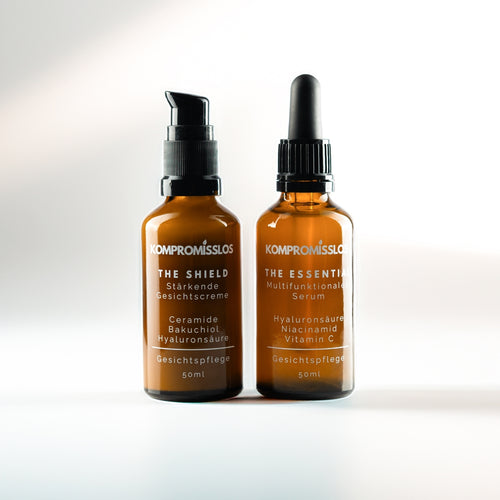
Coconut oil is most likely to suit dry, resilient skin that is not prone to breakouts, and least likely to suit oily, blemish-prone or combination skin. On dry and mature skin, a thin film can ease the feeling of tightness. But this kind of skin usually lacks not just fat but moisture too. An oil on its own seals the skin without putting anything into it first. A better approach is a combination of humectants and skin-identical lipids, such as The Duo with its serum and cream provides: hyaluronic acid in three molecular sizes in the serum, and squalane, jojoba oil and ceramide NP in the cream. If your skin is dry, simply use a little more of both.
On oily skin that is prone to spots, coconut oil is often too heavy. The review in ACS Omega states that coconut and olive oil can clog pores when used in cosmetics and trigger breakouts on sensitive skin. The fact that monolaurin, a derivative of lauric acid, attacks bacteria involved in spots in the lab does not make coconut oil a spot treatment. What really matters when you have breakouts is explained in the article on caring for blemish-prone skin. And if you are looking for a lighter oil, jojoba oil for your face is the liquid alternative that does not set solid even in the cold.
| Skin type | Coconut oil on the face | Better |
|---|---|---|
| Dry or mature | Possible if your skin stays calm, but it only supplies fat | Moisture plus lipids, i.e. serum and cream |
| Very dry in patches | Sparingly and only on those spots, such as rough cheeks in winter | A little more cream on those areas |
| Combination | At most on dry areas, not on the T-zone | Light skincare, oil only where needed |
| Oily or blemish-prone | Better not, often too heavy | Light, non-greasy skincare |
| Sensitive | Only after testing on a small area | Just a few fragrance-free products |
Studies in children with atopic dermatitis (eczema), for example in the International Journal of Dermatology, have compared virgin coconut oil with mineral oil. That does not translate into a skincare recommendation for the face. Atopic dermatitis belongs in the hands of a dermatologist, and whether coconut oil has a role to play is something to discuss with them.
Can you leave coconut oil on your face overnight?
Yes, you can leave coconut oil on your face overnight if your skin is dry and does not react with breakouts. At night, the film of fat sits undisturbed on your skin for many hours and slows down water loss during that time. But this long contact time is also the risk: if coconut oil clogs your pores, overnight use is where it shows first. In the morning, your skin then looks greasy rather than nourished, and after a few days new blackheads appear. If you want to try it, stick to a few simple rules:
- Use very little: a pea-sized amount, melted between your palms, is enough for your whole face.
- Not instead of moisture: if you use the oil at all, it goes on as the last layer over your usual skincare.
- Change your pillowcase more often, because oil and sebum build up in it.
- Watch your skin for two to three weeks. If new blackheads or spots appear, stop using it.
Is coconut oil good for removing make-up?
Coconut oil usually dissolves make-up well, even waterproof mascara, but it is only suitable for removing make-up if you wash it off thoroughly afterwards. Oil dissolves oil: the waxes and oils in make-up dissolve in the coconut oil, the pigments come away with them and can be wiped off with a soft cloth. If the film of oil stays on your skin afterwards, the dissolved make-up and the oil sit on your pores all night. So follow the oil with a mild cleanser that rinses everything away. You may know this principle as double cleansing. Whether you need two steps or a simple cleanse is enough is explained in the article on what kind of cleanser your skin really needs.
Take care around the eyes. Coconut oil that gets into your eyes can sting and blur your vision briefly. So apply it with your eyes closed and remove it gently without rubbing. One everyday drawback: solid coconut oil has to melt between your fingers before you can spread it.
What is fractionated coconut oil, and is it the same as virgin coconut oil?
Fractionated coconut oil is not the same as virgin coconut oil but a separated part of it that stays liquid and feels lighter. Fractionation separates the fat components according to their properties. The longer-chain components, including a large part of the lauric acid, are removed. What remains are mainly triglycerides of the shorter caprylic and capric acids, often called MCT oil. They do not set solid even in the cold, absorb faster and leave less shine. On ingredient lists, this kind of oil often appears as Caprylic/Capric Triglyceride. The name does not reveal which plant the substance comes from, though; it can also be obtained from palm kernel oil, for example.
For your face, the difference is noticeable: fractionated oil is lighter, odourless and better suited to dry areas of combination skin than the solid version. Virgin coconut oil smells of coconut and also contains plant compounds such as polyphenols, although their benefit on the skin has hardly been studied. Neither is a substitute for moisture.
When I chose the lipids for The Shield, my choice fell on squalane, jojoba oil and ceramide NP, among others, not on coconut oil. Coconut oil (Cocos Nucifera Oil) does not appear in the INCI of The Duo at all. That is not a verdict on coconut oil as a raw material. The Duo is designed for sensitive, dry or mature skin, including skin that is prone to breakouts, and for that I wanted lipids that spread easily and work together with the moisture from the serum. To be honest: on the body, coconut oil is often a good, inexpensive moisturiser. For your face, you do not need it. And if your skin tolerates it, there is nothing wrong with using up what is left in your bathroom. Exactly what is in it and what is not is set out in the full ingredient list of The Duo.
Frequently asked questions
Does coconut oil clog pores?
For some people, yes; for others, no. Its reputation for clogging pores comes from raw-material tests on rabbit ears, which only partly apply to human facial skin. Whether it happens to you depends on the formula, the amount and your own skin – more on this in the article on what comedogenic really means.
Does coconut oil help with wrinkles?
No, there is no solid evidence for that. A film of oil makes dry skin look smoother for a few hours, because fine lines caused by dryness are less noticeable. That is a short-term effect on the surface, not a change to the wrinkles themselves. If you want to do something for your skin in the long term, daily sun protection matters more than any oil.
Can I use coconut oil under my eyes?
Yes, but sparingly and not right up to the lash line. The skin under the eyes is thin, and oil easily migrates into the eye, where it can sting and blur your vision. Dab a tiny amount onto the area over the bone, not onto the eyelid. If small white bumps or redness appear there, stop using it and have a dermatologist take a look.
Is virgin or refined coconut oil better for your face?
There is no clear winner. Virgin coconut oil is extracted more gently, smells of coconut and contains more accompanying compounds such as polyphenols. Most skin studies used virgin oil. Refined coconut oil is purified and odourless, which can be more pleasant for sensitive skin. The fatty acids, and therefore how heavy it feels on the skin, are largely the same in both, so for pores and breakouts the choice makes little difference.
Can I mix coconut oil into my face cream?
You can mix a drop of melted coconut oil with your cream in the palm of your hand, but it is rarely worth it. A cream is a carefully balanced mixture of water and fat; extra oil makes it heavier and changes how it absorbs. If anything, the oil goes on separately as a top layer. When an oil is worth using is explained in the article serum or face oil: what your skin actually needs.
Can you be allergic to coconut oil?
Yes, that is possible. The review in ACS Omega lists possible allergic reactions among the drawbacks of coconut oil, along with its tendency to clog pores. The study in Dermatitis only included people who had not reacted in a preliminary test, and no side effects occurred during the two weeks. What that means for you: you should patch test any new skincare before it goes on your whole face.
Do I need coconut oil if I use The Duo?
No. Alongside The Duo, you do not need an additional oil. The cream already provides lipids with squalane, jojoba oil and ceramide NP, and the serum supplies moisture. Coconut oil does not appear in the INCI of The Duo. If your skin is very dry, simply use a little more of the serum and cream in The Duo rather than adding another layer.
Sources
- Agero AL, Verallo-Rowell VM. A randomized double-blind controlled trial comparing extra virgin coconut oil with mineral oil as a moisturizer for mild to moderate xerosis. Dermatitis, 2004. Source
- Lin TK, Zhong L, Santiago JL. Anti-Inflammatory and Skin Barrier Repair Effects of Topical Application of Some Plant Oils. International Journal of Molecular Sciences, 2017. Source
- Abdalla S, Aroua MK, Gew LT. A Comprehensive Review of Plant-Based Cosmetic Oils (Virgin Coconut Oil, Olive Oil, Argan Oil, and Jojoba Oil): Chemical and Biological Properties and Their Cosmeceutical Applications. ACS Omega, 2024. Source
- Evangelista MT, Abad-Casintahan F, Lopez-Villafuerte L. The effect of topical virgin coconut oil on SCORAD index, transepidermal water loss, and skin capacitance in mild to moderate pediatric atopic dermatitis: a randomized, double-blind, clinical trial. International Journal of Dermatology, 2014. Source