Menstrual cycle skincare: do you need different products for each phase?
ROUTINE
For menstrual cycle skincare, you generally do not need separate products for each phase. Your skin does change measurably over the course of your cycle: before your period, the skin barrier is often slightly more permeable, and for many women the skin becomes oilier and more prone to blemishes. A stable routine with well-tolerated active ingredients, however, absorbs these fluctuations. What you usually need to adjust is the amount and the timing of irritating extras, not your entire range of products.
Does your skin change over the course of your cycle?
Yes, your skin changes over the course of your cycle, and this is something you can not only feel but also measure. The reason is the fluctuating levels of oestrogen and progesterone, to which the skin and sebaceous glands respond. A review in Clinical and Experimental Dermatology summarises that oestrogen is associated with thicker skin, more water in the dermis, better barrier function and better wound healing. The same review notes, on the other hand, that when skin conditions get worse around the period, this coincides with peak progesterone levels. A measurement study in Contact Dermatitis fits this picture: water loss through the skin, measured on the back and forearm, was higher on the day with the lowest hormone levels shortly before the period than on the day with the highest oestrogen level shortly before ovulation. The authors interpret this as meaning that the skin barrier is less complete in the days before the period.
One important caveat: these are tendencies across groups, not a timetable for your skin. How strongly you notice the fluctuations depends mainly on how much sebum your skin produces anyway and how sensitive it is. That is exactly why it pays to focus on your skin condition, not your skin type: it describes what your skin needs right now, and your cycle is only one of several influences on it, alongside the season, sleep and stress.
Why does your skin get worse before your period?
For many women, the skin gets worse before their period because more sebum is produced in this phase while the barrier is also slightly less tight. A study in Dermatologica followed sebum excretion over three consecutive cycles. In women with oily skin, it found cyclical changes, with the highest sebum excretion in the week before menstruation. In women with low sebum production, no changes were seen. This explains why some women get shiny skin and spots before their period while others barely notice anything.
A survey in the Journal of the American Academy of Dermatology shows how common this pattern is: of 400 women with acne, 177 – that is, 44 per cent – reported that their skin got worse before their period. Severity, ethnic background and taking the pill made no difference to this rate. Women over 33 even had premenstrual flare-ups more often than women aged 20 to 33. So if you notice in your mid-thirties that the days before your period are becoming more unsettled again, it is not a sign that you are doing something wrong. What generally helps blemish-prone skin, and what makes it worse, also applies to these days. If the spots appear mainly on your chin and jawline, you will find the background in the article on chin breakouts and spots along the jawline.
What is cycle syncing in skincare?
Cycle syncing in skincare means adapting your routine to the four phases of your cycle, often with separate products for each phase. The idea comes from nutrition and fitness and has been carried over to skincare. The grain of truth: your skin does respond to hormonal fluctuations, as the studies above show. What is missing, however, are studies showing that four different sets of products do more for your skin than a consistent routine whose amounts you adjust as needed. The phases are also not as punctual as apps and calendars suggest. Cycle length varies from woman to woman and from month to month, and with hormonal contraception, hormone levels follow a different pattern from the natural cycle, depending on the method. Cycle syncing is therefore useful as an aid to observation: if you know when your skin typically takes a turn, you can react in good time. The table shows the phases of a cycle of around 28 days and what you can realistically adjust.
| Phase (approximate) | What many women notice | What you can adjust |
|---|---|---|
| Period, roughly days 1 to 5 | Skin gets irritated more quickly and looks duller | No new products and no exfoliants, the usual amount of cream |
| Follicular phase, until about day 13 | Skin looks calmer and plumper | A good phase to introduce a new product |
| Ovulation, around day 14 | Usually a balanced state | Leave your routine unchanged |
| Luteal phase, roughly days 15 to 28 | More shine, spots especially in the last week, sometimes dry patches | Less cream on the T-zone, a little more on dry patches, no squeezing |
Do you need different products for each phase of your cycle?
No, you do not need different products for each phase of your cycle, as long as your basic routine covers hydration, the barrier and a balanced complexion. The fluctuations during your cycle are shifts within your skin, not new skin every two weeks. A routine that is too heavy before your period and too light after it is usually just not set up properly. Frequent product changes, by contrast, bring problems of their own: more products mean more ingredients, more potential for irritation and less clarity about what is actually helping. If you are constantly trying out new combinations, you should know how combining skincare ingredients works and where caution is needed. It is much simpler to keep the number of products small from the outset. The article on a minimalist skincare routine shows just how few you can get by with.
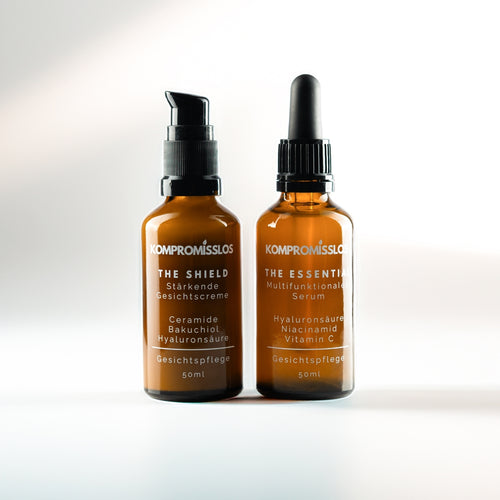
When it comes to ingredients, fluctuating skin is best served by those that suit both extremes. Niacinamide and zinc PCA support a balanced complexion when your skin gets shiny and unsettled. Ceramides and squalane support the skin barrier when it is more permeable before your period. This exact combination is in The Duo of serum and cream, with a total of 5% niacinamide and 1% zinc PCA. It does not replace a medical assessment, but it saves you four sets of products in your bathroom cabinet.
How do you adjust the amount instead of the products?
You adjust the amount by applying the same products a little more sparingly or a little more generously depending on how your skin feels, and by targeting individual zones. That sounds trivial, but it is the simplest lever you have without buying anything new. When your skin gets shiny in the second half of your cycle, your forehead, nose and chin need less cream than your cheeks. When it feels tight before your period, those areas can take a little more. Many people know the same principle from the change of seasons. In her review on Judge.me, Irène S. writes: ‘I need very little of the products in summer’ (review translated from German). Your cycle works the same way on a smaller scale, just in a monthly rhythm.
- Keep your serum dose constant: it delivers the active ingredients, and their amount does not need to change from week to week.
- Dose your cream by zone: more sparingly on the T-zone during oily phases, more generously on dry patches.
- Introduce new products during calm phases: after your period, you are more likely to notice whether a product suits your skin or irritates it.
- Pause irritating extras before and during your period: exfoliants and strong acids can wait.
- Do not squeeze spots: it prolongs redness and increases the risk of post-blemish marks.
- Keep using sunscreen during the day, whatever the phase.
When should you see a doctor about cycle-related breakouts?
You should see a doctor about cycle-related breakouts if they are deep and painful, leave scars or dark marks, or do not improve over several months despite a gentle routine. At that point, it is no longer about skincare but about a diagnosis. Besides acne, the review in Clinical and Experimental Dermatology also names psoriasis, atopic eczema and irritant dermatitis as skin conditions that can get worse around the period. These, too, belong in the hands of a dermatologist.
Questions that go beyond the skin are a matter for a gynaecologist: irregular or missed periods, increased hair growth on the chin or abdomen, skin changes after stopping or switching the pill, and anything to do with hormonal contraception. Whether a pill affects your complexion, and which one, is a medical decision, not a skincare question. In these cases, cosmetics can play a supporting role by not irritating your skin further, but they cannot establish the cause.
You will not find a separate set for each phase of the cycle at Kompromisslos. The brand stands for two products instead of eight, and that still applies when your skin changes over the course of the month. How you use them depends on the condition of your skin, not on the calendar: morning and evening, 3 to 6 drops of serum, followed by 3 to 6 pumps of cream, a little more if your skin is dry. If your T-zone gets shiny before your period, simply use a little less cream there. What The Duo cannot do: resolve hormone-related skin problems or replace a medical assessment. We do not sell an exfoliant for the days after your period either, because many people’s skin does not need one. How to fine-tune the amount is explained in how to use the serum and cream.
Frequently asked questions
Why is my skin dry before my period?
For many women, the skin loses slightly more water before their period because the skin barrier is less tight on these days. A measurement study in Contact Dermatitis found higher water loss through the skin shortly before the period than shortly before ovulation. Apply a little more cream to dry patches and skip exfoliants on these days.
Does zinc help with spots before your period?
Zinc PCA is a skincare ingredient for a balanced complexion, but it is not a remedy for spots before your period. What it can and cannot do is explained in the article Zinc PCA benefits: what it does and how to use it.
Is your skin better after your period?
For many women, yes – the days after the period up to ovulation are considered the calmest phase. A study of 29 women in the Journal of the American Academy of Dermatology found that the skin reacted more strongly to an irritant on the first day of the cycle than on days 9 to 11. That makes this phase a good time to try out a new product.
Why is your skin shinier in the second half of your cycle?
Because in many women the sebaceous glands are more active towards the end of the cycle, especially in the week before the period. A study in Dermatologica found the highest sebum excretion in the week before menstruation in women with oily skin, but no change in women with low sebum production. Using less cream on your T-zone helps more than a harsh, stripping cleanser.
Does your skin change in a similar way during menopause?
Only partly. During the cycle, hormones rise and fall every month; in the years before menopause, the fluctuations become more irregular and oestrogen levels decline over the long term. The skin then tends to become drier and thinner. What is typical in this phase is described in the article on perimenopause skin changes.
Should I avoid exfoliating during my period?
Yes, if your skin is more sensitive at the start of your period. In a study in the Journal of the American Academy of Dermatology, the skin reacted measurably more strongly to an irritant on the first day of the cycle than on days 9 to 11. Exfoliating does not automatically do harm, but if you postpone it by a few days, you remove an unnecessary risk of redness. Many skin types do not need regular exfoliation anyway.
Do I need to adapt The Duo to my cycle?
No – the products stay the same; what you can adjust is the amount. Keep your serum dose constant at 3 to 6 drops, and spread the cream more sparingly on your T-zone on oily days and more generously on dry patches. The Duo of serum and cream needs no more adjustment than that.
Sources
- Raghunath RS, Venables ZC, Millington GW. The menstrual cycle and the skin. Clinical and Experimental Dermatology, 2015. Source
- Harvell J, Hussona-Saeed I, Maibach HI. Changes in transepidermal water loss and cutaneous blood flow during the menstrual cycle. Contact Dermatitis, 1992. Source
- Piérard-Franchimont C, Piérard GE, Kligman AM. Rhythm of sebum excretion during the menstrual cycle. Dermatologica, 1991. Source
- Stoll S, Shalita AR, Webster GF, Kaplan R, Danesh S, Penstein A. The effect of the menstrual cycle on acne. Journal of the American Academy of Dermatology, 2001. Source
- Agner T, Damm P, Skouby SO. Menstrual cycle and skin reactivity. Journal of the American Academy of Dermatology, 1991. Source