Coming off the pill: what happens to your skin in the first months and how to support it
SKIN OVER 30
After coming off the pill, many women find their skin becomes oilier and more prone to breakouts in the first few months, especially on the chin and jawline. The reason: the combined pill dampens the male hormones that drive the sebaceous glands, and that dampening effect disappears. For others, the skin stays the same or even calms down. The adjustment usually takes weeks to a few months. Skincare cannot shorten it, but it can keep your skin calm instead of irritating it further.
What happens to your skin when you come off the pill?
After you stop taking the pill, your own hormones take over again, and for many women this means a rise in free androgens, which stimulate sebum production. The combined pill works in two ways: it slows down the production of androgens in the ovaries, and it raises the transport protein SHBG, which binds testosterone in the blood and takes it out of circulation. A meta-analysis in Human Reproduction Update covering 42 studies and 1,495 healthy women found that free testosterone was on average 61 per cent lower while on the combined pill, while SHBG rose significantly. Once this effect wears off, the sebaceous glands receive a stronger signal again. The result can be more shine, clogged pores and inflamed spots. If you stop using a contraceptive ring or have a hormonal coil removed, a similar adjustment can follow, more or less pronounced depending on the product.
At the same time, your natural cycle returns, and with it the fluctuations that the pill smoothed out for years. Many women notice for the first time in years how their skin changes over the cycle, for example with more breakouts in the days before their period. That is not a sign that something is going wrong – it is simply the normal state without hormonal contraception.
Why do some women get spots after coming off the pill and others don’t?
Whether you break out after coming off the pill depends mainly on how your skin is predisposed without it, and on whether the pill has been masking that predisposition until now. If you were prone to blemishes as a teenager or before you started the pill, you are more likely to see that tendency return. A Cochrane review of 31 studies with 12,579 participants found that all six combined pills tested in placebo-controlled trials reduced inflammatory and non-inflammatory lesions on the face. If the pill has kept your skin calm for years, that effect is missing once you stop. If your skin was unremarkable before the pill, it often stays that way afterwards too.
Then there are factors that have nothing to do with the pill: how active your sebaceous glands are by nature, stress, sleep and age. If you started the pill in your early twenties and stopped in your early thirties, you are also not comparing the same skin, because ten years change it even without hormones. And some women experience the opposite: depending on the progestogen, the skin may even have been more restless on the pill and calm down after stopping. In adult women, new blemishes often gather on the lower face. What lies behind this is explained in the article on spots on the chin and jawline.
When do the changes appear, and how long do they last?
Most changes appear in the first weeks to months after coming off the pill, and how long they last varies from person to person – often a few months. There is no fixed number of months that applies to everyone. How quickly hormone levels readjust was examined in a study in Fertility and Sterility in women with polycystic ovary syndrome: there, all measured androgens and SHBG were back at baseline eight weeks after stopping. The skin lags behind such blood values, because a spot does not appear overnight but builds up in the pore over weeks. That is why your skin may only become more restless in the second or third month and then gradually settle down.
For your skincare, this means: do not judge after a week. Visible results from skincare take time too, and it is worth knowing how long skincare takes to work. If you try a new product every week during this phase, you will not be able to tell in the end what helped and what your skin would have managed on its own.
| What you see | What may be behind it | What skincare can do | When to see a professional |
|---|---|---|---|
| Spots on the chin and jawline | More free androgens, your cycle returning | Keep the skin calm, avoid irritating it further | Deep, painful, scarring or unchanged after months |
| More shine, more visible pores | Sebaceous glands receiving a stronger signal | Light skincare, gentle cleansing | Rarely necessary, unless combined with other signs |
| Drier or more sensitive skin | The adjustment, but often too many anti-blemish products | Support the barrier, shorten the routine | Burning, flaking or a rash that persists |
| Dark patches on the face | Hormonal pigmentation, sun, post-blemish marks | Sun protection, softening their appearance | Larger patches on the forehead, cheeks or upper lip |
| Hair loss or increased hair growth | Can be hormonal | Nothing – this is not a skincare question | Always get it checked |
Dark patches can already develop while you are taking the pill: a review in the Journal of Cosmetic Dermatology lists pregnancy, hormonal therapies and the pill as factors in melasma, alongside genetic predisposition and sun exposure. How to deal with them is covered in the article on dark spots on the face.
How should you adjust your skincare in the first months without overwhelming your skin?
In the first months after coming off the pill, a short, consistent routine helps more than a series of new anti-blemish products. No cream can speed up the hormonal adjustment itself. What skincare can do is avoid putting extra strain on your skin during this phase. That means gentle cleansing morning and evening, followed by a light serum and a cream that supports the barrier, plus sunscreen during the day. Active ingredients such as niacinamide and zinc PCA make sensible companions here, because they are well tolerated and can help your complexion look more even. If you want to target individual spots with a dedicated product, choose one and give it a few weeks.
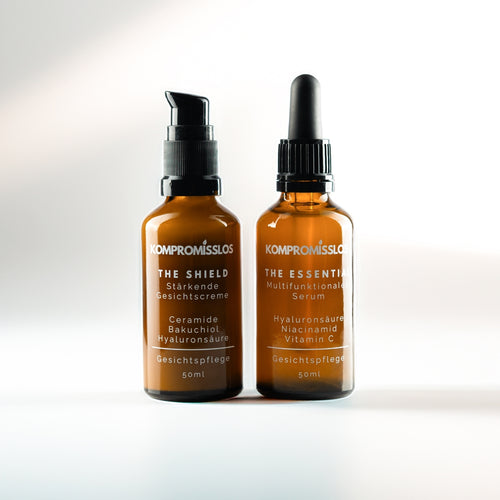
This is exactly the kind of routine The Duo of serum and cream is built for. The Essential serum contains niacinamide and zinc PCA – 5% niacinamide and 1% zinc PCA across The Duo as a whole – for a more even, calmer-looking complexion. On top goes The Shield with ceramide NP and squalane, so that drying anti-blemish products do not overtax the barrier. This is not a promise to get rid of spots or acne. If you are coming off the pill because you want to get pregnant, it is best to discuss which active ingredients are suitable with your doctor or pharmacist.
In the first weeks after coming off the pill, take a photo every two weeks in the same light. Photos show you whether your skin is settling down far more reliably than the mirror on a bad day.
What should you avoid during this phase?
Above all, avoid anything that dries out or irritates your skin further during this phase, because a stressed barrier makes skin more sensitive, not clearer. The impulse is understandable: your skin is changing, so you want to do something about it straight away. But that very impulse often leads to a routine that does more harm than the hormones themselves. You can skip these five things:
- Several acids and anti-blemish products at once, such as a salicylic acid toner, an exfoliant and a spot gel in the same routine.
- Harsh cleansing several times a day or with brushes, because stripping away oil strains the barrier without reducing sebum in the long term.
- Constantly switching products, which makes it impossible to judge anything.
- Squeezing spots, because this can push the inflammation deeper into the tissue and leave marks.
- Home remedies such as toothpaste, lemon juice or baking soda, which mostly just irritate the skin.
If your skin feels tight, stings and is shiny at the same time despite all your products, that often has less to do with hormones than with everything you are putting on it. Knowing the signs of skincare overload helps you tell the two causes apart.
When should you see a doctor about skin changes after coming off the pill?
You should see a doctor about skin changes after coming off the pill if they are severe, do not improve or appear together with other signs. A few extra spots are a normal part of the adjustment. The following, on the other hand, are worth getting checked by a dermatologist or gynaecologist:
- Deep, painful or lumpy spots and anything that leaves scars.
- Blemishes that are still just as severe after a few months, or are getting worse.
- A period that does not come back or is very irregular.
- Increased hair growth on the chin, upper lip or abdomen, or noticeable hair loss, because this can point to a hormonal imbalance such as PCOS.
- Larger dark patches on the face that may indicate melasma.
Whether you go back to hormonal contraception, and which kind, is something you decide with your gynaecologist – not on the basis of your skin alone. Prescription acne treatments such as retinoid prescriptions or isotretinoin belong with a dermatologist. Skincare can accompany medical treatment, but it does not replace it.
I pared Kompromisslos down to two products instead of eight, and a phase like this shows exactly why. When your skin is already adjusting, a stable, short routine helps it more than constant switching. In the cream, I chose bakuchiol instead of retinol and left out fragrance, so that the routine still works during sensitive phases. What I cannot promise you is that the Duo will make hormonal spots disappear. The cause lies in your hormones, and that belongs with a professional. Skincare can look after your complexion during this time and support the barrier – nothing more. I have described openly what each active ingredient in the Duo does, concentrations included.
Frequently asked questions
Will my skin go back to how it was before the pill?
Usually your skin settles back to its own natural tendency, but that does not have to be exactly the same as before the pill. There are often years between starting and stopping, during which your skin has also changed with age. Sebum production tends to decrease over the years, which pleasantly surprises some women after they come off the pill.
Can your skin get better after coming off the pill?
Yes, that happens. Not every pill affects the skin in the same way, and some women actually had more blemishes while taking it than without it. Others simply notice no difference after stopping. Skin getting worse is common, but not inevitable.
Does zinc help with spots after coming off the pill?
Applied to the skin, zinc PCA is a well-tolerated skincare ingredient that can contribute to a more balanced complexion – a cosmetic effect, not a dramatic one. It does not change your hormones. Whether zinc as a supplement makes sense for you is better discussed with your doctor or pharmacist than taken on a hunch.
Do dark patches fade after coming off the pill?
Hormonal patches can slowly lighten after you stop taking the pill, but they will not necessarily disappear and often fade only partially. Consistent sun protection is crucial, because UV light makes the patches darken again and again. Larger patches on the forehead, cheeks or upper lip should be checked by a dermatologist.
Should I go back on the pill if my skin gets worse?
That is not a skincare decision but a medical one, which you make with your gynaecologist. Contraception has pros and cons that go far beyond your skin, and if your spots are severe, a dermatologist is the right person to see first.
Is it purging if I break out after coming off the pill?
No. Purging describes blemishes that a new active ingredient, such as a retinoid or an exfoliating acid, brings to the surface in the first few weeks. Spots after coming off the pill have a hormonal cause. How to recognise genuine purging is explained in the article on skin purging or a reaction.
Is The Duo suitable for skin after coming off the pill?
Yes, as calm basic skincare for this phase. After cleansing, The Duo replaces your previous routine with two steps – fragrance-free, hormone-free and designed not to put extra strain on your skin. It cannot heal spots. Because the adjustment can take months, the 100-day return policy gives you enough time to try the Duo without rushing.
Sources
- Zimmerman Y, Eijkemans MJ, Coelingh Bennink HJ, Blankenstein MA, Fauser BC. The effect of combined oral contraception on testosterone levels in healthy women: a systematic review and meta-analysis. Human Reproduction Update, 2014. Source
- Arowojolu AO, Gallo MF, Lopez LM, Grimes DA. Combined oral contraceptive pills for treatment of acne. Cochrane Database of Systematic Reviews, 2012. Source
- Sánchez LA, Pérez M, Centeno I, David M, Kahi D, Gutierrez E. Determining the time androgens and sex hormone-binding globulin take to return to baseline after discontinuation of oral contraceptives in women with polycystic ovary syndrome: a prospective study. Fertility and Sterility, 2007. Source
- Filoni A, Mariano M, Cameli N. Melasma: How hormones can modulate skin pigmentation. Journal of Cosmetic Dermatology, 2019. Source