Stress and dry skin on your face: what chronic stress does to your skin barrier and complexion
SKIN CONCERNS
Stress shows up on the skin of your face mainly through slower barrier repair: minor damage from cleansing, cold weather or too many products lingers for longer, and your skin feels tight, gets drier and reacts more quickly. If you are prone to blemishes, you will often notice more spots during difficult periods too. Stress is rarely the only cause, though – it is more of an amplifier. What helps is a calm, consistent routine you can keep up even on packed days, not new products.
What does stress do to the skin on your face?
Chronic stress mainly weakens your skin’s ability to close its protective layer again after minor damage. This is well documented in smaller studies. In a study published in the Archives of Dermatology, the skin barrier of 27 medical, dental and pharmacy students was measured at three points: after the winter holidays, during their final exams and during the spring holidays that followed. During the exams, the barrier recovered more slowly after a standardised tape-stripping test; in the holidays afterwards, it recovered about as quickly as at the start. The effect was strongest in those whose perceived stress had risen the most. A second study in the Journal of Investigative Dermatology found something similar in 25 healthy women after a stressful interview in the lab, together with a rise in blood cortisol.
In everyday terms, this means stress does not wreck your skin overnight. But it does eat into its reserves. Things it would normally shrug off – a hot shower, an acid peel or a new serum – suddenly leave their mark. How the skin barrier is built and how to recognise a damaged one is covered in a separate article. Here, the focus is on what stress actually changes about it.
| What you notice on your face | What may be behind it under stress | What you can skip |
|---|---|---|
| Tightness and dryness after washing | The barrier is slower to close small gaps | An extra cleanse or a peel to tackle flakes |
| Stinging from products that used to be fine | Lower tolerance in overloaded skin | Testing several new products at once |
| More spots in stressful weeks | Stress amplifying existing blemishes | Aggressive drying out and squeezing |
| Dull, tired-looking complexion | Often a mix of too little sleep and a stressed barrier | Reaching for more and more actives |
Can stress cause dry skin on your face?
Yes, stress can encourage dry skin on your face, even if it is rarely the sole cause. The mechanism runs through the barrier: when it recovers more slowly, your skin keeps losing water for longer than it should after every strain. That feels like tightness after washing, fine flakes on your nose and cheeks, or a cream that no longer feels like enough by mid-afternoon. If a stressful period falls in winter, dry air from central heating, cold temperatures and biting winds add to it.
The flip side matters: stress-related dryness is rarely helped by one richer product after another, but by less irritation. If you exfoliate on top of everything during weeks like these, try a new acid serum and cleanse twice in the evening, you are putting strain on exactly the structure that is currently repairing itself more slowly. If your skin is currently stinging with almost every product, the article on what to do when your skin suddenly reacts to everything takes you through it step by step.
How can you tell if spots are caused by stress?
You recognise stress spots by their timing, not their appearance: they look like any other spots, but they crop up more often during or shortly after stressful periods. A study in the Archives of Dermatology followed 22 students with acne through exam-free weeks and the exam period. During the exams, both acne severity and perceived stress were higher, and the increase in spots was clearly linked to the increase in stress, with a correlation of r = 0.61. Sleep duration, sleep quality and diet were adjusted for in the analysis.
If you are prone to blemishes anyway, you will usually notice a flare-up in stressful weeks in the places where spots tend to appear regardless – for some people, around the chin and jawline. What is behind chin breakouts goes beyond stress, though: hormones and habits play a part too. If you have spots all the time, whatever your stress levels, stress is more of a supporting character. The causes of blemish-prone skin in general are therefore a topic of their own. One more thing: stress tempts you to pick, and that often leaves visible marks for longer than the spot itself.
Does stress make your skin age faster?
Chronic stress can contribute to visible skin ageing, but the evidence is much thinner than for sun exposure and smoking. A review in Inflammation & Allergy Drug Targets summarises the links between the brain and the skin. It describes how glucocorticoids, the group of hormones that cortisol belongs to, impair several building blocks of connective tissue, including collagen I and III and elastin. According to the review, stress hormones can also promote DNA damage and interfere with its repair. Much of this evidence, however, comes from lab and animal studies and from observations during long-term corticosteroid therapy, not from measurements in stressed people going about their daily lives. The authors themselves describe exactly how stress affects skin ageing as still largely unclear.
Put honestly: there is no evidence that a few tough weeks will give you wrinkles. But if you sleep badly for years, have no time to recover and protect your skin less during that time, several factors add up that make your complexion look older. In any case, your biggest and best-documented lever against premature skin ageing is sun protection – especially in stressful periods, when it is often the first thing to go.
What skincare helps during stressful weeks?
During stressful weeks, the skincare that helps is the skincare you know, tolerate and use every day without thinking about it. Precisely because the barrier recovers more slowly under stress, it does not need extra products but calm: a mild cleanser, one product for hydration, one that supplies lipids and seals everything in, and sunscreen during the day. Fragrance-free products are the calmer choice in this phase, because fragrances are among the more common triggers when sensitive skin suddenly starts to sting.
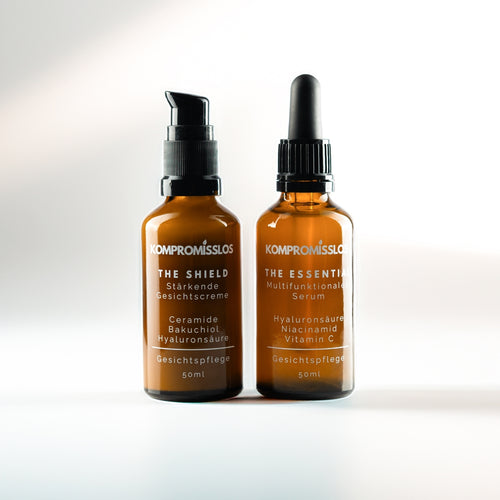
When it comes to ingredients, it is worth looking for barrier-friendly actives. Ceramides are lipids that occur naturally in the outermost layer of the skin, squalane is an oil closely related to the skin’s own lipids, niacinamide supports the skin barrier and panthenol has a soothing effect on how your skin feels. In The Duo, the cream contains ceramide NP and squalane, the serum contains niacinamide, and the Duo also contains panthenol. It is not a remedy for stress, but a two-step routine that takes hardly any time morning and evening. In his review on Judge.me, Silas writes: “The skincare routine is super simple and therefore ideal for me, as I have no desire to spend a lot of time in the bathroom” (review translated from German). That is exactly what counts when your days are full.
New products are hard to judge during a stressful phase. If your skin reacts, you cannot tell whether it is the product or the week you are having. So it is better to make changes during a calm phase, and only one product at a time.
What else helps your skin when the stress does not go away?
Besides skincare, what helps your skin most is whatever helps with the stress itself: sleep, breaks and less experimenting. Why sleep ranks so high is explained in the frequently asked questions below. One detail from the study in the Journal of Investigative Dermatology is interesting here: a three-day exercise programme did not slow barrier recovery in 10 women, unlike the stressful interview. The group was small, but for a demanding phase it means exercise does not have to be the first thing you drop. In practice:
- Protect your sleep as best you can, even if it only means going to bed half an hour earlier.
- Pare your routine down to the essentials instead of expanding it during bad weeks. How many products that really means is covered in the article on a minimalist skincare routine.
- Keep your hands off spots and flakes, even in front of the mirror when working from home.
- Wash and shower with lukewarm rather than hot water, especially in winter.
- Keep moving: in the study mentioned, exercise did not slow barrier recovery.
If your skin still has not settled weeks after a stressful period has ended, if weeping, intensely itchy patches appear or if redness stays for good, that is something for a dermatologist. Signs like these can point to eczema, rosacea or acne that needs to be properly assessed.
I deliberately limited Kompromisslos to two products instead of eight. One reason is exactly what this article is about: a routine only works if it keeps going on bad days too. You can manage two steps morning and evening even after a twelve-hour day. Eight steps are what you skip on days like that, and then at the weekend you try to make up for it by doing twice as much. For the same reason, both products are fragrance-free, and I disclose the concentrations so you do not have to guess what ends up on your skin. What The Duo cannot do is make your stress go away. It is no substitute for sleep, breaks and seeing a professional about persistent problems. You can see the active ingredients in both products at a glance.
Frequently asked questions
How quickly does your skin react to stress?
Your skin barrier reacts faster than many people think. In a lab experiment, it recovered more slowly after just a single stressful interview, and in students the effect showed up during exam weeks. Whether and when you see this as tightness, flakes or spots varies from person to person. What matters more is the overall course: once the stress was over, the barrier in the study recovered again.
Can stress cause redness?
Stress can make redness worse, for example through sudden flushing or irritated, more sensitive skin. Temporary redness during a stressful period is usually harmless. If it persists, or if burning, visible small blood vessels or bumps appear, you should have it checked by a dermatologist, because rosacea may be behind it.
Is cortisol to blame for spots?
Blaming cortisol alone is too simplistic. Stress changes several hormonal, nerve and immune signals at the same time, and cortisol is just one of them. Studies show a clear link between stress and more spots, but the exact mechanism has not been fully explained. You can skip cortisol detox products or teas.
Does more sleep help your skin?
Yes, sleep helps your skin in measurable ways. In a study in the Journal of Investigative Dermatology, a single sleepless night was enough to slow skin barrier recovery. More sleep does not replace skincare, but no skincare can make up for a lasting lack of sleep. If you can only change one thing during a demanding phase, make it that.
Should I try new products during stressful periods?
Better not. Under stress, your skin is less resilient, and you can hardly tell whether a reaction comes from the new product or from the situation. Stick with what your skin tolerates and try new things during a calmer phase – always just one product at a time and over a few weeks.
Can stress trigger eczema?
Stress is considered one of the factors that can trigger or worsen skin conditions such as atopic dermatitis or psoriasis – the study in the Archives of Dermatology describes it this way too. Whether you have eczema and how it should be managed, however, is a matter for a dermatologist. Cosmetic skincare can accompany medical care, but it cannot replace it.
Does The Duo make sense during stressful periods?
Yes, if you are looking for a calm, fragrance-free routine that takes little time. The serum and cream support the skin barrier with ceramides, squalane, niacinamide and panthenol, in two steps morning and evening. They do not solve the stress itself, and you still need a separate sunscreen during the day. You can see how the two steps work together on the page for the Duo of serum and cream.
Sources
- Garg A, Chren MM, Sands LP, Matsui MS, Marenus KD, Feingold KR et al. Psychological stress perturbs epidermal permeability barrier homeostasis: implications for the pathogenesis of stress-associated skin disorders. Archives of Dermatology, 2001. Source
- Altemus M, Rao B, Dhabhar FS, Ding W, Granstein RD. Stress-induced changes in skin barrier function in healthy women. Journal of Investigative Dermatology, 2001. Source
- Chiu A, Chon SY, Kimball AB. The response of skin disease to stress: changes in the severity of acne vulgaris as affected by examination stress. Archives of Dermatology, 2003. Source
- Chen Y, Lyga J. Brain-skin connection: stress, inflammation and skin aging. Inflammation & Allergy Drug Targets, 2014. Source