Red face during menopause: hot flush, broken capillaries or rosacea, and when to get it checked
SKIN OVER 40
A red face and red cheeks during menopause are often caused by hot flushes: the blood vessels in your facial skin widen in waves, and the redness fades again afterwards. If the redness stays between flushes, broken capillaries (couperose) or rosacea are more likely, and other causes less so. Three questions are enough to narrow it down: does the redness go away again, can you see thread veins or small spots, and do you have any other symptoms? The answers tell you whether gentle skincare is enough or whether you should get the redness checked.
Why do many women get red cheeks during menopause?
Many women get red cheeks during menopause because hot flushes send waves of blood to the face, and the way the skin regulates its blood vessels becomes less stable as oestrogen levels fall. A review in Clinical and Experimental Dermatology describes flushing – sudden episodes of reddening – in around 75 per cent of perimenopausal and menopausal women. The authors put it down to the widening of blood vessels in the dermis and the tissue beneath it, possibly because control of the peripheral vessels weakens when oestrogen is low. It shows mainly on the cheeks, neck and décolletage. So a red face at this stage of life is, first and foremost, common and not a sign that something is fundamentally wrong with your skin.
On top of that, your skin can become drier and more reactive during these years. Products you used without any problems for years suddenly sting, and that shows up as redness too. How the skin changes overall during this time is covered in our article on perimenopause skin changes and what’s typical from your early 40s. This article is only about redness in the face and what it means.
What happens in your facial skin during a hot flush?
During a hot flush, the blood vessels in your skin widen within a short space of time so that your body can release heat, and it is exactly this extra blood flow that you see as redness. The pattern is typical: a feeling of warmth rises over your chest and neck into your face, often with sweating and sometimes with palpitations, and it is frequently followed by a chill. The redness is spread out, cannot be pinned to individual thread veins and disappears once the flush is over. At night, the same episodes show up as night sweats. How long this phase lasts varies widely. In the US SWAN study, published in JAMA Internal Medicine, frequent hot flushes and night sweats lasted a median of 7.4 years in total among the women affected, and a median of 4.5 years after their last period. So if the flushes are weighing on you, there is little point in simply waiting for them to stop any time soon.
For your skin, this means that a single flush leaves nothing behind. But if the flushes come many times a day and over several years, your facial skin is warm and red more often. In skin that is prone to rosacea, frequent flushing can make the symptoms worse. Whether and how the flushes themselves are treated medically is a matter for your gynaecologist, not for a skincare guide.
Hot flush, broken capillaries or rosacea: how can you tell the difference?
The main way to tell the difference is whether the redness disappears completely. A hot flush comes and goes, and in between your skin looks the way it did before. Broken capillaries (couperose) stay visible as a fine network of dilated thread veins, mainly on the cheeks and the sides of the nose, usually without any other symptoms. You can read more in our article on couperose and broken capillaries. Rosacea is an inflammatory skin condition with background redness that does not go away. In the British Journal of Dermatology, the international ROSCO expert panel names persistent redness in the centre of the face and thickening of the skin caused by connective tissue or sebaceous glands as diagnostic features. As major features, it lists transient flushing, red bumps and pustules, and visible blood vessels in the centre of the face; as minor features, burning, stinging, a feeling of dryness and swelling. Rosacea can also affect the eyes, and the panel describes separate signs for this.
| Feature | Hot flush | Broken capillaries | Rosacea |
|---|---|---|---|
| How long the redness lasts | Comes in waves, disappears again | Stays | Background redness stays, plus flare-ups |
| Where | Face, neck, décolletage | Cheeks, sides of the nose | Centre of the face: cheeks, nose, chin, forehead |
| Accompanying signs | Feeling of heat, sweating, sometimes palpitations | Usually none | Burning, stinging, feeling of dryness, swelling |
| Thread veins | No | Yes, typically | Often |
| Bumps or pustules | No | No | Possible |
| Eyes | Not affected | Not affected | May be dry, red or irritated |
| Who to see | Gynaecologist, if the flushes are a burden | Dermatologist, if the thread veins bother you | Dermatologist, and an ophthalmologist for eye symptoms |
The table is no substitute for a diagnosis. But it helps you describe exactly what you are noticing when you see a doctor, and for working out what is going on, that is often worth more than a photo taken at the worst possible moment.
Can rosacea appear for the first time during menopause, and why is it so easily mistaken for something else?
Yes, rosacea can appear for the first time or become more noticeable during menopause, because hot flushes can make it worse or trigger it, but it is not a menopausal condition. The review in Clinical and Experimental Dermatology notes that there is very little literature on the link between menopause and rosacea, but that menopausal flushing is known to worsen or even trigger rosacea. At the same time, a systematic review in the American Journal of Clinical Dermatology concludes that rosacea tends to improve overall after menopause: large cohort data show fewer new cases in postmenopausal women than in women before menopause. So the flushes themselves probably matter more than age as such, although this has not been well studied.
Rosacea is easily mistaken for something else because transient flushing is one of its major features too. If you already have hot flushes, you tend to put every bout of redness down to hormones and miss the fact that it no longer fully disappears between flushes. A simple test: photograph your cheeks every morning for a week in the same light, before you apply anything. If background redness remains in every photo, that is a case for a dermatologist. What skincare can still contribute after that is covered in our article on rosacea skincare and when to see a dermatologist.
Which everyday triggers make flushing worse at this stage?
Flushing is made worse above all by heat, rapid changes in temperature, hot drinks, alcohol, spicy food, stress and sun – in other words, anything that further widens the blood vessels or heats up the body. Which triggers matter for you is individual. A short diary kept over two weeks usually shows quickly whether the redness tends to follow your coffee, a glass of wine or a stressful phone call.
- Heat and changes in temperature: overheated rooms, saunas, hot showers, coming in from the cold into a warm living room.
- Hot drinks and alcohol: often it helps simply to let your coffee cool down a little.
- Spicy food: has a clear effect in some women and hardly any in others.
- Stress and agitation: intensify both hot flushes and blushing.
- Sun and heat: in summer, but also when skiing in spring.
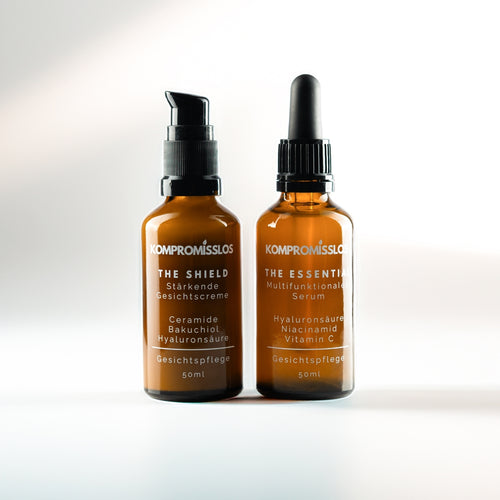
Skincare can become a trigger too if it stings or is fragranced. No cream can switch off hot flushes or rosacea. Skincare can only stop your skin’s irritation threshold from dropping even further. What it can actually do for redness, and what you are better off leaving out, is covered in our article on what skincare can do cosmetically for facial redness. If you are looking for skincare that does not add to the irritation: The Duo is fragrance-free, contains no essential oils and works with 5% niacinamide. The Essential serum contains niacinamide and hyaluronic acid, while The Shield cream contains ceramide NP and squalane to support the skin barrier. If you also want anti-ageing ingredients, it is worth reading our article on anti-ageing care for sensitive mature skin without redness or stinging.
For many women, sun makes redness noticeably worse. That is why separate sun protection belongs in your daytime routine, not least because neither the serum nor the cream in The Duo contains an SPF.
When should you get red cheeks during menopause checked by a doctor?
You should get red cheeks checked as soon as the redness no longer goes away, new skin changes appear or it comes with symptoms beyond the skin. A review in the Journal of the American Academy of Dermatology notes that most cases of flushing have harmless causes such as rosacea or menopause and can be identified through a consultation and an examination. In some cases, however, further tests such as blood tests are needed to rule out rare, more serious causes. That is exactly why an appointment is worthwhile if any of these signs appear:
- The redness persists between flushes or increases over several months.
- Red bumps, pustules or swelling appear on your face.
- Your eyes burn or feel dry, or the rims of your eyelids are red.
- The redness comes with a racing heart, diarrhoea, headaches or dizziness. If you have difficulty breathing or swollen lips, call the emergency number 144 straight away.
- A rash appears suddenly, for example in a butterfly shape across the cheeks and the bridge of the nose, especially with joint pain or fatigue.
- The redness has only appeared since you started a new medication. Do not stop taking it on your own; talk to your doctor.
Your first port of call is your GP. Hot flushes are a matter for a gynaecologist, your skin for a dermatologist and your eyes for an ophthalmologist. No guide can give you a diagnosis from a distance, and that includes this one.
I deliberately made The Duo fragrance-free and without essential oils. For skin that reddens easily anyway, fragrance is an irritant you do not need, no matter how natural it sounds. For the same reason, it is two products rather than eight: every extra product brings new ingredients with it, and if your skin reacts, you no longer know what it is reacting to. What I do not do is promise results for rosacea or hot flushes. No cream can prevent a hot flush, ours included, and rosacea belongs in a dermatologist’s hands. You can check what you are putting on your skin line by line in the full list of ingredients.
Frequently asked questions
Do red cheeks go away after menopause?
Redness caused by hot flushes usually subsides once the flushes ease off, but that can take several years. Broken capillaries do not disappear on their own, because the small vessels stay dilated. For rosacea, a systematic review found that it tends to improve overall after menopause. That does not mean existing rosacea simply clears up, though. If the redness stays, it is worth getting a dermatologist’s opinion.
Can hot flushes leave permanent thread veins?
A single hot flush does not leave thread veins behind. Whether frequent flushing over years causes broken capillaries in its own right has not been clearly established. In skin that is prone to rosacea, however, menopausal flushing can make the redness worse. Thread veins that are already visible do not disappear with skincare; only a dermatologist can remove them.
Does hormone therapy help with a red face?
Whether hormone therapy is an option for you is something to decide with your gynaecologist, because it involves far more than your skin. The medical literature describes menopausal flushing as generally responding to oestrogen. However, a systematic review also found a higher risk of rosacea with hormone therapy. Creams containing hormones or phytoestrogens are covered in a separate article on menopause face cream without hormones.
What quickly helps with the redness during a hot flush?
Cooling down helps fastest: take off a layer, open the window, hold your wrists under cold water or put a cool, damp cloth on your cheeks and the back of your neck. Ice cubes directly on the skin are overdoing it. The redness passes with the flush. Applying a new product at that moment does nothing and, if anything, only adds irritation.
Are red cheeks during menopause a sign of high blood pressure?
Red cheeks alone are not a reliable sign of high blood pressure, because raised blood pressure often causes no noticeable symptoms. But the only way to rule it out is to measure it. So have your blood pressure checked by your GP or at a pharmacy, especially if you also have headaches, dizziness or palpitations. A red face can have several causes, and blood pressure is quick to check.
Should I change my skincare if I have red cheeks?
Only if your skincare itself stings or itches, or the redness gets worse after you apply it. In that case, it is worth dropping fragrance, essential oils and exfoliants and cutting your routine down to a few products. Redness that comes and goes with hot flushes is not a skincare problem. Introduce new products one at a time so that you can tell what your skin tolerates.
Is The Duo suitable for skin that reddens easily during menopause?
Yes, if you are looking for a short routine without unnecessary irritants. The Duo is fragrance-free, contains no essential oils and consists of two steps: serum and cream. It provides moisture, supports the skin barrier and can help irritated skin look calmer. It has no effect on hot flushes or rosacea. If you suspect rosacea, get it checked first and use The Duo as supporting care at most.
Sources
- Kamp E, Ashraf M, Musbahi E, DeGiovanni C. Menopause, skin and common dermatoses. Part 2: skin disorders. Clinical and Experimental Dermatology, 2022. Source
- Avis NE, Crawford SL, Greendale G, Bromberger JT, Everson-Rose SA, Gold EB, et al. Duration of menopausal vasomotor symptoms over the menopause transition. JAMA Internal Medicine, 2015. Source
- Schaller M, Almeida LMC, Bewley A, Cribier B, Del Rosso J, Dlova NC, et al. Recommendations for rosacea diagnosis, classification and management: update from the global ROSacea COnsensus 2019 panel. British Journal of Dermatology, 2020. Source
- Roster K, Fleshner L, Karatas TB, Ecanow A, Sayegh A, Farabi B, et al. Menopause and common dermatoses: a systematic review. American Journal of Clinical Dermatology, 2026. Source
- Izikson L, English JC 3rd, Zirwas MJ. The flushing patient: differential diagnosis, workup, and treatment. Journal of the American Academy of Dermatology, 2006. Source