Medications that cause dry skin: the usual suspects and what helps
SKIN CONCERNS
Dry skin is a known side effect of several groups of medications: above all oral retinoids such as isotretinoin, water tablets, some blood pressure medicines, cholesterol-lowering drugs, long-term corticosteroids and certain cancer treatments. Never stop a medicine on your own because of it – talk to your doctor or pharmacist instead. Skincare cannot remove the cause. What it can do is support your skin with a few gentle products for as long as you need the medication.
Which medications can cause dry skin?
The medications most likely to dry out your skin are oral retinoids, diuretics, lipid-lowering drugs, some blood pressure medicines, long-term corticosteroids and certain cancer drugs. A position paper on xerosis cutis, the medical term for dry skin, published in the journal of the German Dermatological Society (JDDG), lists the following among its drug-related causes: retinoids, topical glucocorticoids used over longer periods, diuretics, lipid-lowering drugs, calcium channel blockers, beta blockers, antirheumatic drugs, contraceptives and anti-androgens, and certain cytostatic drugs. Calcium channel blockers and beta blockers are two widely used groups of blood pressure medicines, and diuretics are also frequently prescribed for high blood pressure. It is important to keep this in perspective: the list shows what can trigger dry skin, not what will do so in everyone. Many people take these medicines for years without any noticeable change to their skin. The effect is best documented for isotretinoin, the oral retinoid used for severe acne.
The pill, hormone replacement therapy and weight-loss injections raise their own, more complex questions about the skin. That is why they are deliberately left out here.
| Group of medications | What it is used for | What you may notice on your skin | Who to ask first |
|---|---|---|---|
| Oral retinoids (e.g. isotretinoin) | Severe acne, some other skin conditions | Dry lips, tight and flaky facial skin | Your prescribing dermatologist |
| Diuretics (water tablets) | High blood pressure, fluid retention, heart failure | Drier skin that may itch | Your GP or pharmacist |
| Other blood pressure medicines (beta blockers, calcium channel blockers) | High blood pressure, heart conditions | Dryness, itching in some people | Your GP or cardiologist |
| Lipid-lowering drugs (cholesterol-lowering medicines) | Raised blood lipid levels | Drier, rougher skin | Your GP or pharmacist |
| Corticosteroids taken orally or applied as an ointment over a long period | Inflammatory conditions, allergies, eczema | Dryness, more sensitive and thinner skin | Your prescribing doctor |
| Certain cancer treatments | Chemotherapy and targeted therapies | Marked dryness, cracks, itching | Your oncology team |
Why do some medications dry out your skin?
Medications dry out the skin in different ways: they slow down sebum production, change how the outer layer of the skin renews itself, interfere with fat metabolism or alter the body’s fluid balance. With isotretinoin, the mechanism is clearest. The drug shrinks the sebaceous glands, which is the intended effect in acne, but it also strips the skin of its own protective film of oil. According to the position paper mentioned above, vitamin A derivatives can also speed up cell production in the epidermis, so that smaller, less mature cells are formed. This weakens the barrier further. With diuretics, a plausible explanation is the change in fluid balance; with cholesterol-lowering drugs, the fact that cholesterol is also one of the building blocks of the lipid layers in the outermost layer of the skin. For these two groups, however, the exact mechanism is less clearly established than for retinoids. So read these explanations as plausible assumptions, not as established fact.
With cancer drugs that block the EGF receptor, the inhibition hits a signalling pathway the epidermis needs to renew itself normally. The end result usually looks similar: the skin loses more water than it can hold on to, and it lacks lipids. What that means in detail is covered in the article on what very dry skin on the face is really missing.
How can you tell whether the dryness is caused by your medication?
The best clue as to whether the dryness comes from your medication is the timing: it starts after you begin a medicine or increase the dose, and no other change explains it. You can never be certain, though, because dry skin has many triggers. Central heating in winter, a new cleanser, a retinol serum or simply age can all produce the same picture, and several factors often come together. Conditions such as an underactive thyroid also go hand in hand with dry skin and should be checked by a doctor if the symptoms persist. A quick check helps before you discuss your suspicion with your doctor or pharmacist:
- Timing: did the dryness start after you began or changed a medication?
- Where it appears: does it affect only your face, or also your lips, hands, legs and scalp?
- Skincare: did you introduce new products, acids or retinol around the same time?
- Surroundings: do the season, central heating, frequent hand washing or long hot showers play a part?
- Other signs: is there also itching, redness, cracking or burning?
Tightness, stinging when you apply products and rough patches are typical signs that the barrier has suffered, whatever the reason. To put this in context, it helps to know how to recognise a damaged skin barrier and tell it apart from ordinary dryness.
Should you stop taking a medication because of dry skin?
No, you should never stop a medication or change the dose on your own because of dry skin. Blood pressure medicines, water tablets and cholesterol-lowering drugs protect you from consequences far more serious than tight skin, and a course of isotretinoin loses its purpose if it is cut short without a plan. The right step is to talk it through. Your doctor can check whether the dryness really comes from the medication, whether a different dose or a different drug is an option, or whether it makes more sense to manage the side effect. Your pharmacist also knows the side effect profiles and can tell you whether your medicine is a known trigger.
With isotretinoin, dry skin is one of the most common side effects. In a meta-analysis in the International Journal of Environmental Research and Public Health, dry skin occurred in 1584 of 3228 participants across the studies analysed, or 49.07 per cent, and dry lips in 58.21 per cent. The authors describe the side effects on the skin and mucous membranes as mostly mild and reversible. That is no reason to simply put up with them, but it is a reason to tackle them with your dermatologist rather than on your own.
Before your appointment, write down when your skin became dry, which medications you started and in what order, and which skincare products you use. With these three details, a possible connection can be assessed much more quickly during the consultation.
How should you care for facial skin that is dry because of medication?
Facial skin that is dry because of medication is best cared for with a few fragrance-free products that bind moisture and replenish lipids, and with as few additional irritants as possible. The cause remains for as long as you take the medication, so the aim is support, not correction. Cleanse gently and no more often than necessary, avoid scrubs, acid toners and products with Alcohol Denat. near the top of the ingredient list, and leave out experiments with new active ingredients for now. This applies especially while you are on isotretinoin: adding retinol on top intensifies exactly the effects you already have, as the side effects of retinol in skincare show. If you need a new cream, clear criteria for choosing a moisturiser for dry skin will serve you better than working your way along the shelf. And if you apply corticosteroids to your face over a long period, you should know about thin skin after long-term corticosteroid use and only use the ointment as your doctor directs.
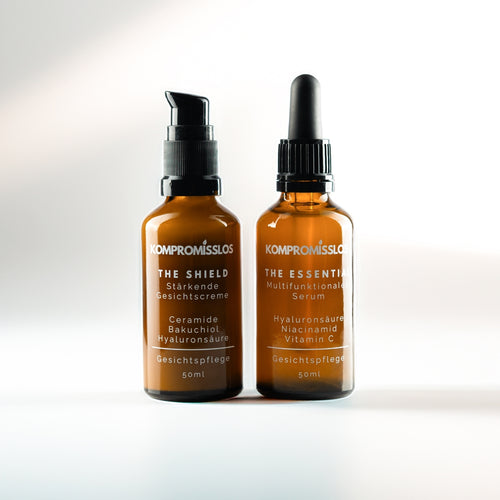
Two steps after cleansing are enough for this. In The Duo, made up of The Essential serum and The Shield cream, The Essential provides moisture with hyaluronic acid in three molecular sizes, while The Shield supports the skin barrier with Ceramide NP, squalane and jojoba oil. For dry skin, the application guide recommends using a little more. To be honest about it: The Duo contains niacinamide and vitamin C, which very dry skin may feel as a tingle at first. If you are on isotretinoin or use prescription skin medication, agree your skincare with your dermatologist and patch test a new product first. During the day, add a separate sunscreen, because our products contain no SPF.
When should you see a doctor or dermatologist about medication-related dry skin?
Medication-related dry skin should be seen by a doctor or dermatologist as soon as it cracks, bleeds, weeps, itches badly or does not improve despite consistent care. The same applies if a rash appears, the skin turns red over larger areas or the dryness affects your daily life and your sleep. Contact your doctor straight away, rather than waiting for your next routine appointment, if you develop blisters, painful skin, symptoms in your mouth, eyes or genital area, or a fever after starting a new medicine, because this can point to a serious drug reaction. A doctor can do more than cosmetics can: there are medical skincare preparations, and your dermatologist can decide whether a short course of medication for the skin makes sense.
Dry skin is common during cancer treatment and should be part of the conversation with your oncology team from the outset. A review in Dermatology Research and Practice describes xerosis as the second most common skin side effect of EGFR inhibitors, occurring in over 35 per cent of patients in most reports. Which skincare suits you during chemotherapy is something to clarify with your treatment team; the Swiss Cancer League (Krebsliga Schweiz) also offers support and information.
I disclose the concentrations in The Duo: 5% niacinamide, 2% vitamin C as 3-O-Ethyl Ascorbic Acid and 1% zinc PCA. The full INCI list with every ingredient is public, so you can print it out and show it to your doctor or pharmacist if you take medication. The Duo is fragrance-free and contains no essential oils, because for irritated skin, fragrance is just one more irritant. It is two products instead of eight, and we deliberately do not sell an exfoliator. At the same time, I want to be clear about the limits: a cream does not replace a conversation about your medication, and it does not get rid of a side effect. All it can do is support your skin as well as possible for as long as you need the medication.
Frequently asked questions
Do blood pressure medications cause dry skin?
Some blood pressure medications can contribute to dry skin, but by no means all of them and not in everyone. A position paper on dry skin lists diuretics, beta blockers and calcium channel blockers among the possible drug-related triggers. If your skin has become noticeably drier since you started a blood pressure medicine, talk to your GP rather than simply skipping the tablets.
Do cholesterol-lowering drugs dry out your skin?
Cholesterol-lowering drugs can dry out the skin: the position paper on dry skin names lipid-lowering drugs as a possible drug-related trigger. This can affect your whole body, not just your face, and by no means everyone reacts this way. Keep a note of what you observe and discuss it with your doctor or pharmacist.
How long does dry skin last after stopping a medication?
There is no fixed timeframe, but as a rule the skin does not improve overnight; it recovers over a few weeks. The outermost layer of the skin first has to renew itself, and the barrier and sebum production need time to settle. With isotretinoin, the medical literature describes the side effects on the skin and mucous membranes as reversible. If the dryness persists for longer, have it checked.
Which skincare ingredients should I avoid while taking isotretinoin?
While taking isotretinoin, it is best to leave out anything that further strips or irritates the skin: retinol and other retinoids, acid exfoliants with AHA or BHA, grainy scrubs, toners high in alcohol and fragranced products. Niacinamide or vitamin C can also tingle on very dry skin at first. Agree your skincare with your prescribing dermatologist.
Can a pharmacist tell me whether my medication dries out the skin?
Yes, a pharmacist can tell you whether dry skin is a known side effect of your medication. Pharmacists know the prescribing information and patient leaflets and can also assess interactions with other medicines. Whether the dryness in your case really comes from the medication, and whether switching is an option, is decided by the prescribing doctor.
Does drinking more water help with dry skin from water tablets?
Drinking a lot is not automatically right when you take water tablets, and it only helps the skin to a limited extent. People on diuretics often have a fluid intake set by their doctor, for example in heart failure, and more fluid can even be harmful. Ask your doctor how much you should drink, and care for your skin from the outside with moisture and lipids.
Can I use The Duo if I take medication that dries out my skin?
In most cases, there is nothing against using The Duo as supportive skincare. If you are on isotretinoin or use prescription skin medication, however, check with your dermatologist first and do a patch test, because niacinamide and vitamin C can irritate very dry skin at first. You can take the full ingredient list of The Duo with you to that appointment.
Sources
- Augustin M, Wilsmann-Theis D, Körber A, Kerscher M, Itschert G, Dippel M, et al. Positionspapier: Diagnostik und Therapie der Xerosis cutis. Journal der Deutschen Dermatologischen Gesellschaft, 2018. Source
- Kapała J, Lewandowska J, Placek W, Owczarczyk-Saczonek A. Adverse Events in Isotretinoin Therapy: A Single-Arm Meta-Analysis. International Journal of Environmental Research and Public Health, 2022. Source
- Chanprapaph K, Vachiramon V, Rattanakaemakorn P. Epidermal Growth Factor Receptor Inhibitors: A Review of Cutaneous Adverse Events and Management. Dermatology Research and Practice, 2014. Source