Is double cleansing necessary? When cleansing twice actually makes sense
ROUTINE
Double cleansing – a cleansing oil followed by a mild water-based cleanser – is only necessary on evenings when your skin is wearing make-up or a water-resistant, long-wearing sunscreen. The oil dissolves these oil-soluble layers, and the second step removes what is left of the oil. Without layers like these, a single mild step or even just water is enough. Double cleansing is a tool for certain evenings, not a ritual you have to follow every day.
What is double cleansing and how does it work?
Double cleansing is an evening cleanse in two short steps: first a cleansing oil or cleansing balm on dry skin, then a mild water-based cleanser. The idea behind it is simple. Make-up, waterproof mascara and many sunscreens are designed to cling to the skin and repel water. A water-based cleanser on its own struggles to get at these oil-soluble layers, so you end up rubbing for longer and harder. An oil, on the other hand, dissolves them with very little pressure, on the principle that like dissolves like. The second step has a different job: it takes away oil residue, sweat and dust, so that your skin is left clean for serum and cream. The method became popular mainly through Korean skincare. If you want to know what the 10-step Korean routine does and doesn’t do, and which of its steps genuinely pull their weight, you will find that there. This article is only about cleansing, and about when a second round actually achieves something.
- Apply the cleansing oil or balm with dry hands to a dry face and spread it with light pressure.
- Do not rub the eye area: let the oil sit on your lashes for a moment, then gently stroke it downwards.
- Add a little lukewarm water until the oil turns milky, then rinse thoroughly.
- Briefly massage in a mild cleanser with damp hands and rinse it off.
- Pat your skin dry rather than rubbing it, and apply your skincare straight away.
When does double cleansing make sense, and when is one step enough?
Double cleansing makes sense when your skin is wearing something that is meant to stay put: foundation, concealer, waterproof mascara or water-resistant sunscreen. On every other evening, one step is enough. What matters is not your skin type but what you put on during the day. A day cream without sun protection, a little powder or a light sunscreen for an ordinary office day can usually be removed with a single mild cleanser. If you cleanse twice on days like these anyway, you are washing off something that was already gone after the first round. So it is a question to answer afresh each evening, not once and for all. For the basics – how often to cleanse, gel or milk, water temperature – it is worth reading the article on what kind of cleanser your skin really needs. The table below only shows when the second step comes in.
| What is on your skin in the evening | Is one step enough | Sensible way to cleanse |
|---|---|---|
| Only serum and cream, no make-up | Yes | Water or a mild cleanser |
| Light sunscreen that is not water-resistant | Usually, yes | A mild cleanser, rinsed off thoroughly |
| Tinted fluid, powder, light make-up | Often, yes | A mild cleanser, or a short oil step on its own |
| Foundation, concealer, waterproof mascara | No | Cleansing oil, then a mild cleanser |
| Water-resistant or long-wearing sunscreen | No | Cleansing oil, then a mild cleanser |
Do you need to double cleanse to remove sunscreen at night?
No, not every sunscreen needs two cleansing steps in the evening, but water-resistant and very long-wearing formulas often do. Sunscreen is meant to stay on your skin, even through sweat and water. Film formers and oily ingredients make sure of that, and a water-based cleanser on its own is slow to dissolve them. With mineral filters you can sometimes see this for yourself: a faint white residue is left along the hairline or around the sides of the nose. A simple test helps you decide. If, after a mild cleanser, water still beads on your skin as you rinse, or your skin feels smooth and slightly coated, there is still sunscreen on it. That is when the oil step makes sense – not a second, more vigorous round with the same cleanser. A light everyday sunscreen, by contrast, usually comes off in one step. Which SPF suits everyday life and how much sunscreen you need is a separate question, covered in the article on sunscreen for your face if your skincare has no SPF. All that matters here is that you get all of it off again in the evening without putting your skin under strain.
Can double cleansing dry out your skin?
Yes, double cleansing can dry out your skin, but usually not because of the oil. The more common culprit is a second step that is too harsh, too long or too frequent. A review in Dermatologic Therapy describes how harsh surfactants in cleansers can damage the skin’s proteins and lipids, leading to tightness, dryness, barrier damage, irritation and even itching. The same paper names pH as an additional factor: cleansers with a neutral or slightly acidic pH, close to the natural value of the outermost layer of skin, the stratum corneum, are potentially less damaging. A review in the Journal of Cosmetic Dermatology classes synthetic detergents, known as syndets, as less damaging to the barrier than alkaline soaps. In practice, that means three things: the second cleanser should be mild, it only needs a few seconds on your skin, and it should only be used on evenings when it genuinely has something to do. If your skin regularly feels tight after washing, it is worth reading up on where tight skin after washing comes from. If it also stings and reacts to lots of things, it helps to know how to recognise a damaged skin barrier.
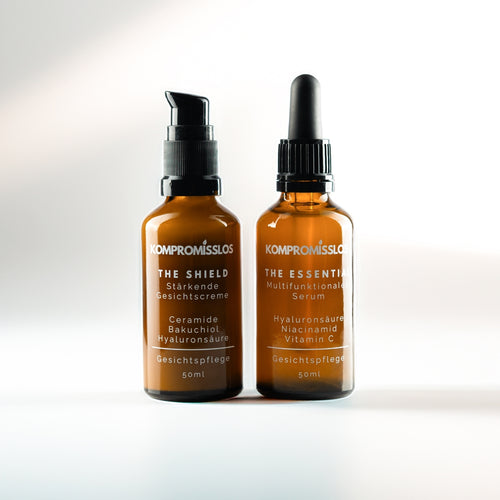
The honest answer, then, is that less cleansing tends to leave the barrier in peace. Whatever lipids are lost during washing are topped up afterwards by your skincare. With The Duo of serum and cream, that means The Essential provides hyaluronic acid in three molecular sizes and niacinamide, among other things, followed by The Shield with ceramide NP, squalane and jojoba oil. The cleanse beforehand only has to get your skin clean, not do the caring as well.
Not sure whether you need the second step tonight? After rinsing off the oil, run clean fingers over your forehead and the sides of your nose. If your skin feels neither greasy nor coated, you can skip the second cleanser that evening.
Does cleansing oil clog pores?
A cleansing oil with an emulsifier does not usually clog pores, because it rinses off completely with water. That is exactly what sets a cleansing oil apart from a pure plant oil from your kitchen cupboard. Cleansing oils and most cleansing balms contain emulsifiers. As soon as water is added, the mixture turns milky, and the oil, together with the dissolved make-up, combines with the water and runs off. A pure oil without an emulsifier does not do this. It stays on your skin as a film, and to get rid of it you need either a face cloth – which means more rubbing again – or a stronger second step. If a cleansing oil does not turn milky when you rinse it and leaves a greasy residue behind, that suggests it contains too little emulsifier or none at all. Whether individual oils are considered pore-clogging, and how reliable the well-known scales are, is covered in the article on which oils really are comedogenic. What matters here is this: an oil that is on your skin only briefly and is then rinsed off completely is a different situation from an oil left on overnight. If you have inflamed spots that last for weeks or leave scars, that is a matter for a dermatologist, not a question of how you cleanse.
Is double cleansing suitable for mature and sensitive skin?
Yes, double cleansing can suit mature and sensitive skin well, as long as both steps are mild and you only do it on evenings when there is something to remove. The main benefit is less rubbing. A study in the Journal of Cosmetic Dermatology looked at 35 women with mild atopic dermatitis on the face who used a cleansing oil with high cleansing power instead of their usual make-up remover for four weeks. The oil required less rubbing. Over that period, dryness, scaling, irritation, redness and itching decreased significantly, and transepidermal water loss fell. The authors suspect that many people with the condition rub too hard without realising it, because their cleansers are too weak. This is a small study of a single product over four weeks, but the direction makes sense: if you can remove make-up thoroughly without scrubbing, you spare sensitive skin. Mature skin is often drier, so a mild second step – or, on light days, none at all – is particularly worthwhile here. If you have rosacea, eczema or persistent redness, a dermatologist is the right person to see; cleansing can only play a supporting role.
I deliberately did not add a cleanser to our range, nor a toner or an exfoliant. Two products instead of eight also means that our instructions for use simply say: cleanse your face with water, then serum, then cream. Because The Duo contains no SPF, I recommend a separate sunscreen during the day. And that very sunscreen is the most common reason why a mild second cleansing step makes sense in the evening. This is also where my honest limit lies: which cleanser you should use is not something I can answer from my own range. All I can tell you is what I would look for: mild, easy to rinse off, fragrance-free, and used twice only when two layers really do need to come off.
Frequently asked questions
Do I need to double cleanse every night?
No, double cleansing every evening is only necessary if you wear make-up or water-resistant sunscreen every day. On evenings without these layers, a mild cleanser or water is enough. So decide based on what was on your skin during the day, not on a fixed rule. Fewer cleansing steps are kinder to dry and sensitive skin.
Do I need to double cleanse in the morning too?
No, you do not need to double cleanse in the morning. Overnight there is no make-up or sunscreen on your skin, at most your skincare from the evening before and a little sebum. Lukewarm water or a mild cleanser is enough for that. An oil step in the morning removes nothing that a single step would not take care of just as well.
Can I use olive oil or coconut oil as a cleansing oil?
You can, but it is rarely the better choice. Olive oil and coconut oil contain no emulsifier and barely rinse off with water. They leave a film that you then have to remove with a face cloth or a second cleanser, which means more rubbing. A cleansing oil with an emulsifier turns milky on contact with water and simply runs off.
What is a cleansing balm?
A cleansing balm is a cleansing oil in solid form. It is solid in the jar, melts as you spread it over your skin and dissolves make-up and sunscreen just like an oil. Most balms also contain emulsifiers and turn milky with water. Whether you choose an oil or a balm is mainly a question of which texture you prefer.
Does micellar water count as the first step?
Micellar water can remove light make-up as a first step, but with waterproof mascara and long-wearing sunscreen you often need several cotton pads and more rubbing. Whether you should rinse it off afterwards, and whether micellar water is enough to cleanse your face, is covered in a separate article.
How long should I massage in a cleansing oil?
Only until your make-up and sunscreen have visibly dissolved – going on for longer achieves very little. Massage with light pressure and circular movements, without force. Around the eyes, let the oil sit for a moment and then gently stroke it away. The less you rub, the better for sensitive skin.
Do I need to double cleanse if I use The Duo?
No, not because of The Duo. Serum and cream are not layers that need an oil step to come off, and on our instructions page the cleanse is simply water. What tips the balance is make-up and sunscreen. Because The Duo contains no SPF, you wear a separate sunscreen during the day. If it is water-resistant or long-wearing, or if you wear make-up, a mild second step makes sense in the evening – otherwise it does not.
Sources
- Ananthapadmanabhan KP, Moore DJ, Subramanyan K, Misra M, Meyer F. Cleansing without compromise: the impact of cleansers on the skin barrier and the technology of mild cleansing. Dermatologic Therapy, 2004. Source
- Draelos ZD. The science behind skin care: Cleansers. Journal of Cosmetic Dermatology, 2018. Source
- Hosokawa K, Taima H, Kikuchi M, Tsuda H, Numano K, Takagi Y. Rubbing the skin when removing makeup cosmetics is a major factor that worsens skin conditions in atopic dermatitis patients. Journal of Cosmetic Dermatology, 2021. Source