Skincare after a workout: wash, moisturise or leave your face alone
ROUTINE
Washing your face after a workout is worth it once you have worked up a proper sweat, worn sunscreen or make-up, or had a headband, helmet or towel rubbing against your skin. Lukewarm water is usually enough; if you wore sunscreen or make-up, use a mild cleanser. You can moisturise once your skin has stopped sweating, with your usual skincare rather than an extra product. If you train in the evening, this round replaces your evening routine.
Should you wash your face after a workout?
Yes, after a workout that has left you properly sweaty, a quick wash is worthwhile – but not because sweat is dirty. Sweat consists mostly of water and salts and is not a problem for the skin in itself. The tricky part is the mixture that sits on your face after an hour of exercise: sweat, sebum, sunscreen or make-up, plus dust from training outdoors and residue rubbed off your headband, helmet padding or towel. If this film stays on for hours, the salt dries on, your skin feels irritated, and pores have a harder time wherever there is pressure and friction. The American Academy of Dermatology recommends showering straight after training, particularly if you are prone to spots, and using a mild, oil-free cleanser. After exercise, you do not need a more thorough cleanse than usual – at most an extra, gentle one. When it comes to the basic question of what kind of cleanser your skin really needs, the same rules apply after training as on any other day.
The easiest way to do this is in the shower after your workout. There is no fixed number of minutes after which it becomes a problem. What matters is that the film of sweat and sunscreen does not stay on your skin until the next morning. During your workout, a clean towel helps: dab the sweat away rather than wiping it off, as the AAD also advises.
Is lukewarm water enough, or do you need a cleanser after a workout?
Lukewarm water is enough after a workout if there was nothing on your face beforehand apart from your usual skincare. Sweat is water-soluble and comes off with water. It is a different matter if you trained outdoors in sunscreen or had make-up on. Sunscreen and make-up are designed to stay put even when you sweat, and water alone only removes them partially. In that case, a mild cleanser is the right step – once, without a brush and without an exfoliant. Hot water or a second round of cleansing will not get your skin any cleaner; it simply strips more oil than necessary, which you usually notice as tightness after towelling dry. The table shows how to approach the most common situations.
| Situation | Cleansing after exercise | Afterwards |
|---|---|---|
| Indoor training without make-up | Lukewarm water | Your usual skincare once you have stopped sweating |
| Outdoor training with sunscreen | One round of mild cleanser | Skincare, then fresh sunscreen before you head outside again |
| Training with make-up | One round of mild cleanser | Skincare; make-up only once your skin has cooled down |
| Training in the evening | Mild cleanser, which replaces your evening cleanse | Evening routine, no second wash before bed |
| On the go without a shower | Rinse with water or dab clean | Catch up on your skincare at home |
When should you moisturise your face after a workout, and what do you really need?
You can moisturise after exercise as soon as your skin has stopped sweating – in other words, once your pulse has come down and your forehead feels dry. If you apply serum and cream while sweat is still coming through, it dilutes your skincare and the cream feels greasy. After an ordinary workout, your skin does not need a special product. It has lost moisture and may be a little stressed where something has rubbed, and a normal routine of hydration and a barrier-supporting cream is designed for exactly that. Intense heat is a different story: how to handle your face before and after the sauna is covered separately. Here, the focus is on movement, sweat and friction.
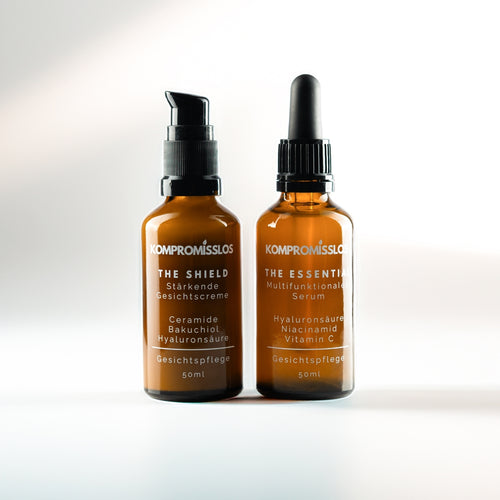
With The Duo of serum and cream, it looks like this: cleanse your face with water, then apply 3 to 6 drops of The Essential with hyaluronic acid in three molecular sizes, niacinamide and zinc PCA, followed by The Shield with ceramide NP, squalane and jojoba oil. The Duo contains 5% niacinamide and 1% zinc PCA. If your skin is still shiny after your workout, stick to the lower amount. If you train in the evening, this is your evening routine, not an extra round. In her review on Judge.me, Sabine B. writes about the serum and cream: “Especially now in the heat, it feels very fresh and light on the skin, yet still richly nourished” (review translated from German).
What should you put on your face before a workout, and what is better left off?
Before a workout, as little as possible belongs on your face: sunscreen outdoors, at most your light morning skincare indoors, and preferably no make-up. The AAD advises removing make-up before exercise and wearing an oil-free sunscreen with at least SPF 30 outdoors. On the subject of make-up, there is now a small study in the Journal of Cosmetic Dermatology. In it, 43 students wore foundation on one half of the face and ran on a treadmill for 20 minutes. Measured with a skin analyser, the oil value rose in the areas without make-up and fell in the made-up ones, while the sebum value rose in the made-up areas. The authors conclude that foundation can dry out the skin and clog pores during endurance exercise, and they advise people with dry skin against it. This is a short measurement in young, healthy people rather than a long-term finding, but the direction matches the professional body’s recommendation.
You only need to wash your face before exercise if you are wearing make-up or a thick layer of cream. If you applied your skincare in the morning, there is no need to cleanse again before a lunchtime workout. If you want to put make-up back on after training, the article on skincare before make-up will help. Which SPF you need day to day, and how much of it, is explained in the article on sunscreen for your face. For training, the main thing is that you wear it at all – and that you reapply it after sweating for a long time.
Why does sweating give you spots, and what can you change in your training?
Spots after exercise are rarely caused by sweat alone; they usually come from pressure, friction and heat under kit that sits against your skin. In dermatology, this is known as acne mechanica. The term goes back to a paper by Mills and Kligman in the Archives of Dermatology. It describes local flare-ups caused by pressure, friction, rubbing, squeezing or stretching, triggered for example by clothing or sports equipment. In their experiments, covering acne-prone skin with adhesive plaster for two weeks regularly led to new inflamed spots. Applied to your training, this means that headbands, helmet padding or chin straps matter more to your skin than how much you sweat. If you always break out in the same place along your hairline, exactly where your headband sits, you are looking at this pattern. If blemishes also appear on rest days, looking into the causes of blemish-prone skin will get you further than a new workout routine.
- Dab sweat away with a clean towel instead of rubbing, and do not use the same towel to wipe down equipment.
- Wash headbands, caps and helmet padding regularly, and do not put a damp headband back on.
- Wipe down shared equipment before use, as the AAD recommends, and keep your hands off your face while you train.
- No make-up and no thick layer of cream on your forehead and cheeks before a workout.
- After training, change out of sweaty clothes and wash your face.
If you keep getting inflamed spots, nodules or scars, that is acne, and it calls for a dermatologist’s appointment, not a tweak to your training.
Why does your face go so red during exercise, and when is it more than a workout effect?
A red face during exercise is, in most cases, thermoregulation: your body releases heat through the skin, the blood vessels widen to allow this, and you see it particularly clearly on your face. A review by Kenney and Johnson in Medicine & Science in Sports & Exercise describes how blood flow to the skin increases as soon as body temperature rises, so that heat can travel from the body’s core to the skin. How pronounced this is depends on factors such as intensity, duration, fitness, heat acclimatisation and age. Some people turn bright red on an easy jog, others barely change colour at all. That says nothing about your fitness or the quality of your skin. It is normal for the redness to fade once you have cooled down. Cooler training times, shade and airy clothing help against overheating; a cream makes no difference here.
It is more than a workout effect if hives, itching, swelling of the lips or eyes, shortness of breath or dizziness appear during or after exercise. In that case, stop training and have it checked by a doctor – straight away if you are short of breath or feel faint. If the redness lasts for hours, stings, or is accompanied by pustules and visible small blood vessels, see a dermatologist. What skincare can do cosmetically for facial redness, and where its limit lies, is covered in a separate article.
If you shower straight after your workout, wash your face at the end with lukewarm rather than hot water, and do not let the jet beat down on it for minutes. Then pat dry, wait briefly until you have stopped sweating, and apply your skincare.
A dedicated post-workout product – a cooling face mist or a toner for your gym bag – would have sold well. I deliberately did not make one, because after a workout your skin needs nothing it does not get anyway: water, then serum, then cream. That is why the range stays at two products instead of eight. Both are fragrance-free, because fragrance adds nothing to skin that has just been through heat, sweat and friction. And there is one limit I would rather state openly: The Duo contains no SPF. If you train outdoors, you need separate sun protection, and I do not sell any. How cleansing, serum and cream work together is explained in our step-by-step application guide.
Frequently asked questions
How soon should I wash my face after a workout?
Ideally in the shower straight after training, which is also what the American Academy of Dermatology advises. More important than the exact number of minutes is that sweat, sunscreen and make-up do not stay on your skin for hours or overnight. Until then, dab your face with a clean towel.
Are cleansing wipes a good option after a workout?
As a stopgap on the go, yes; as a long-term solution, not really. Wipes work by rubbing and leave their cleansing liquid on your skin. For people prone to spots, the AAD mentions salicylic acid pads as an option when a shower is not possible, but for sensitive skin that quickly becomes too much after every workout. It is better to use the wipe just to remove the worst and then rinse briefly with water at home.
Can I work out with make-up on?
You can, but your skin gets little out of it. The AAD recommends removing make-up before exercise, and a small study in the Journal of Cosmetic Dermatology advises people with dry skin against wearing foundation during endurance exercise. If you must, keep it light and only where nothing rubs, and remove it afterwards with a mild cleanser.
Do I need sunscreen on my face for outdoor sport?
Yes, whenever you train outdoors during the day. A review in Clinics in Dermatology describes how outdoor athletes are exposed to high UV doses and how sweating can increase the skin’s sensitivity to light and make sunburn more likely. Among other things, it recommends water-resistant sunscreen. In the mountains, altitude and reflection from snow and ice add to this.
Do I need to wash my face twice if I exercise and cleanse in the evening anyway?
No. If you train in the evening, cleansing after exercise is your evening cleanse; a second wash before bed only strips more oil from your skin. If you train in the morning or at lunchtime, add at most a quick round with water or a mild cleanser, and cleanse as usual in the evening.
Do I need different skincare after swimming than after running?
Hardly. After swimming, rinse off chlorine or salt water thoroughly with clean water and then apply your skincare as usual, with a little more cream if your skin is dry. After running, it is more about sweat, sunscreen and friction under a cap or headband. The routine afterwards is the same in both cases.
When should I apply The Duo after a workout?
As soon as you have cleansed your face and stopped sweating: first 3 to 6 drops of The Essential, then 3 to 6 pumps of The Shield, each time working from the centre of your face outwards and down over your neck. If your skin is still shiny, stick to the lower amount. In the evening, this replaces your evening routine – after that, you need nothing more than The Duo.
Sources
- American Academy of Dermatology. Is your workout causing your acne? Patient information from the AAD. Source
- Mills OH, Kligman A. Acne mechanica. Archives of Dermatology, 1975. Source
- Kenney WL, Johnson JM. Control of skin blood flow during exercise. Medicine and Science in Sports and Exercise, 1992. Source
- Yoon EJ, Kwon EH, Kim JH, Delacruz J, Symons TB, Lee S, et al. Influence of cosmetic foundation cream on skin condition during treadmill exercise. Journal of Cosmetic Dermatology, 2024. Source
- Moehrle M. Outdoor sports and skin cancer. Clinics in Dermatology, 2008. Source