Lactic acid for your face: a gentle exfoliant that also hydrates
ACTIVE INGREDIENTS
Lactic acid for your face does two different jobs: at higher concentrations and an acidic pH, it loosens dead skin cells and acts as a gentle exfoliant, while at low doses or as a salt (sodium lactate) it mainly binds water in the outer layer of the skin. Lactate is already part of your skin’s own natural moisturising factor. That is why lactic acid is often the better-tolerated acid for sensitive or dry skin – but it is not an essential step. One or two evenings a week are usually enough.
What does lactic acid do for your face?
On your face, lactic acid loosens the bonds between the outermost dead skin cells so that they shed more easily, and at the same time it holds water in the outer layer of the skin. Chemically, it is an alpha hydroxy acid, or AHA for short – a fruit acid, in other words, even though its name goes back to soured milk. A review in the journal Molecules describes the mechanism like this: the acidic nature of AHAs lowers the pH in the epidermis and disrupts the bonds between skin cells, which stimulates shedding. You notice the result as a smoother surface, and your complexion can look more even because rough flakes no longer scatter light so unevenly. The second effect is less well known: as lactate, lactic acid is a component of the natural moisturising factor, the small water-binding molecules found in the outer layer of the skin. The same review describes lactic acid in the form of sodium lactate as a well-known part of this moisturising system.
Which of the two effects comes to the fore is decided not by the name on the bottle but by concentration and pH – more on that in a moment. Whether you need anything exfoliating at all is a separate question, which we answer in our article on whether you need to exfoliate your face at all.
How can one acid exfoliate and hydrate at the same time?
Lactic acid can do both because it comes in two forms: as a free acid, which loosens skin cells, and as lactate, which binds water. Which form dominates depends on the pH of the product. An acidic formula contains more free acid, so exfoliation takes centre stage. In a more neutral formula, or as sodium lactate, it is mainly the moisture-binding role that remains. Just how important lactate is for your skin is shown by a study in the Journal of Investigative Dermatology involving 40 healthy people: lactate and potassium were the only components of the natural moisturising factor that correlated significantly with the hydration, stiffness and pH of the stratum corneum, the skin’s outermost layer. Lactate levels fell significantly from summer to winter, and potassium lactate was able to restore hydration after the natural moisturising factor had first been removed experimentally.
There is also a third, indirect effect. In a study in the Archives of Dermatological Research, lotions containing L-lactic acid increased the ceramide content of the stratum corneum by 48 per cent, and barrier function improved measurably. The study comes from a cosmetics manufacturer’s laboratory and is around 30 years old, but the direction it points in is still interesting: lactic acid does not only remove layers from the skin, it can also support its protective barrier. That is not a licence to exfoliate every day.
At what concentration does lactic acid exfoliate, and which pH matters?
One study found visible effects on the skin’s surface with as little as 5% lactic acid, and the accepted upper limit for products you use yourself is 10 per cent at a pH of at least 3.5. This limit comes from the Cosmetic Ingredient Review Expert Panel, whose assessment is reported by the US Food and Drug Administration (FDA): glycolic and lactic acid are considered safe for consumers if the concentration is 10 per cent or less, the pH is 3.5 or higher and the product either protects against increased sun sensitivity or tells you to use sun protection every day. How the dose plays out is shown by a study in the Journal of the American Academy of Dermatology: for three months, participants applied 5% or 12% lactic acid twice a day. Both concentrations improved smoothness and the appearance of fine lines, but only the 12% version also changed the deeper layer of the skin.
The pH matters at least as much as the percentage. A product with 10% lactic acid at a neutral pH can be milder than one with 5% at a low pH. Unfortunately, the pH is rarely printed on the packaging. The table helps you roughly interpret what the label tells you.
| What the packaging says | What it probably does | Who it suits |
|---|---|---|
| Sodium Lactate | Binds water, does not exfoliate | Every skin type, even daily |
| Lactic Acid far down the INCI list | Usually a pH adjuster or humectant | Not an exfoliating product in the true sense |
| Lactic acid with a stated percentage of around 5% | Gentle exfoliation, smooths the surface | Beginners, dry or sensitive skin |
| Up to 10%, pH 3.5 or above | Noticeable exfoliation, more tingling | Resilient skin that is used to acids |
| Over 10% or a low pH | Chemical peel | Best left to professionals |
What happens at the level of the last row in a clinic, and what it costs, is explained in our article on a professional AHA peel.
Is lactic acid gentler than glycolic acid?
Yes, of the two best-known fruit acids, lactic acid is considered the milder one. The review in Molecules notes that studies have described lactic acid as less irritating than glycolic acid. One reason lies in the chemistry: glycolic acid is the smallest fruit acid, whereas lactic acid has one more carbon atom and is therefore slightly larger. As a rule of thumb, the smaller molecule penetrates faster, while the larger one works at a more leisurely pace. The second reason is its moisture-binding property: glycolic acid mainly strips away dead cells, but lactic acid brings a degree of moisture binding with it. For dry, mature or sensitive skin, that is often the deciding difference.
Gentler does not mean harmless, though. At the same concentration and an equally low pH, lactic acid can also sting and cause redness. For resilient skin that is used to acids, glycolic acid can be the better choice, because it delivers visible smoothness more quickly. Mandelic acid, an even larger molecule, is considered another gentle option, but that is a topic in its own right. How fruit acids, salicylic acid and the even milder polyhydroxy acids differ in principle is explained in our article on the difference between AHA, BHA and PHA.
Which skin types suit lactic acid, and when should you leave it out?
Lactic acid is best suited to dry, rough or dull skin that tolerates gentle exfoliation, and to mature skin that benefits from the extra moisture binding. Sensitive skin also often copes well with a low-strength lactic acid, as long as you start slowly. You should leave it out if your skin is currently red, irritated or cracked, after sunburn, on freshly shaved or waxed skin, and if you already use a retinoid or another exfoliant. If a product stings for much longer than a few seconds, that is not a sign that it is working. We have written separately about how to tell when stinging is a warning sign. With skin conditions such as acne or rosacea, and with severely flaking skin, the question of whether an acid is suitable, and which one, is one for a dermatologist.
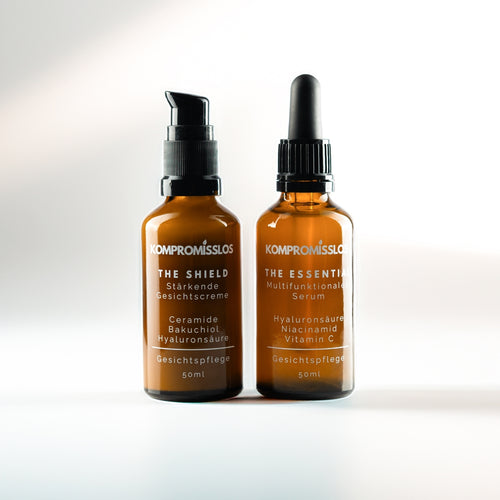
If what you mainly want is moisture rather than exfoliation, you do not need an acid. There are plenty of humectants without an acid effect, such as glycerin as a humectant or hyaluronic acid. The Duo contains no lactic acid and no exfoliating acid, but it covers the moisture-binding half through other ingredients: hyaluronic acid in three molecular sizes in The Essential serum, and in the Duo as a whole also glycerin, tamarind seed polysaccharide and Biosaccharide Gum-1. The final layer comes from The Shield, with Ceramide NP and squalane. In her review on Judge.me, Barbara F. writes about switching from a longer routine: ‘Two products, clear ingredients, no frills’ (review translated from German).
How often and when should you use lactic acid?
Lactic acid is best applied in the evening, once or twice a week to start with, and you should only increase this if your skin stays calm. Why the evening? Because fruit acids increase sensitivity to light. The FDA reports from its own studies with a glycolic acid cream that sensitivity to UV-induced skin reddening rose by 18 per cent after four weeks of use. The effect was reversible and did not last long after stopping. Even so, the agency recommends a warning for all AHA products, including lactic acid: sun protection while using them and for a week afterwards. Using it more often does not bring more benefit, just more irritation.
- Apply in the evening to cleansed, dry skin, avoiding the eye and lip area.
- Start with a low-strength product and watch your skin for two weeks before you increase it.
- On lactic acid evenings, do not use a second exfoliant or a retinoid.
- Afterwards, follow your usual routine so that your skin gets moisture and lipids back.
- Apply sunscreen the next morning and throughout the whole period of use.
Count up the acids in your week: an acid toner, an exfoliating serum and a mask with AHAs quickly amount to more exfoliation than you had planned. A single lactic acid product on fixed evenings is easier to keep track of.
I have not added an exfoliant or an acid to our range, and that is a deliberate choice. Kompromisslos consists of two products rather than eight because I developed the Duo primarily for sensitive, dry or mature skin. This kind of skin needs a base it can use morning and evening, without recovery breaks and without having to work out which evening it is. An acid does not fit this principle, because it belongs on the skin in a targeted way and only occasionally. That is why the moisture in the Duo comes from hyaluronic acid in three molecular sizes and not from an acid. If you want to exfoliate, add lactic acid on one or two evenings a week. The Duo cannot replace an exfoliant, and you do not need an exfoliant for it to work. What goes into it is set out openly on our page about the active ingredients in the Duo.
Frequently asked questions
Can I use lactic acid every day?
As sodium lactate or at a very low dose, yes; as an exfoliant, generally not. For most skin types, an exfoliating lactic acid product is enough on one or two, at most three, evenings a week. Daily use is only worthwhile for resilient skin that has demonstrably tolerated it, and only with consistent sunscreen in the morning.
Does lactic acid make your skin sensitive to sunlight?
Yes, fruit acids such as lactic acid increase sensitivity to UV radiation, which is why the FDA recommends a sunburn warning for all AHA products. In its own studies with glycolic acid, the effect was reversible: one week after stopping, the researchers no longer found any significant differences. So wear sunscreen during the day for as long as you use lactic acid. What to look out for is covered in our article on sunscreen for your face.
Is lactic acid vegan?
Usually yes, despite the name. Lactic acid for cosmetics is generally produced by fermenting sugar or synthetically, not obtained from milk. You can only be completely sure if the product is labelled as vegan or the manufacturer discloses where it comes from.
Is it normal for lactic acid to tingle or sting?
A slight tingle in the first few seconds is normal with acidic products. If the stinging persists, your skin turns very red or it starts to flake, the product is too strong or your skin is too irritated at the moment. In that case, rinse it off, take a break and start again later with a lower concentration or less often.
Is lactic acid better than urea for dry skin?
Not necessarily better, just different. Both are part of the skin’s natural moisturising factor. Urea is not an acid and is mainly used as a humectant, whereas lactic acid also exfoliates at higher doses. If you only want moisture and are not looking to exfoliate, you do not need an acid. There is more on this in our article on urea as a humectant on your face.
Can I combine lactic acid with niacinamide or vitamin C?
With niacinamide, generally yes: lactic acid in the evening, followed by your usual skincare with niacinamide, is a common combination. If your skin tends to react, use the two at different times. Vitamin C and fruit acids together is a separate topic; for sensitive skin, it is usually calmer not to layer them in the same step.
Do I need lactic acid if I use The Duo?
No, the Duo works without an exfoliant. It contains no lactic acid, but it binds moisture through hyaluronic acid, glycerin and polysaccharides. If you also want to exfoliate gently, you can add lactic acid on one or two evenings a week, then apply the serum and cream from The Duo as usual and use sunscreen in the morning.
Sources
- Tang SC, Yang JH. Dual Effects of Alpha-Hydroxy Acids on the Skin. Molecules, 2018. Source
- Nakagawa N, Sakai S, Matsumoto M, Yamada K, Nagano M, Yuki T, et al. Relationship between NMF (lactate and potassium) content and the physical properties of the stratum corneum in healthy subjects. Journal of Investigative Dermatology, 2004. Source
- Rawlings AV, Davies A, Carlomusto M, Pillai S, Zhang K, Kosturko R, et al. Effect of lactic acid isomers on keratinocyte ceramide synthesis, stratum corneum lipid levels and stratum corneum barrier function. Archives of Dermatological Research, 1996. Source
- Smith WP. Epidermal and dermal effects of topical lactic acid. Journal of the American Academy of Dermatology, 1996. Source
- U.S. Food and Drug Administration. Alpha Hydroxy Acids. FDA, updated 2022. Source