Urea face cream: which concentration makes sense and why it sometimes stings
ACTIVE INGREDIENTS
A urea face cream makes sense if your skin is dry and rough and the concentration stays low. For everyday facial skincare, creams with around 2 to 5% are enough, and 10% marks the upper limit of the moisturising range. Above that, urea becomes increasingly keratolytic, meaning it loosens dead skin cells, so it has no place in your daily face cream. If a urea cream stings, your skin barrier is often already compromised. In that case, take a break and give your skin gentler humectants first.
Can you use urea on your face?
Yes, you can use urea on your face as long as the concentration is low and your skin is not broken or acutely irritated. Urea is not a foreign substance to your skin. It is part of the natural moisturising factor, or NMF for short – the mix of small, water-binding molecules that holds on to moisture in the outermost layer of the skin. A review in Dermatologic Therapy accordingly describes urea as a component of this moisturising factor that plays an important role in skin hydration and integrity. So when you apply urea, you are topping up something that dry skin is often short of.
The catch lies not in the ingredient itself but in the dose and in the condition of your skin. Facial skin is thinner and reacts more quickly than the skin on your elbows or heels. Products with high levels of urea are meant for thickened, hardened areas, not for your cheeks and forehead. If you simply carry on using a strong cream on your face, you will soon end up with the stinging discussed further down. In a face cream in the low range, on the other hand, urea is an unspectacular, well-tolerated choice for many dry skin types.
What does urea do in the skin?
Urea binds water in the outer layer of the skin and, at higher concentrations, helps loosen flakes of dead skin. The molecule is very small and hygroscopic, which means it attracts water and holds it where your skin feels dry and rough. A review in Dermatology and Therapy by Piquero-Casals and colleagues describes urea as moisturising, keratolytic and supportive of the skin barrier, and notes that urea products are well tolerated, with side effects that are mild and occur more often at high concentrations.
Urea does, however, appear to do more than passively bind water. In a study in the Journal of Investigative Dermatology, urea applied to the skin improved barrier function in 21 volunteers. The researchers also showed that urea enters skin cells via special transporters and activates genes there that are important for barrier proteins such as filaggrin and for the production of skin lipids. For context: both papers include authors who, according to their own disclosures, are linked to a manufacturer of urea products. The basic point – that urea is a moisture-binding substance the body produces itself and that matters for skin hydration and integrity – is, however, also supported by Celleno’s review in Dermatologic Therapy.
Which urea concentration makes sense for your face?
For your face, a low concentration makes sense: around 2 to 5% to start with, and no more than 10% for very dry, resilient skin. The review in Dermatologic Therapy draws a clear line: up to 10%, urea acts mainly as a moisturiser, and above 10% it is keratolytic. The review in Dermatology and Therapy uses finer categories, classing 2 to 10% as moisturising, 10 to 30% as moisturising and keratolytic, and 30% and above as keratolytic.
In everyday terms, this means that a face cream with 5% urea is a sensible starting point for dry, slightly flaky skin. More is not automatically better. As the concentration rises, so does the keratolytic effect, and that is exactly what your face does not normally need every day. If you are new to urea, start low and only go higher if your skin stays calm after a few weeks and still feels tight or has rough patches.
| Urea concentration | Main effect | On the face |
|---|---|---|
| 2 to 5% | Binds moisture | A good starting point for dry skin |
| 5 to 10% | Moisturising, slightly smoothing | For very dry, rough and resilient skin |
| Above 10 to 30% | Moisturising and keratolytic | Not for daily facial skincare |
| 30% and above | Keratolytic | Not intended for the face |
Why does urea sometimes sting on the face?
Urea stings on the face mainly when the skin barrier is already disrupted, for example by dryness with tiny cracks, fresh redness or an exfoliation done shortly before. The small molecule then penetrates more easily and can irritate nerve endings that are better protected when the skin is intact. Urea is also considered a penetration enhancer, and the review in Dermatologic Therapy names precisely this property. That is desirable in medicines, but on irritated skin it can make the stinging worse.
A double-blind study in Acta Dermato-Venereologica with 197 patients with atopic dermatitis shows how often this happens. With a cream containing 4% urea and 4% sodium chloride, 24 per cent rated smarting, described as a sharp, superficial sensation, as moderate or severe. With a cream containing 20% glycerin, the figure was 10 per cent. For stinging, itching, and dryness and irritation as a skin reaction, the researchers found no difference, and both creams improved dryness equally well. This cannot be transferred one-to-one to healthy facial skin, but it shows the pattern: the more compromised the barrier, the sooner it makes itself felt. Whether stinging is harmless or a sign that a cream does not suit you is explained in more detail in the article on face cream stinging. For urea specifically:
- Remove the cream with lukewarm water, without rubbing.
- Avoid urea for a few days and use a gentle, fragrance-free moisturiser.
- Only start again once your skin has calmed down, and then with a lower concentration.
- Do not combine exfoliation, acids and starting a retinoid in the same week.
Urea or hyaluronic acid: which humectant suits you better?
Urea is better suited to dry, rough, slightly flaky skin with an intact barrier, while hyaluronic acid suits sensitive skin that stings easily and prefers light textures. Both bind water, but in different ways. Urea is a tiny molecule that the body produces itself; it penetrates the outer layer of the skin and also smooths it. Hyaluronic acid works mainly on the surface and rarely irritates. What hyaluronic acid can do and where its limits lie is covered in the article what hyaluronic acid really does for skin. There are also two other humectants that are often underrated:
- Urea: binds water, smooths rough patches, can sting on irritated skin.
- Hyaluronic acid: binds water at the surface, very well tolerated, not keratolytic.
- Glycerin: small, inexpensive and well researched, often the real workhorse of a cream. There is more on this in the article on glycerin in skincare.
- Panthenol: binds water and is considered particularly gentle on irritated skin.
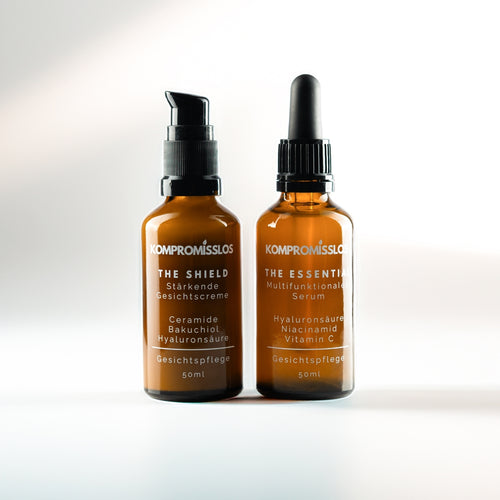
What matters is that no humectant solves dry skin on its own. Water only stays in the skin if lipids such as ceramides seal the barrier on top. That is why a cream combining urea with ceramides makes good sense. With very dry skin on the face, it is usually precisely these lipids that are missing. An honest comparison also has to mention this: The Duo contains no urea. Its humectants include hyaluronic acid in three molecular sizes, aloe vera juice, glycerin and panthenol, with ceramides added in the cream.
Who should not use urea on their face?
Urea on the face is not suitable if your skin is broken, cracked or acutely inflamed, or if it already stings with gentle products. In these situations, the molecule penetrates too easily and the irritation outweighs the benefit. Take care, too, straight after an exfoliation, after shaving, in the first weeks of using a retinoid and on the thin skin around your eyes. If your redness is persistent, stings or comes with small bumps, the cause belongs with a dermatologist, because something like rosacea may be behind it. The same applies to eczema: skincare can play a supporting role, but it is no substitute for getting it checked.
And finally, you simply do not need urea if your skin is not dry in the first place. Normal or oily skin gains little from an extra humectant if your current skincare is already enough. Where urea often goes down well, on the other hand, is dry skin with age, because mature skin produces less sebum and holds on to moisture less well.
Test a new urea cream on a small patch along your jawline for three to four evenings first. If your skin stays calm, you can move on to your whole face.
There is no urea in the Duo, and I say so openly on purpose. For humectants, we rely on hyaluronic acid in three molecular sizes, aloe vera juice, glycerin and panthenol, among others, complemented in the cream by ceramides, squalane and jojoba oil. I wanted a two-product routine designed for sensitive skin, not a separate step for every humectant. That does not mean urea is bad. If your skin is very dry and rough and urea does not sting, a urea cream can be a sensible addition. The Duo cannot cover every skin situation on its own, and it does not have to. You can see exactly what is in it in our full ingredient list.
Frequently asked questions
Is urea suitable for sensitive skin prone to redness?
Only to a limited extent. Sensitive skin often tolerates low concentrations, but it is more likely to sting with urea than with hyaluronic acid or panthenol. Start with a cream in the low range and test it on a small area first. If you have persistent redness, have the cause checked by a dermatologist before you introduce any new active ingredients.
Is 10% urea too much for the face?
For most faces, yes, at least to begin with. 10% is right at the threshold above which urea becomes increasingly keratolytic. It can work for very dry, rough and resilient skin, but for sensitive or normal skin, a cream with around 5% is the calmer choice.
Can urea cause spots?
Urea itself is a small, water-soluble molecule, not an oil. If spots appear after using a urea cream, it is usually down to the base, such as very rich fats, or to the cream simply being too heavy for your skin type. If your skin is prone to blemishes, a lighter texture with a low urea content is worth considering.
Is urea synthetic or animal-derived?
Urea in cosmetics is made synthetically from ammonia and carbon dioxide. It is chemically identical to the urea your body produces, but it is not obtained from urine or any animal source. The ingredient itself is therefore vegan. Whether the whole cream is vegan depends on the other ingredients.
Does urea help with wrinkles?
Not in the true sense. Urea binds moisture, which makes your skin look plumper and fine dryness lines less noticeable. Deeper wrinkles, however, are caused by changes in deeper layers of the skin that a humectant cannot reach. Expect a smoother surface from urea, not wrinkle correction.
Can I combine urea with retinol?
Yes, but not right at the start. Because urea can increase the penetration of other substances, combining it with retinol can raise the risk of stinging and redness. Get your skin used to the retinol first and only add urea once everything has settled. One option is to separate the two: urea in the morning, retinol in the evening.
Do I need urea if I use The Duo?
Usually not. The Duo contains no urea, but for moisture it relies on hyaluronic acid, aloe vera juice, glycerin and panthenol, among others, with ceramides added in the cream. Only if your skin stays very dry and rough and urea does not sting can a urea cream be a useful addition to The Duo.
Sources
- Celleno L. Topical urea in skincare: A review. Dermatologic Therapy, 2018. Source
- Piquero-Casals J, Morgado-Carrasco D, Granger C, Trullàs C, Jesús-Silva A, Krutmann J. Urea in Dermatology: A Review of its Emollient, Moisturizing, Keratolytic, Skin Barrier Enhancing and Antimicrobial Properties. Dermatology and Therapy, 2021. Source
- Grether-Beck S, Felsner I, Brenden H, Kohne Z, Majora M, Marini A et al. Urea uptake enhances barrier function and antimicrobial defense in humans by regulating epidermal gene expression. Journal of Investigative Dermatology, 2012. Source
- Lodén M, Andersson AC, Anderson C, Bergbrant IM, Frödin T, Ohman H et al. A double-blind study comparing the effect of glycerin and urea on dry, eczematous skin in atopic patients. Acta Dermato-Venereologica, 2002. Source