Glycerin vs hyaluronic acid: is glycerin good or bad, and when does it do more?
ACTIVE INGREDIENTS
Glycerin in skincare is good, not bad: it is one of the longest-used and best-researched humectants, and it also occurs naturally in your skin. It binds water in the outermost layer of the skin, makes it more supple and supports the skin barrier. In normal formulations, it is not harmful. There are two genuine catches: undiluted, it feels sticky, and in very dry air it needs a layer of cream on top so that the moisture it binds does not evaporate straight away.
Is glycerin in skincare good or bad?
Glycerin is a good ingredient for almost every skin type, and the research behind it is unusually solid. Chemically, it is a trihydric alcohol: a small molecule that attracts water and holds on to it. A review in the British Journal of Dermatology by Fluhr, Darlenski and Surber concludes that glycerin improves the hydration of the stratum corneum, the skin’s outermost layer, strengthens the skin’s barrier function and mechanical properties, and can help protect the skin against irritating influences. That it still has a dubious reputation comes down to three things: the word ‘alcohol’, which brings drying ethanol to mind; the claim that humectants draw water out of the skin in dry air; and its image as a cheap filler.
The first is a misunderstanding. Apart from the chemical group it belongs to, glycerin has little in common with Alcohol denat.: it does not evaporate and does not strip oil from the skin. Which alcohols really dry the skin and which care for it is a topic of its own, covered in the guide to alcohol in skincare. The second is a half-truth, which is discussed in more detail below. The third is actually true: glycerin is an inexpensive raw material. But the price of a raw material says nothing about how well it works, and with glycerin the ratio of price to evidence is, if anything, exceptionally good.
What does glycerin do for your skin?
Glycerin holds water in the uppermost layer of the skin, making it softer and more elastic – and it is not a foreign substance, because your skin produces and transports it itself. A study in the Proceedings of the National Academy of Sciences shows how important this naturally occurring glycerin is. Hara and Verkman worked with mice that lack the transport channel aquaporin-3. Their stratum corneum contained only a third as much glycerin and a third as much water, was less elastic and recovered more slowly from damage. When the animals were given glycerin, either applied to the skin or given systemically, these differences evened out, whereas similar substances such as xylitol, erythritol or propanediol did not correct the water content. The authors see this as a scientific basis for the more than 200-year-old practice of using glycerin in skincare. It is an animal study, but it explains well why glycerin is more than a water reservoir on the surface.
Studies in humans point the same way. A study in Acta Dermato-Venereologica deliberately damaged the skin barrier, once with adhesive tape and once by repeated washing with the surfactant sodium lauryl sulfate. In the areas treated with glycerin, the barrier recovered more quickly, and the effect was still measurable seven days after the treatment ended. Glycerin is therefore particularly helpful when your skin feels tight and rough, in other words when it lacks water rather than oil. How to tell whether your skin is short of water rather than oil is explained in the guide to dehydrated skin.
Does glycerin dry out your skin in dry air?
No, there is no solid evidence that glycerin dries out the skin, and the available data, if anything, point the other way. The worry goes like this: in dry air, a humectant supposedly pulls water up from deeper layers of the skin to the surface, where it evaporates. Laboratory findings show something different. In the International Journal of Cosmetic Science, Lodén and Wessman refer to in vitro studies in which glycerin prevented model lipids of the stratum corneum from crystallising at low humidity. A study from Lund University in the European Journal of Pharmaceutical Sciences found, using samples of pig skin, that under drying conditions glycerin kept the skin’s permeability high, which otherwise falls as the skin dries out. Water, glycerin and urea changed the structure of the stratum corneum in similar ways. In other words, glycerin takes over part of the role of water when water becomes scarce. Consistent with this, the review in the British Journal of Dermatology notes that the extra moisture from glycerin matters precisely when dry, cold weather takes its toll on the skin, for example in dry winter conditions.
The real kernel of truth behind the worry lies elsewhere: a humectant on its own does not seal anything in. A thin, water-based layer quickly dries off in centrally heated rooms in January, in a cold bise or in a foehn wind, and the tight feeling comes back. In the study in Acta Dermato-Venereologica, skin hydration in the first experiment was highest where the glycerin was additionally covered airtight. Humectants and a layer on top therefore belong together.
On days with a foehn wind or dry central heating, one simple rule helps: never leave a light, water-based product with humectants on its own – always apply a cream on top. That way, the moisture it binds is more likely to stay in your skin rather than in the air of the room.
Glycerin vs hyaluronic acid: which is better?
Neither is better in principle: they work in different places and complement each other. Glycerin is a small molecule that penetrates the stratum corneum and works there with the skin’s own moisture system. Hyaluronic acid in skincare consists of considerably larger molecules, a large proportion of which stay on the surface, where they hold water in a fine film. Asking which one wins is therefore the wrong question. Glycerin has been in use for a long time and has been thoroughly studied as a humectant, whereas hyaluronic acid is marketed far more loudly. Glycerin does more above all when your skin is rough, feels tight after washing or has a stressed barrier. Hyaluronic acid is more about that instantly smooth, plump feel on the surface. What hyaluronic acid does in detail and where its limits lie is covered in the guide to what hyaluronic acid really does.
| Criterion | Glycerin | Hyaluronic acid |
|---|---|---|
| Molecule | Small | Large, with smaller fragments depending on the type |
| Where it works | In the stratum corneum | Mainly on the surface |
| Occurs naturally in skin | Yes, as part of the skin’s own moisture system | Yes, mainly in deeper layers of the skin |
| Skin feel | Sticky in high amounts | Smooth, leaves a light film |
| Typical role in a formulation | Base humectant | Supporting humectant |
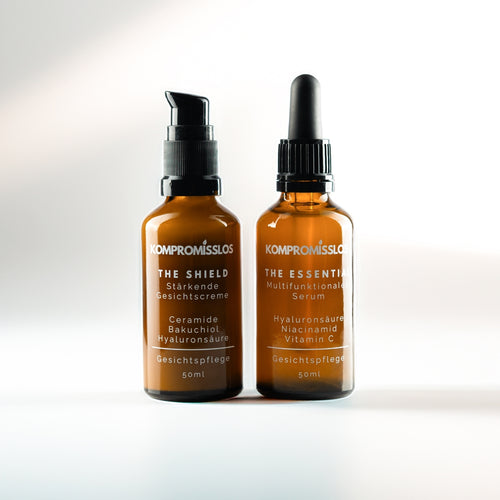
In practice, you do not have to choose: most good formulations combine several humectants. The Duo of Essential serum and Shield cream contains both: hyaluronic acid in three molecular sizes and glycerin, which the ingredients page lists as a plant-based moisturising ingredient. On top of that come plant polysaccharides from tamarind seed. A separate guide explains how such plant-based humectants differ from hyaluronic acid.
Is glycerin natural or synthetic?
Glycerin can be plant-derived, animal-derived or synthetic, and you cannot tell the difference from the packaging: in the ingredient list, every version is simply called ‘glycerin’. Plant glycerin is produced when processing oils and fats such as rapeseed, soya, coconut or palm oil, and much of it is now a by-product of biodiesel production. Animal glycerin comes from tallow, while synthetic glycerin is made petrochemically from propylene. The finished molecule is identical in all three cases. For your skin, what counts is purity, not origin. For your conscience, origin may still matter, and the only things that help there are information from the manufacturer or a reliable vegan label. Why ambiguous names such as glycerin, squalane or ceramides are worth asking about when you buy a vegan moisturiser is explained in the guide on that topic.
The word ‘natural’ itself is not a legally defined term for cosmetics either. It is much the same as with the promise of skincare without additives: the only reliable thing is the ingredient declaration, not the marketing copy on the front of the pack.
What are the downsides of glycerin?
Glycerin has a few downsides, and they are real, but none of them makes it harmful. Most concern how it feels on the skin or what you expect of it, not how well it is tolerated. A double-blind study in the International Journal of Cosmetic Science shows its limits well: in 17 healthy volunteers, a cream with 20% glycerin significantly increased measured skin hydration after ten days, but the researchers found no difference from the cream without the active ingredient in water loss through the skin or in sensitivity to an irritating surfactant. So glycerin measurably moisturises, but it does not additionally seal healthy skin against water loss.
- Sticky feel: the higher the proportion, the more likely your skin is to feel slightly tacky, especially if the formulation has no balancing oils.
- Unsuitable undiluted: pure glycerin is very viscous and strongly attracts water. For your face, it is better off in a finished formulation.
- Not enough on its own in dry air: without a layer on top, the moisture it binds evaporates more quickly.
- Origin you cannot see: the ingredient list does not reveal whether it is plant-derived, animal-derived or synthetic.
- No substitute for lipids: very dry skin usually lacks lipids as well, and glycerin does not supply them.
With The Duo, I chose two products instead of eight and decided to disclose the concentrations of the main active ingredients, such as 5% niacinamide and 1% zinc PCA. Glycerin is not one of these main active ingredients. It is in our ingredient list as an unspectacular, well-researched humectant; I do not give a percentage for it, and I do not turn it into a big promise either. What matters more is how the two steps work together: first the light serum, then the cream with ceramides, squalane and jojoba oil as a layer on top. A humectant on its own does little for you in centrally heated air if nothing sits on top of it. Glycerin is no wonder ingredient, and it does not need to be. You will find every single ingredient on our A to Z ingredients page.
Frequently asked questions
Is glycerin comedogenic?
No, glycerin is not considered pore-clogging. It is water-soluble rather than an oil, and it is widely used in skincare for combination skin, too. Whether a cream gives you breakouts depends on the whole formulation, not on glycerin. Why lists of comedogenic ingredients are of limited help anyway is explained in the guide to the term.
Is glycerin vegan?
Glycerin can be vegan, but it does not have to be. It is made from plant oils, from animal tallow or synthetically, and the ingredient list does not distinguish between them. Only a reliable vegan label or information from the manufacturer gives you certainty. If a product is declared vegan, that also applies to the glycerin it contains.
How much glycerin makes sense in a cream?
There is no fixed ideal amount. In the study in the International Journal of Cosmetic Science, a cream with 20% glycerin measurably increased skin hydration; most everyday creams contain less, because higher proportions feel sticky. Its position in the ingredient list gives you a rough guide: the nearer the top glycerin appears, the more of it the product contains.
Can I put pure glycerin on my face?
Better not. Pure glycerin is viscous and sticky and strongly attracts water, with nothing to hold the moisture in afterwards. In a finished cream or serum, it is balanced with water, oils and other humectants so that it absorbs pleasantly. Home-made mixtures are also hard to make hygienically and with a reliable shelf life.
Is plant-derived glycerin better?
Not for your skin. Plant-derived, animal-derived and synthetic glycerin are chemically the same molecule and work in the same way; what matters is purity. The difference lies in whether a product is vegan and in your personal standards for where raw materials come from. None of this gives it an advantage in how well it works.
Is glycerin suitable for sensitive skin?
Yes, glycerin is considered very well tolerated and is suitable for sensitive skin, too. Genuine intolerances are rare. If your skin reacts to a cream with burning or redness, the cause is more often fragrances or essential oils in the same formulation. If the symptoms persist, have them checked by a dermatologist.
Does The Duo contain glycerin?
Yes. Glycerin is in the Duo’s ingredient list and is listed on the ingredients page as a plant-based moisturising ingredient; no percentage is given for it. In the Duo, it works together with hyaluronic acid and tamarind seed polysaccharides. You do not need an additional glycerin product alongside The Duo, because the cream already provides the layer on top.
Sources
- Fluhr JW, Darlenski R, Surber C. Glycerol and the skin: holistic approach to its origin and functions. British Journal of Dermatology, 2008. Source
- Hara M, Verkman AS. Glycerol replacement corrects defective skin hydration, elasticity, and barrier function in aquaporin-3-deficient mice. Proceedings of the National Academy of Sciences of the USA, 2003. Source
- Fluhr JW, Gloor M, Lehmann L, Lazzerini S, Distante F, Berardesca E. Glycerol accelerates recovery of barrier function in vivo. Acta Dermato-Venereologica, 1999. Source
- Lodén M, Wessman W. The influence of a cream containing 20% glycerin and its vehicle on skin barrier properties. International Journal of Cosmetic Science, 2001. Source
- Björklund S, Engblom J, Thuresson K, Sparr E. Glycerol and urea can be used to increase skin permeability in reduced hydration conditions. European Journal of Pharmaceutical Sciences, 2013. Source