Plant-based hyaluronic acid: what tamarind seed and other plant humectants can really do
NATURAL SKINCARE
Plant-based hyaluronic acid does not really exist as such: the hyaluronic acid used in cosmetics today is mostly made by bacterial fermentation, which means it is usually vegan anyway. What is sold under the label are plant polysaccharides, such as the one from tamarind seed. They also bind water at the skin’s surface and leave a fine, smoothing film, but chemically they are a different substance. They complement hyaluronic acid well, but they are not a like-for-like replacement.
Is there such a thing as plant-based hyaluronic acid?
No, there is no hyaluronic acid from plants as a cosmetic ingredient, which makes ‘plant-based hyaluronic acid’ a marketing term. Hyaluronic acid is a molecule that occurs in human and animal connective tissue and is produced by certain bacteria. A review in Microbial Cell Factories describes how hyaluronic acid used to be extracted from rooster combs and is now mainly produced by fermentation with streptococci. For you, this means that the hyaluronic acid in a cream is usually made biotechnologically and does not need a plant label to be vegan. Whether a formula is free from animal ingredients as a whole depends on everything else in it, which the article on what vegan actually means in a moisturiser explains in more detail.
So when a product advertises ‘plant-based hyaluronic acid’, the ingredient list usually says something else: a polysaccharide from tamarind seed, a gel from algae or a fermented sugar. These ingredients can be useful. They simply work in their own way, and you should know how before treating them as the same thing as the well-known active ingredient. What hyaluronic acid itself does is covered in the article on what hyaluronic acid really does for skin.
What does tamarind seed extract do for your skin?
In skincare, tamarind seed extract acts as a humectant and film former: it binds water at the surface and lays a thin film over it, which can make the skin look smoother and feel less tight. This does not mean the fruit pulp, but the polysaccharide from the seed kernel, listed in the ingredients as Tamarindus Indica Seed Polysaccharide. Chemically, it is a xyloglucan. A review in the International Journal of Molecular Sciences describes it as a neutral, branched polysaccharide with a cellulose-like backbone carrying side chains of xylose and galactose. This structure is considered mucin-like and explains why the substance adheres well to mucous membranes. A review in Carbohydrate Polymers lists its properties as high viscosity, a wide pH tolerance and good biocompatibility.
To put this honestly: most of the data on tamarind seed polysaccharide comes from eye drops, products for mucous membranes and drug carriers, not from studies on facial skin. That it holds moisture on the skin and leaves it feeling smoother fits these properties. Big promises about wrinkles or firming cannot be derived from them.
How do polysaccharide humectants differ from hyaluronic acid?
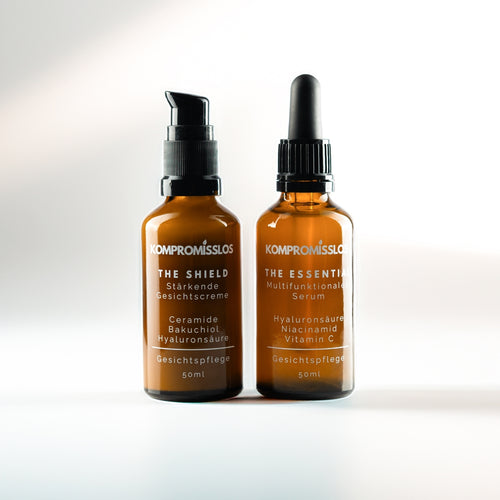
Polysaccharide humectants and hyaluronic acid both bind water, but they differ in structure, charge and skin feel. According to the review in Microbial Cell Factories, hyaluronic acid is a linear molecule made of repeating sugar units. One of these units is an acid, which gives the molecule a negative charge. It binds a lot of water, which is why it is mainly used in cosmetics to provide moisture. The xyloglucan from tamarind seed, by contrast, is branched and uncharged. In skincare products, it is therefore used less as a water reservoir in the classic sense and more as a soft, adhesive film. That is why The Duo contains both side by side: hyaluronic acid in three molecular sizes and tamarind seed as one of five plant extracts, plus Biosaccharide Gum-1 from fermentation. Exactly which ingredients are in The Duo is openly declared.
Where the two substances have been compared head to head, it has mainly been in the eye. The review in the International Journal of Molecular Sciences cites an open, randomised study of 30 adults with dry eyes who used eye drops containing either xyloglucan or hyaluronic acid for 90 days. Xyloglucan scored better in some of the subjective ratings. This cannot be transferred to facial skin, but it does show that the plant sugar is more than just filler.
| Humectant | Origin | Structure | Typical skin feel |
|---|---|---|---|
| Hyaluronic acid (Sodium Hyaluronate) | Bacterial fermentation | Linear, negatively charged | Fresh, plump, slightly sticky depending on size |
| Tamarind seed (Tamarindus Indica Seed Polysaccharide) | Seed kernel of the tamarind | Branched, uncharged | Smooth, silky, light film |
| Biosaccharide Gum-1 | Fermentation | Microbial polysaccharide | Soft, supple |
| Glycerin | Plant fats or synthetic | Small molecule | Neutral to slightly moist |
The smallest molecule in this line-up is glycerin, a humectant with a logic all of its own. The article on glycerin in skincare explains when it does more than the large sugar chains.
Why combine plant humectants with hyaluronic acid?
Plant humectants are combined with hyaluronic acid because different molecules hold water in different ways and complement each other in texture and adhesion. Hyaluronic acid attracts water strongly and creates that plump feeling shortly after application. An adhesive plant sugar such as tamarind seed polysaccharide forms an even film that makes the surface look smoother. Together, this often gives a more balanced skin feel than a single humectant in a high amount, which is more likely to feel sticky.
There is a limit, though: more humectants do not automatically mean more moisture in the skin. All of these substances work in the uppermost layers. The same applies to newer trending humectants such as polyglutamic acid. Without a sealing layer of lipids on top, the water they bind evaporates again. If your skin feels tight even though it actually has enough oil, the article on dehydrated skin will help you make sense of it.
What is Biosaccharide Gum-1?
Biosaccharide Gum-1 is a polysaccharide obtained by fermentation and used as a humectant in skincare products. Despite the name, it is not a plant extract, and the ‘bio’ has nothing to do with an organic label. As a fermentation product, the substance is closely related to microbial exopolysaccharides, sugar chains that microorganisms release into their surroundings. A review in Marine Drugs on bacterial exopolysaccharides in skincare states that polysaccharides can act as humectants to promote a moist environment on the skin, and also describes these sugar chains as texturisers. Biosaccharide Gum-1 is on the ingredient list of The Duo. Attributing an anti-ageing effect of its own to it would go beyond what the data shows. Its job is a soft skin feel and binding water at the surface.
When a label promises ‘plant-based hyaluronic acid’, any of the following may be behind it:
- A seed polysaccharide such as Tamarindus Indica Seed Polysaccharide
- A fermented sugar such as Biosaccharide Gum-1, which strictly speaking is not plant-based
- Algae or fungal polysaccharides, which are often there mainly for texture
- Perfectly ordinary hyaluronic acid made by fermentation, with plant-sounding marketing copy
Which skin types benefit most from plant humectants?
Plant humectants are particularly interesting for dry, sensitive and mature skin that needs moisture but does not take well to heavy textures or sticky serums. The film left by tamarind seed feels smooth and light, which makes it a good fit for skin that feels tight after washing. On combination skin, they are pleasant because they add moisture without leaving a greasy feel. The same goes for aloe vera, whose juice forms the base of both products in The Duo. They make little sense as the only skincare for very dry skin that is mainly lacking lipids.
Beatrix describes what this can feel like in practice in her review on Judge.me: ‘The serum feels very pleasant on the skin and immediately hydrated my skin’ (review translated from German). That is a personal impression, not proof that any single ingredient works. In formulas like these, plant humectants are team players, much like edelweiss extract rounds off a formula without replacing the dosed active ingredients.
If you are looking for a plant humectant in a product, check the INCI list rather than the front of the pack. If it lists neither Tamarindus Indica Seed Polysaccharide nor a similar seed or fermented sugar, ‘plant-based hyaluronic acid’ is just an advertising phrase.
I could easily have sold the tamarind seed polysaccharide as ‘plant-based hyaluronic acid’. I didn’t, because it isn’t true. In The Duo, tamarind seed is one of five plant extracts alongside hyaluronic acid in three molecular sizes, not in its place. On top of that comes Biosaccharide Gum-1 from fermentation. These humectants complement each other, and none of them can do on its own what well-matched skincare with lipids does. That is also why you don’t need a separate product with ‘plant-based hyaluronic acid’ if your skincare already contains these humectants. If you want to check for yourself, you will find the complete list of ingredients with every single substance, including the ones that don’t sound like plants.
Frequently asked questions
Is tamarind extract vegan?
Yes, the polysaccharide from tamarind seed comes from the seed kernel of a plant and is therefore vegan. Whether a product containing tamarind is vegan overall, however, depends on all the other ingredients. One vegan humectant does not make a vegan cream, and conversely, fermented hyaluronic acid is usually free from animal ingredients too.
Can tamarind irritate the skin?
Tamarind seed polysaccharide is considered well tolerated: reviews describe it as biocompatible, and it does not act as an acid. Even so, a reaction can never be ruled out, because sensitive skin can react to any formula. Patch-test new products on a small area of skin first. If redness or itching persists, have it checked by a dermatologist.
Does tamarind replace hyaluronic acid?
No, tamarind is not a like-for-like replacement for hyaluronic acid. Both bind water, but hyaluronic acid works more strongly as a water reservoir, while tamarind seed polysaccharide acts more as a smoothing film. In a good formula, they complement each other. If you deliberately want to avoid hyaluronic acid, tamarind will give you a different skin feel, not the same one.
Is tamarind an exfoliant?
The seed polysaccharide is not an exfoliant. It does not loosen dead skin cells, but binds water and forms a film. The confusion comes from tamarind fruit pulp, which contains fruit acids such as tartaric acid. In cosmetics, that usually appears in the INCI list as Tamarindus Indica Fruit Extract, not Seed Polysaccharide.
How can I spot plant humectants in the INCI list?
You can recognise them by plant names combined with terms such as Polysaccharide, Gum or Seed. Typical examples are Tamarindus Indica Seed Polysaccharide or Aloe Barbadensis Leaf Juice. Biosaccharide Gum-1 sounds plant-based but comes from fermentation. Sodium Hyaluronate is hyaluronic acid itself, however it is marketed.
Are plant humectants suitable for mature skin?
Yes, plant humectants suit mature skin well because they hold moisture at the surface and leave the skin feeling smoother. However, mature skin usually needs lipids too, because its own oil production declines over the years. A humectant on its own is therefore rarely enough; only together with a protective cream does it become complete skincare.
Why does The Duo contain tamarind seed and hyaluronic acid?
Because the two substances bind water in different ways and complement each other in skin feel. Hyaluronic acid in three molecular sizes provides moisture, tamarind seed polysaccharide adds a smooth film, and Biosaccharide Gum-1 joins them as a further humectant. Tamarind seed is a complement, not a substitute. That is how the humectants in The Duo are deliberately put together.
Sources
- Liu L, Liu Y, Li J, Du G, Chen J. Microbial production of hyaluronic acid: current state, challenges, and perspectives. Microbial Cell Factories, 2011. Source
- Piqué N, Gómez-Guillén MDC, Montero MP. Xyloglucan, a Plant Polymer with Barrier Protective Properties over the Mucous Membranes: An Overview. International Journal of Molecular Sciences, 2018. Source
- Raj V, Lee S. State-of-the-art progress on tamarind seed polysaccharide (Tamarindus indica) and its diverse potential applications, a review with insight. Carbohydrate Polymers, 2024. Source
- Benhadda F, Zykwinska A, Colliec-Jouault S, Sinquin C, Thollas B, Courtois A, et al. Marine versus Non-Marine Bacterial Exopolysaccharides and Their Skincare Applications. Marine Drugs, 2023. Source