Polyglutamic acid vs hyaluronic acid: what the trending humectant really does
ACTIVE INGREDIENTS
Polyglutamic acid is a humectant made by bacterial fermentation that binds water and forms a fine film on the skin’s surface to hold moisture in. That makes it a useful addition for dehydrated skin. The often-repeated claim that it binds four times more water than hyaluronic acid, however, is a marketing statement: there are no human studies comparing the two directly. If your routine already includes humectants and a cream on top, you do not need an extra polyglutamic acid serum.
What is polyglutamic acid and where does it come from?
Polyglutamic acid – PGA for short, or more precisely γ-polyglutamic acid – is a long chain of the amino acid glutamic acid, produced by bacteria of the genus Bacillus. The bacteria release it into their surroundings during fermentation; it is water-soluble and biodegradable. You may already know it from the kitchen: according to a paper in the International Journal of Molecular Sciences, it is the slimy substance in Japanese natto, which is made from fermented soybeans. The soybean itself does not supply the polyglutamic acid, though – the bacterium makes it. For cosmetics, it is now produced specifically in fermentation plants. The molecule is large: depending on the bacterial strain, its molecular weight is roughly 100 to 1,000 kilodaltons. As early as 2001, a review in Bioresource Technology described its use as a humectant in cosmetics, alongside many other applications. So the substance itself is not new; what is new is mainly the marketing around it.
What does polyglutamic acid do for the skin?
On the skin, polyglutamic acid works first and foremost as a humectant: it attracts water and, because of its size, forms a thin film on the stratum corneum, the skin’s outermost layer, and this film slows down evaporation. A molecule this large cannot penetrate deeply, so its effect plays out on the surface. That is enough for what most people expect from a hydrating serum: the skin feels less tight and smoother for as long as the product stays on it.
Anything beyond that has so far been shown mainly in the lab. A 2025 study in the International Journal of Molecular Sciences treated skin cells and a lab-grown skin model with polyglutamic acid. In the cells, the activity of genes for barrier proteins such as filaggrin and loricrin went up, as did that of aquaporin 3, a channel protein involved in water transport. In the skin model, a solution containing 1% polyglutamic acid produced more filaggrin and involucrin than the control. The authors themselves name the lack of data from living people as a significant limitation and call for clinical studies. Some members of the team also work for companies in the industry. That does not make the results wrong, but they are pointers from cell culture, not proof of what happens on your skin.
Does polyglutamic acid really bind four times more water than hyaluronic acid?
There is no solid evidence for this in humans. The figures doing the rounds in shops and magazines – four times as much as hyaluronic acid, or many times its own weight – can be traced back to raw-material and manufacturer data, not to measurements on skin. They describe how much water a substance can absorb in a glass. So far, the medical literature database PubMed contains no controlled human study that compares polyglutamic acid and hyaluronic acid directly on the skin. Water binding in the lab and measured skin hydration are two different things. The fact that a substance soaks up a lot of water in a beaker tells you nothing about how much of it actually reaches your stratum corneum after a day in dry, centrally heated air. That depends on the formula, the concentration, the molecular size and, above all, on what you apply on top.
By comparison, hyaluronic acid has been studied in humans. In a randomised study in the Journal of Drugs in Dermatology, 76 women aged between 30 and 60 applied a hyaluronic acid cream around one eye twice a day and a cream without the active ingredient around the other. At the end of the 60-day treatment period, all the hyaluronic acid creams had improved skin hydration and elasticity significantly more than the comparison cream. No study of this kind exists for polyglutamic acid yet. If you want to put advertising figures into perspective, four questions help:
- Was it measured on people, or in the lab, on cells or in a glass?
- Was there a comparison group or an untreated side of the face?
- Is the source named with journal and year, or does it just say ‘studies show’?
- Does the figure refer to the pure raw material or to the finished product you buy?
Polyglutamic acid vs hyaluronic acid: how do they differ in skincare?
In skincare, polyglutamic acid and hyaluronic acid do almost the same job – both bind water on the skin’s surface – but they differ in structure and, above all, in how well they have been studied. Hyaluronic acid is a polysaccharide that your skin produces itself, and for cosmetics it is also mostly obtained by fermentation. Polyglutamic acid is a chain made from a single amino acid and does not occur in the skin in this form. What hyaluronic acid does at which molecular size, and where its limits lie, is covered in detail in the article on what hyaluronic acid really does for your skin.
| Criterion | Polyglutamic acid | Hyaluronic acid |
|---|---|---|
| Origin | Bacterial fermentation (Bacillus) | Occurs naturally in the skin; for cosmetics mostly fermented |
| Structure | Chain of glutamic acid | Polysaccharide |
| Molecular size | Large, stays on the surface | Small to very large, depending on the raw material |
| Where it works | Film on the stratum corneum | Stratum corneum; smaller forms reach slightly deeper |
| Studies in humans | Hardly any, mainly lab data | Several controlled studies |
| Skin feel | Smoothing, slightly filmy depending on the amount | Light, slightly sticky depending on the amount |
There are other contenders on the same shelf. If you are looking for alternatives to hyaluronic acid, you will often come across plant humectants such as tamarind seed and Biosaccharide Gum-1. And the cheapest and longest-studied option to this day is glycerin, the underrated humectant. Polyglutamic acid is therefore one option among several, not a replacement that makes all the others look outdated.
Which skin benefits from polyglutamic acid, and when can you skip it?
Polyglutamic acid is most worthwhile for skin that lacks water rather than oil: it feels tight after washing, looks dull and shows fine crinkly lines, even though it may actually be shiny. Whether that applies to you is explained in the article on how to recognise dehydrated skin. It can also be worth a look if you find hyaluronic acid products sticky and want a different texture. For very dry skin that is short of lipids, on the other hand, it does not solve the underlying problem, because what is missing there is fat in the barrier, not yet another water binder. And no humectant changes deep wrinkles. What hydration can visibly improve shows up mainly in fine lines. If you know how to tell dehydration lines apart from wrinkles, your expectations stay realistic.
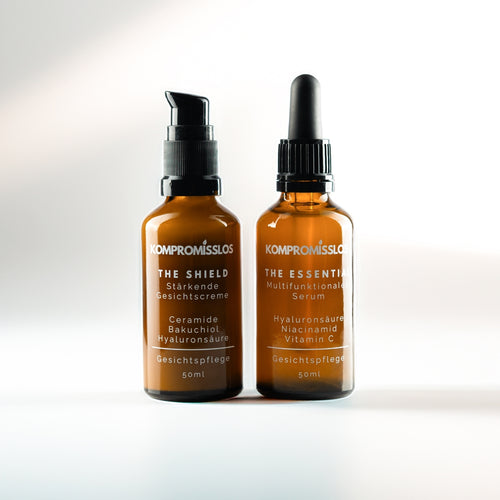
You can skip it if your routine already has at least one good humectant and a lipid-rich layer on top. Polyglutamic acid is not in the INCI list of The Duo of Essential serum and Shield cream. The Duo relies on other humectants with a lipid-containing cream on top, and in a set-up like this, an additional humectant is not a must. In her review on Judge.me, Simone writes: ‘I think it’s really great that you only need 2 products and that nobody is running a money-spinner with more than 10 serums etc. […]’ (review translated from German). If you have atopic dermatitis or eczema, your skincare should in any case be discussed with a dermatologist.
How do you spot polyglutamic acid in the INCI list, and how do you use it?
In the ingredient list, you can recognise polyglutamic acid by the names Polyglutamic Acid or Sodium Polyglutamate, its sodium salt. It is usually listed fairly far down, because even small amounts noticeably change the texture. If it comes right at the end, after fragrances and preservatives, it is probably only present in a small amount. You use it like a hydrating serum: after cleansing, on the skin, before your cream. It gets on with hyaluronic acid, niacinamide and vitamin C without any known problems, so there is no reason to use these products at separate times. What matters is the step that follows. In dry air, a humectant without a sealing layer quickly gives up the water it has bound, which is why it is worth knowing which layer should never be missing on top of humectants. Layering several water-binding serums on top of each other usually achieves less than a suitable cream.
If a hydrating serum feels tight once it has dried, this is often less down to the active ingredient than to the cream coming too late. Apply your cream while your skin still feels slightly supple.
Polyglutamic acid is not in the INCI list of the Duo, and I would rather say so openly straight away than write this article as if it were. The moisture in the Duo comes from hyaluronic acid in three molecular sizes, glycerin, Biosaccharide Gum-1 and the polysaccharide from tamarind seed. On top of that, Ceramide NP, squalane and jojoba oil in the Shield cream keep this moisture in the skin. For me, two products instead of eight also means not offering a separate serum for every new humectant. If you already have a polyglutamic acid serum, there is nothing wrong with carrying on using it. You just do not need one for the Duo to work. Exactly what it contains is set out in the full list of ingredients.
Frequently asked questions
Is polyglutamic acid vegan?
As a rule, yes. Polyglutamic acid for cosmetics is produced by fermentation using bacteria of the genus Bacillus, and no animal raw materials are needed. Whether a specific product is vegan as a whole, however, depends on all its other ingredients. So rely on the product’s labelling rather than on the individual active ingredient alone.
Is polyglutamic acid a peptide or an exfoliating acid?
Neither, in the usual sense. Polyglutamic acid is a very long chain of the amino acid glutamic acid and is sometimes described in the scientific literature as a polypeptide, but it does not work like a signal peptide. Despite the word acid in its name, it does not loosen dead skin cells the way AHAs or BHAs do. It binds water and forms a film.
Can I use polyglutamic acid and hyaluronic acid together?
Yes, the two get on perfectly well, and some serums even contain both. You can combine them in one step or apply them one after the other. So far, studies have not shown a measurable extra benefit of the combination in humans. More important than the number of humectants is a cream on top that holds in the water they have bound.
Can polyglutamic acid irritate the skin?
Rarely. Polyglutamic acid is considered well tolerated, and a review in Frontiers in Microbiology describes it as harmless to humans. Reactions are still possible with any product, often caused by other ingredients in the formula. If your skin is sensitive, test a new serum on a small area for a few days first, for example along your jawline.
Does polyglutamic acid replace a face cream?
No. Polyglutamic acid binds water and forms a thin film, but it supplies hardly any lipids – and those are exactly what dry and mature skin lacks. A cream with oils and barrier-like substances such as ceramides seals the moisture in. A polyglutamic acid serum is therefore a step before your cream, not a replacement for it.
Is polyglutamic acid suitable for mature skin?
Yes. Mature skin often loses moisture more easily and benefits from humectants, and polyglutamic acid is one possible choice. It can make fine dryness lines look smoother for a while. It does not change real wrinkles, and how much it helps depends heavily on whether it is followed by a richer cream that replenishes lipids.
Do I need a polyglutamic acid serum if I use The Duo?
No. Polyglutamic acid is not in the Duo, but the Duo already contains several humectants, including hyaluronic acid in three molecular sizes and glycerin, and seals them in with the cream. If you already have a polyglutamic acid serum, you can apply it before the Duo of serum and cream. It is not necessary, though.
Sources
- Ko HJ, Park S, Shin E, Kim J, Lee GS, Lee YJ, et al. Poly-γ-Glutamic Acid from a Novel Bacillus subtilis Strain: Strengthening the Skin Barrier and Improving Moisture Retention in Keratinocytes and a Reconstructed Skin Model. International Journal of Molecular Sciences, 2025. Source
- Shih IL, Van YT. The production of poly-(gamma-glutamic acid) from microorganisms and its various applications. Bioresource Technology, 2001. Source
- Elbanna K, Alsulami FS, Neyaz LA, Abulreesh HH. Poly (γ) glutamic acid: a unique microbial biopolymer with diverse commercial applicability. Frontiers in Microbiology, 2024. Source
- Pavicic T, Gauglitz GG, Lersch P, Schwach-Abdellaoui K, Malle B, Korting HC, et al. Efficacy of cream-based novel formulations of hyaluronic acid of different molecular weights in anti-wrinkle treatment. Journal of Drugs in Dermatology, 2011. Source