Vegan moisturiser: what vegan actually means
VEGAN SKINCARE
A vegan moisturiser contains not a single raw material of animal origin – so no lanolin, beeswax, honey, collagen or milk protein. How much it hydrates does not depend on that origin but on the formulation: glycerin, hyaluronic acid and squalane are now obtained from plants or by biotechnology and work in exactly the same way.
What exactly does vegan mean for a moisturiser?
For a moisturiser, vegan means that no component of the formula comes from an animal – not even a by-product for which no animal had to die. This is the point that surprises many people: beeswax, honey and wool fat cost no animal its life, yet they are still not considered vegan. The line is drawn by the origin of the raw material, not by how it was obtained. This clearly sets vegan apart from terms such as natural or gentle, which say nothing about where the raw materials come from. It is also important to know what vegan doesn’t tell you: nothing about effectiveness, tolerance or the concentration of the active ingredients. A vegan cream can be sparingly dosed and a non-vegan one generously formulated. So alongside the question of origin, it is always worth looking at the ingredients with stated percentages – otherwise you are only answering half the question.
Which moisturising ingredients are animal-derived and which are plant-based?
Moisturising skincare works with three building blocks, and for each there is both an animal-derived and a plant-based version. First, humectants, which bind water in the outermost layer of the skin: glycerin, hyaluronic acid, panthenol. Second, replenishing lipids, which keep the barrier supple: lanolin on the animal side; squalane, shea butter and jojoba oil on the plant side. Third, film-formers, which stop water from evaporating: beeswax versus candelilla or carnauba wax. The key point is that several of these raw materials can come from either source, and the INCI name doesn’t reveal which. Glycerin can be obtained from palm, rapeseed or coconut oil, but also from animal fats. Squalane was long sourced from shark liver but today comes mainly from olives or sugar cane. Plant extracts such as gentian root are also clearly identifiable, whereas ceramides can be animal-derived, plant-based or entirely synthetic depending on how they are made. If you want to be sure, check exactly these few names rather than the whole list.
| Function in the cream | Animal-derived raw material | Plant-based alternative | INCI name clear? |
|---|---|---|---|
| Binding water | Collagen, milk protein | Hyaluronic acid from fermentation | No |
| Replenishing lipids | Lanolin from sheep’s wool | Squalane from olives, jojoba oil | Only for lanolin |
| Forming a film | Beeswax (Cera Alba) | Candelilla or carnauba wax | Yes |
| Keeping skin supple | Emu or mink oil | Shea butter, almond oil | Yes |
| Supporting the barrier | Ceramides from animal tissue | Ceramides from fermentation | No |
Does a vegan moisturiser hydrate less?
No, the origin of a raw material doesn’t change its function in the formula. Hyaluronic acid binds water whether it comes from fermentation or from an animal source, because chemically it is the same molecule. The same applies to glycerin and squalane. The only raw material without an exact plant-based twin is lanolin: it is highly occlusive and therefore popular for very dry, cracked skin. In vegan formulas, this role is taken on by combinations of shea butter, squalane and waxes, which together seal in a similar way but feel lighter. So whether a cream keeps your skin hydrated depends on the dosage and how the ingredients work together, not on the word vegan on the front. That is exactly why asking about percentages tells you more than any debate about origin – and the same goes for active ingredients such as vitamin C and niacinamide. A vegan formula is therefore neither a disadvantage nor, in itself, a mark of quality.
How can you tell from the packaging whether a cream is vegan?
The most reliable route is the list of ingredients, which must appear on every cosmetic product in Switzerland. According to the information sheet from the Cantonal Laboratory of Bern, ingredients are listed under the heading Ingredients using a nomenclature such as INCI, in descending order of quantity, although ingredients below one per cent by mass may appear at the end in any order. For you, this means that the clearly animal-derived names are easy to spot, such as Lanolin, Cera Alba, Mel, Collagen or Carmine. The ambiguous names are harder, such as Glycerin, Squalane or Stearic Acid, which say nothing about their source. Here, either a certification or asking the manufacturer directly will help. You can look up unfamiliar names in the European Commission’s ingredient database, which gives the chemical identity for every INCI name. However, it only tells you which substance it is, not where a particular manufacturer sources it from.
Which vegan texture suits which skin?
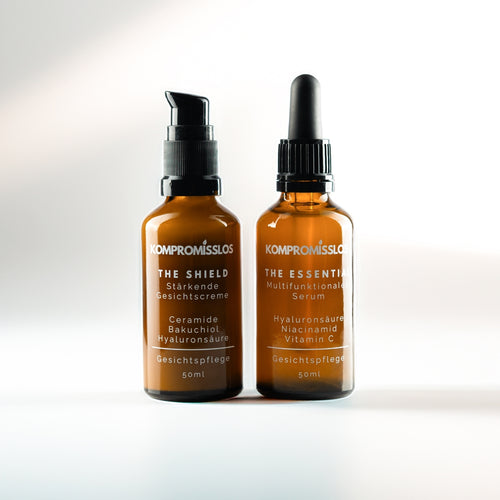
The answer depends on whether your skin lacks water or oil, and the two states feel different. If it lacks water, your skin feels tight shortly after cleansing, looks dull and shows fine dehydration lines that disappear once you apply your skincare. If it lacks oil, it stays rough and sensitive even when you give it plenty of moisture. In the first case, a light serum with humectants does most of the work; in the second, you need a cream with lipids on top. Our Duo of serum and cream is built on exactly this logic: 2% hyaluronic acid and 5% niacinamide for the water side, squalane, ceramides and jojoba oil for the lipid side, all without animal-derived raw materials. How to layer the two morning and evening, and how much you need, is explained in the how-to-use guide. What still matters is that you stick with a new cream for at least four weeks before you judge it.
When is a professional the better person to ask?
A moisturiser is a cosmetic product that cares for the surface of the skin; it is not a substitute for a dermatological assessment. If your skin weeps, bleeds or flakes heavily, or if redness persists for weeks and is painful, it needs a doctor’s attention, however well formulated your skincare is. The same applies to sudden reactions to products you have tolerated for a long time, and to changes in moles. A dermatology practice can establish whether a contact allergy, a skin condition or simply a disrupted barrier is behind it – something that can’t be reliably told apart from the outside. Skincare can and should improve the look of your skin, but it doesn’t make diagnoses. If your complexion is unsettled with no other symptoms, it is worth first taking a calm look at your routine, as we describe for blemish-prone skin. Often the cause is simply too much product or switching too often, and you can sort that out without an appointment.
I set up the formula for the serum and cream as vegan from the start – not as a label, but as a purchasing rule. For every raw material with two possible sources, I chose the plant-based one, even where the animal-derived version would have been cheaper. This mainly concerns squalane and the ceramides, both of which are also available from animal sources. For me, the deciding factor was that I didn’t want to leave this question open when someone asks me. If you want to know what is in it, you should be able to read it for yourself without having to take my word for it.
Frequently asked questions
Is every vegan moisturiser also natural skincare?
No, the two terms describe different things. Vegan means that no animal-derived raw material is included. Natural skincare refers to the proportion of natural rather than synthetic ingredients. A vegan cream can be entirely synthetic, and a natural skincare cream can contain beeswax or honey.
Does vegan automatically mean no animal testing?
No, these are two separate claims. Vegan concerns the raw materials in the formula; no animal testing concerns how the finished product and its ingredients were tested. A product without animal-derived raw materials may still have been tested on animals in other markets. Conversely, there are creams made without animal testing that contain beeswax or lanolin.
Is the hyaluronic acid in a cream animal-derived?
As a rule, not any more. Hyaluronic acid used to be obtained from rooster combs, but today it is almost always produced biotechnologically by fermentation. The INCI name Sodium Hyaluronate doesn’t reveal the source, however, so a quick question to the manufacturer remains the safe route if this matters to you.
Is a vegan moisturiser enough for very dry skin?
In most cases yes, provided it contains enough lipids. Combinations of shea butter, squalane and plant waxes seal the surface of the skin in a similar way to lanolin but feel much lighter. For badly cracked skin, a serum underneath to take care of the water side can also make sense.
How can I spot ambiguous INCI names?
Look for raw materials that can be obtained from both plants and animals. These include Glycerin, Squalane, Stearic Acid, Lactic Acid and ceramides. If there is no addition such as vegetable or olive, the name alone says nothing about the source, and only the manufacturer can confirm it.
Does a vegan moisturiser need a certification?
It isn’t necessary, but it helps. In Switzerland, the V-Label is awarded by Swissveg and provides external confirmation of what you would otherwise have to check yourself in the ingredient list. If it is missing, the cream isn’t automatically non-vegan – you just need to look more closely.
Is a vegan cream better tolerated?
Not in principle. Tolerance depends on fragrance, essential oils, preservatives and the concentration of active ingredients, not on the origin of the raw materials. Plant extracts and essential oils can irritate just as much as animal-derived ingredients. What matters is a short formula and introducing new products one step at a time.