AHA peel: what it does, what it costs and when you can skip it
SINGLE INGREDIENT
An AHA peel, also known as a fruit acid peel, uses alpha hydroxy acids such as glycolic acid to loosen the bonds between the uppermost skin cells and so speeds up visible skin renewal. At home, low-strength products are the norm; in beauty salons and medical practices, much stronger ones are used. In Switzerland, a professional session costs around CHF 85 to 250, and a product for home use usually CHF 15 to 60.
What does an AHA peel do to your skin?
An AHA peel loosens the bonds between the dead cells of the skin’s outermost layer, so that they shed more quickly and the surface looks smoother. Fruit acids are alpha hydroxy acids, or AHAs for short, and form one of the three main groups of acids in skincare. The most commonly used are glycolic acid and lactic acid, followed by mandelic acid, malic acid, tartaric acid and citric acid. What matters is not just the percentage on the pack but the pH of the formula. According to the opinion of the EU scientific committee SCCNFP on the safety of alpha hydroxy acids, pH is even more important than concentration for how irritating a product is. A product with 8 per cent glycolic acid at pH 3.6 can turn out milder than one with 4 per cent at pH 3.7. So the number on the label tells you surprisingly little about how much a peel actually demands of your skin. Two products with an identical percentage can feel completely different in use.
Before you reach for an acid at all, it is worth asking first whether your skin really needs exfoliating. Healthy skin renews itself. An acid speeds this process up; it does not replace it.
What can you do at home, and what only professionally?
At home, you are working with low-strength acids; professionals work with much higher concentrations. As a precaution, the EU scientific committee SCCNFP recommended limiting glycolic acid in consumer products to 4 per cent at a pH of 3.8 or above, and lactic acid to 2.5 per cent at a pH of 5 or above. The expert panel Cosmetic Ingredient Review made a further assessment, rating up to 10 per cent at pH 3.5 as acceptable for home use, and up to 30 per cent at pH 3.0 for salon use – but only with a short contact time, thorough rinsing and application by trained people. That is exactly where the difference lies. A beauty therapist controls the contact time and neutralisation; at home, you do not. Oil-soluble acids such as salicylic acid, incidentally, work on a different principle and also reach the inside of the pores. Using a peel at home therefore means deliberately staying within a milder range – and that is not a disadvantage but the price of having no one standing beside you.
| Feature | At home | Beauty salon | Medical practice |
|---|---|---|---|
| Usual strength | Low strength, for keeping and reusing | Higher strength, short contact time and rinsed off | Can reach medium skin depth |
| Cost | Around CHF 15 to 60 per product | Around CHF 85 to 180 per session | Around CHF 210 to 250 per session |
| Control | You yourself, without a skin analysis | Trained professional with a skin analysis | Dermatological assessment beforehand |
| Suits you if | You want gentle smoothing | You want a visible result over a course of sessions | Your skin has existing problems or you need a diagnosis |
How much does an AHA peel cost in Switzerland?
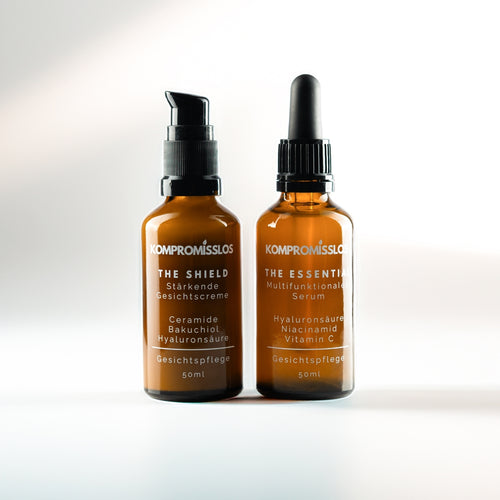
A professional AHA peel for the face costs around CHF 85 to 250 per session in Switzerland, depending on the provider. This range comes from publicly available price lists of Swiss beauty salons and skin clinics, as of August 2026. Short express treatments of about half an hour are at the lower end, comprehensive facials with cleansing, mask and aftercare in the middle, and peels performed by doctors at the upper end. Because a single session is rarely enough, many salons sell courses: packages of five sessions often cost around CHF 650. Some clinics also charge for an initial consultation, which they then credit against the treatment. So do not calculate with the price of one session, but with the cost of a course plus suitable skincare afterwards. For comparison: The Duo of serum and cream costs CHF 109.90 and lasts two to four months, depending on how often you use it. A course of peels and a daily basic skincare routine are therefore two separate budget items that do not replace each other.
How often does an AHA peel make sense?
Professional AHA peels are usually planned as a course of several sessions a few weeks apart, and products for home use should be used much less often than the pack often suggests. The reliable rule is: one source of acid, not two. If you keep using acids at home alongside a course at the salon, you are adding two stimuli that cannot be coordinated. One customer wrote to us that she was in the middle of a course of peels and was also using an acid product from the chemist; since then, her skin had felt tight and reacted with redness to her usual cream. Our answer was uncomfortable and honest: not more active ingredient, but one source fewer. Between sessions, what matters most is calm basic skincare, as described in our instructions for using the serum and cream. Moisture, barrier care and sun protection achieve more in this phase than any additional acid, because after exfoliation the skin first has to rebuild.
What are the risks of an AHA peel?
The biggest risk of an AHA peel is increased sensitivity to UV straight after use, along with redness, stinging, flaking and, if the peel goes too deep, dark spots. In the studies compiled by the EU committee SCCNFP, four weeks of daily use of 10 per cent glycolic acid at pH 3.5 measurably lowered the minimal erythema dose and increased the number of sunburn cells. One week after stopping, this effect had disappeared again. The conclusion is very direct: peels and unprotected sun do not go together, which is why consistent sun protection for your face is part of the treatment, not optional. According to a review in Clinical Cosmetic and Investigational Dermatology, the depth of a glycolic acid peel depends on the concentration, the number of layers and the contact time, while the result depends on how the skin is prepared and on timely neutralisation. These are exactly the three factors that you can only estimate at home.
You do not need an AHA peel if your skin is already irritated, flaky or tight. Then what it lacks is barrier, not exfoliation.
When to see a professional: if you have persistent redness, inflamed areas, changing dark spots or a skin condition diagnosed by a doctor, the assessment belongs in a dermatology practice. Skincare looks after the appearance of your skin; it does not replace diagnosis or treatment.
I am regularly asked why there is no fruit acid in our two products. The answer is a deliberate decision: an acid that stays on the skin and is applied morning and evening would have created exactly the UV sensitivity I do not want to impose on a daily routine. I wanted two products you can use twice a day without having to think about it. That is why, for our two products, I chose active ingredients that support the barrier rather than strip it away, and disclosed the percentages rather than hiding them behind marketing language.
Frequently asked questions
What does an AHA peel really do?
An AHA peel smooths the skin’s surface because dead skin cells shed more quickly, and it can soften the look of uneven texture and dark spots. It does not rebuild the barrier and does not replace daily skincare. The effect only lasts as long as you keep using it and look after your skin calmly afterwards.
How much does an AHA peel at a beauty salon cost in Switzerland?
An AHA peel from a beauty therapist in Switzerland usually costs around CHF 85 to 180 per session, and around CHF 210 to 250 when performed by a doctor. Packages of five sessions often cost about CHF 650. Also budget for aftercare, because without it part of the result is lost.
How often can I do an AHA peel on my face?
Stick to a single source of acid and plan deliberate breaks in between. Professional peels are carried out as a course, several weeks apart. If you also use acids at home, you are adding stimuli without any control. If your skin feels tight or turns red, that is not a sign that it is working but a signal to take a break.
Can I have an AHA peel in summer?
It is possible, but usually not sensible. After an AHA peel, the skin reacts more sensitively to UV radiation, and this effect only subsides after you stop. That is why courses of peels are usually scheduled in the months with less sun. If you do have a peel in summer, daily sun protection is not a recommendation but a requirement.
Is an AHA peel suitable for sensitive skin?
With sensitive skin, restraint is the better choice. Even low concentrations of acid cause itching or stinging in some users, and the pH of the formula influences this more than the percentage. If your barrier is already compromised, rebuilding achieves more than exfoliating.
What should I apply after an AHA peel?
After an AHA peel, your skin needs moisture, barrier care and sun protection during the day. For the next few days, avoid further acids, retinol and mechanical scrubs. A calm, consistent routine supports recovery more than an additional specialist product off the shelf.
Does The Duo contain fruit acid?
No, The Duo contains no fruit acid. Instead, it deliberately contains 5% niacinamide, 2% hyaluronic acid, 2% vitamin C as 3-O-Ethyl Ascorbic Acid, 2% gentian root extract, 2% edelweiss extract, 1% zinc and 0.3% bakuchiol, each relative to the Duo as a whole. You can see what else it contains on our ingredients page.
Sources
- SCCNFP, Position Paper concerning the Safety of Alpha-Hydroxy Acids, SCCNFP/0370/00, 2000. Source
- Cosmetic Ingredient Review, Safety Assessment of Alpha Hydroxy Acids as Used in Cosmetics, 1998. Source
- Sharad J, Glycolic acid peel therapy: a current review, Clinical Cosmetic and Investigational Dermatology, 2013. Source