Is dermaplaning good for your skin? What face shaving does for women and when it irritates
ROUTINE
Dermaplaning is a facial shave with a fine blade that removes the pale peach fuzz and the top layer of dead skin cells. Afterwards, your skin feels smoother and make-up goes on more evenly. The hairs do not grow back thicker; they only look that way for a while because of the blunt cut edge. But dermaplaning is no more than an optional smoothing trick: studies on its effects are scarce, and if you have spots, rosacea or irritated skin, you are better off leaving the blade alone.
What happens to your skin during dermaplaning?
During dermaplaning, a sharp blade glides flat across the skin and takes two things with it: the fine peach fuzz, known as vellus hair, and the outermost layers of the stratum corneum. These cells may be dead, but the layer they form has an important job. It keeps water in the skin and irritants out. A laboratory study in AAPS PharmSciTech shows how directly the blade interferes with this protective layer: after four passes with a dermaplaning device, tissue analysis showed that the stratum corneum had been removed, in places along with parts of the living epidermis beneath it. The electrical resistance of the skin samples dropped significantly, a sign of a weakened barrier, and test substances then penetrated measurably more easily. This was an experiment on skin samples in the lab, not on faces in everyday life, and the researchers’ aim was to get drugs through the skin more effectively. For you, it still means this: dermaplaning is not a gentle pampering treatment but mechanical exfoliation. That puts it in the same category as a scrub or peel, and the question of whether you need to exfoliate your face at all applies here in just the same way.
What does not happen is just as important. The hair root is left untouched, so dermaplaning is not hair removal in the true sense but shaving. The hairs come back, and the stratum corneum continuously renews itself from below. Whatever you gain is therefore always temporary.
Does hair grow back thicker or darker after dermaplaning?
No, hair does not grow back thicker or darker after dermaplaning – it just feels different for a while. The blade cuts the hair off at the surface of the skin. The hair root deep down, which determines thickness, colour and growth, is not affected at all. What you feel is the cut edge: a hair that has never been cut tapers to a fine tip, whereas a cut hair ends bluntly and therefore seems coarser as it grows back. This is exactly how the Endocrine Society’s guideline on excess hair growth in premenopausal women describes it: shaving leaves a blunt rather than a tapered tip, which creates the illusion of thicker hair. With the pale peach fuzz on your face, this effect is usually barely noticeable, because vellus hairs are thin and contain little pigment anyway. You are more likely to notice it where you also shave off coarser, dark individual hairs, for example on your upper lip or chin.
It is a different matter if hair growth increases noticeably within a short time, becomes darker or spreads across your chin, cheeks and neck. That is not a skincare issue, as hormonal causes may be behind it. The same guideline recommends having the levels of male hormones (androgens) in your blood tested if hair growth is unusually heavy. This belongs with a doctor or dermatologist, not under the blade.
What does dermaplaning really do, and what is just first-day smoothness?
Dermaplaning mainly does two things you can see straight away: it leaves a smoother surface and skin without visible peach fuzz. Make-up and powder catch less in the fine hairs, and light is reflected more evenly, which is why your skin looks fresher right afterwards. This effect is real, but it is a snapshot. The fuzz grows back, the stratum corneum renews itself, and after a while your skin looks just as it did before. Anything promised beyond that is much less well supported. A systematic review in Aesthetic Plastic Surgery assessed the literature on dermaplaning, oxygen therapy and light therapy and concluded that the scientific data for these methods are scarce, anecdotal and poorly documented. The review dates from 2011, but even today PubMed lists only a handful of papers under the search term, hardly any of them on cosmetic use on the face. Claims about fewer wrinkles, more collagen or fading pigmentation spots are therefore best taken with a pinch of salt.
| Expectation | Realistic? | How long |
|---|---|---|
| Smoother surface | Yes, you feel it straight away | A few days |
| No visible peach fuzz | Yes | Until the hairs have grown back |
| Make-up goes on more evenly | Yes, especially powder and foundation | As long as the fuzz is gone |
| Fewer wrinkles, firmer skin | Not proven | – |
| Lighter pigmentation spots | Not proven | – |
| Fewer spots | No – on active spots, it tends to cause more irritation | – |
Who should skip dermaplaning?
Dermaplaning is not a good idea if your skin is currently inflamed, irritated or already under strain, because the blade removes exactly the layer that protects it at such times. Anything open, inflamed or sensitive should not be shaved. In practice, that means:
- Active spots and inflamed areas: the blade can tear them open and make the irritation worse. Recurring inflammation should be looked into – there is more on this in blemish-prone skin: causes and what actually helps.
- Rosacea or very red skin that stings easily: the diagnosis belongs with a dermatologist, and it is worth knowing what rosacea skincare can and cannot do.
- Cold sores, eczema or open areas on your face, as long as they are active.
- Sunburn, or skin that is currently peeling after a holiday, an exfoliant or a retinoid.
- Ongoing use of retinoids or acids: both already thin out the stratum corneum, and the blade removes even more.
- Very thin, mature skin that tears easily or bruises quickly.
If your skin generally reacts quickly, dermaplaning is not off-limits, but it is rarely worth it. The principles of caring for sensitive skin and what to leave out come down to fewer irritants, and a blade is an irritant. And heavy hair growth that increases suddenly is, as described above, a question for your doctor.
How often is too often for dermaplaning, and how can you tell it is irritating your skin?
You are dermaplaning too often as soon as your skin no longer fully settles between sessions. There is no scientifically established schedule – the studies simply do not exist. Some guides suggest once a week, which I think is too often for most skin types. A calmer approach is to wait until the peach fuzz is visibly back before you start again, which for most people means every few weeks rather than every week. What matters, though, is not the calendar but how your skin reacts. Warning signs include stinging when you apply skincare you normally tolerate well, a tight feeling that lasts all day, fine red lines, small bumps around the hair follicles or flaky patches. If this lasts longer than a day or two, take a break and leave your skin alone. If these signs keep coming back, it is worth looking at how to recognise a damaged skin barrier.
If you do it at home, a few rules reduce the risk considerably:
- Only on cleansed, completely dry skin, with no oil or serum underneath.
- A clean, sharp disposable blade used only by you: never share it, and replace a blunt blade rather than pressing harder.
- Pull your skin slightly taut with your free hand and work without pressure in short strokes, in the direction of hair growth.
- Go over each area only once, not back and forth.
- Never over spots, moles, scabs or irritated areas.
| Criterion | At home | At the beautician’s |
|---|---|---|
| Blade | Facial razor, often with a safety guard | Sterile, scalpel-like disposable blade |
| Depth | Rather superficial, mainly peach fuzz | More thorough, removes more of the stratum corneum |
| Hygiene | Entirely up to you | New blade for every appointment, skin check beforehand |
| Frequency | Tempts you to do it too often | Appointments set an interval |
What skincare does your skin need after dermaplaning?
After dermaplaning, your skin does not need an extra active step but fragrance-free skincare that provides moisture and supports the barrier. The stratum corneum has been thinned out, so everything you apply now meets less protection. The lab study in AAPS PharmSciTech shows this from the other side: substances get in more easily through skin that has been planed. That is not a reason to pile on as many active ingredients as possible, but a reason to be more careful that day. Leave out acids, retinoids, exfoliants, toners high in alcohol and fragrances on the same day. If you use acids regularly, the overview AHA, BHA and PHA: which acid suits which skin type helps you avoid stacking the two forms of exfoliation.
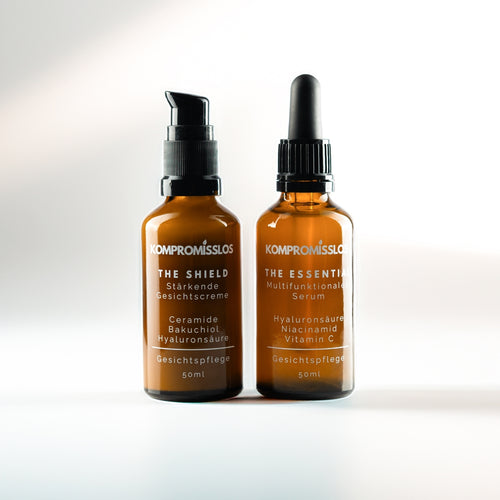
Simple aftercare consists of a serum and a cream. The Duo of serum and cream contains no exfoliant and no fragrance: The Essential provides moisture with hyaluronic acid in three molecular sizes, and The Shield supports the skin barrier with ceramide NP, squalane and jojoba oil. To be honest, the serum also contains active ingredients such as niacinamide and vitamin C, and freshly planed skin may react with brief stinging. In that case, use only the cream that evening and add the serum back in from the next day. The morning after, sunscreen for your face is the final step, because The Duo contains no SPF.
I do not sell an exfoliant or a dermaplaning tool, and I will be honest with you: your skin needs neither. Dermaplaning is an optional smoothing trick that lasts a few days. If you like it and your skin tolerates it well, there is little against it. If not, you are not missing anything. Our range deliberately consists of two products instead of eight, and when you dermaplane, The Duo only takes care of the aftercare. Both products are fragrance-free, and freshly planed skin in particular is the last place you want an ingredient that is only there for the scent. What they cannot do is protect you from the sun. The cream has no SPF, so you need a separate sunscreen during the day. Our how-to page explains how to apply the serum and cream step by step.
Frequently asked questions
Is dermaplaning at the beautician’s better than doing it at home?
At the beautician’s, dermaplaning is usually more thorough and more hygienically controlled, while at home it is more superficial. A professional looks at your skin first and is more likely to recognise when it is better not to shave it. In a lab study, the result also depended on who was handling the device. A facial razor is enough for peach fuzz alone; if your skin is sensitive, an appointment with a skin check is the more cautious choice.
Can I combine dermaplaning with an exfoliant?
Not on the same day, and if your skin is easily irritated, not in the same week either. Both remove part of the stratum corneum, and the effects add up. If you already exfoliate regularly, dermaplaning is more of a replacement than an addition. How much exfoliation your skin can take is covered in the article on whether and how often you need to exfoliate your face.
Does dermaplaning help with spots or blackheads?
No, dermaplaning does not get rid of spots or blackheads. The blade does not reach the pores where blackheads form, and shaving over inflamed spots can tear them open and irritate the skin further. For recurring blemishes, a calm, consistent routine helps more; for persistent acne, see a dermatologist.
How long should I wait before wearing make-up after dermaplaning?
Ideally, skip make-up on the day you dermaplane and only wear it again the next morning. Freshly planed skin has less protection against friction and against ingredients it would otherwise tolerate without any problem. The next day, a light, fully absorbed moisturiser makes a good base – more on which skincare to use before make-up.
Is dermaplaning worth it for mature skin over 50?
On mature skin, dermaplaning can remove peach fuzz and make make-up look smoother, but it does nothing for wrinkles. Skin often becomes thinner and drier over the years, so restraint makes sense: less often, without pressure and only if your skin shows no cracks, eczema or bruising. If your skin is prone to these, it is better to skip it altogether.
What should I do if my face burns after dermaplaning?
If your face burns, rinse it with lukewarm water and leave out all active ingredients, acids and fragrances until it settles. A simple, fragrance-free cream is enough, and a cool, clean cloth can feel pleasant. Mild stinging should ease quickly. If it lasts longer, or if swelling, weeping areas or pustules appear, see a doctor or dermatologist.
Can I apply The Duo straight after dermaplaning?
Yes, you can apply The Duo straight afterwards: both products are fragrance-free and contain no exfoliant. If the serum stings briefly on freshly planed skin, use only the cream that evening and add the serum back in from the next day. During the day, you also need sunscreen, because The Duo contains no sun protection factor.
Sources
- Pryor L, Gordon CR, Swanson EW, Reish RG, Horton-Beeman K, Cohen SR. Dermaplaning, topical oxygen, and photodynamic therapy: a systematic review of the literature. Aesthetic Plastic Surgery, 2011. Source
- Tijani AO, Frempong D, Kaur J, Sergent S, Shaw K, Lessaint R, et al. Dermaplaning for Transdermal Drug Permeation Enhancement: A Qualitative and Quantitative Assessment. AAPS PharmSciTech, 2023. Source
- Martin KA, Anderson RR, Chang RJ, Ehrmann DA, Lobo RA, Murad MH, et al. Evaluation and Treatment of Hirsutism in Premenopausal Women: An Endocrine Society Clinical Practice Guideline. The Journal of Clinical Endocrinology & Metabolism, 2018. Source